
Guide / open source and IT assets
Open source computer inventory management
For tracking computers, laptops and IT gear, open source tools are genuinely good — asset registers, check-in/check-out, barcode labels. The catch is not the software; it is the hosting, updating and integrating you sign up for. Here is the honest picture, including where BSimple sits.
The key facts
- Open source fits IT assets well: the job (a register of serials, locations and custody) is exactly what asset-tracking projects were built for.
- The real cost is operations: hosting, backups, upgrades and integrations are yours — the license being free does not make the total free.
- "Computer inventory" can mean two jobs: tracking your IT equipment, or running stock for a business that sells computers. Different tools entirely.
- BSimple is not open source: it is hosted business software for stock-carrying wholesalers, manufacturers and distributors — see the inventory management pillar.
- 01The key facts
- 02When open source is the right call
- 03The costs the "free" label hides
- 04Where BSimple sits — and does not
When open source is the right call
If the job is an IT asset register — every laptop, phone and monitor with a serial number, an owner and a location — open source asset-tracking tools are hard to beat. The workflows are mature: check-out and check-in to staff, CSV import of an existing register, barcode labels, and reporting on what is where. Someone on the team who is comfortable with a server (or a small monthly hosting bill with a managed provider) can run it indefinitely.
It also suits the budget reality of IT departments: no per-seat license fights, no procurement cycle for a tool the helpdesk needs this quarter. Our summary of the open-source inventory discussion covers the wider tool landscape, and network inventory in open source looks at the network-device corner specifically.
The costs the "free" label hides
- Operations. Someone owns updates, backups and security patches. Missed updates do not announce themselves; they surface as an outage or a breach.
- Integration. Getting asset data into your helpdesk, finance or HR systems is custom work, and it breaks when either side changes.
- Accountability. Community software has no support contract; when an upgrade fails on a Friday, the escalation path is a forum.
- Growth past the job. Asset registers do not manage supplier orders, purchase approvals or sales — if the "computers" are actually products you sell, an asset tracker is the wrong shape.
The last one is the fork in the road. If you are a business that buys and sells computers — stock, margins, suppliers, invoices — you need inventory management for computer hardware, not an equipment register.
Where BSimple sits — and does not
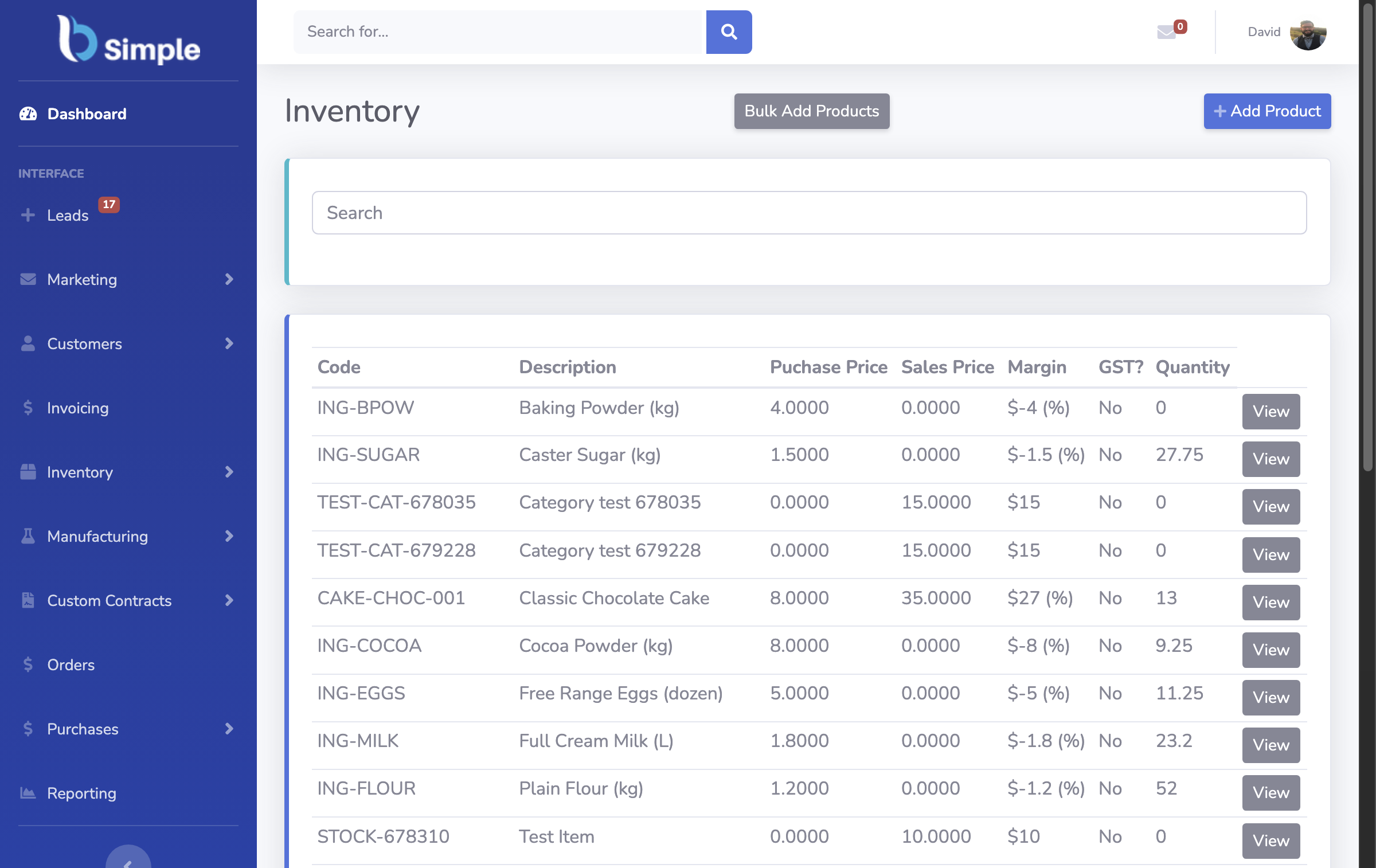
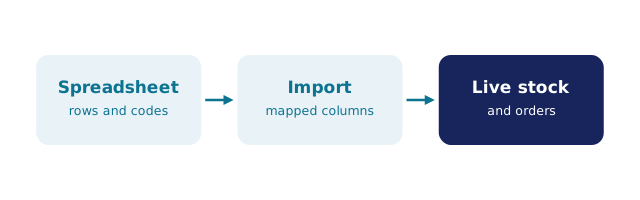
We build BSimple, so weigh that. It is not open source and it is not an IT asset register. It is hosted operations software for businesses that carry stock to sell: live quantities across locations, purchase orders raised from demand, batch tracking, invoicing with a handoff to Xero or MYOB, and a customer portal — from $180/month AUD with every feature in the core plans. If you sell computers or components and your problem is stock truth rather than equipment custody, the free trial will tell you quickly whether it fits.
If the problem really is custody of staff equipment, stay with the open source asset trackers or a purpose-built ITAM tool — buying BSimple for that would be paying for inventory machinery you would not use.
Frequently Asked Questions
Is open source inventory software really free?
The license is free; the operation is not. Hosting, backups, upgrades and any integration work are your cost — either as staff hours or a managed-service bill. For an IT asset register that total is usually still low; for running a sales operation it rarely is.
Can open source tools track computers with serial numbers and warranty?
Yes — that is the core of most IT asset-tracking projects: serials, assigned users, locations, purchase details and check-in/check-out history. Match the tool to the size of your fleet rather than the longest feature list.
Does BSimple work as a computer inventory system?
Only in the stock sense: if computers are products you sell, BSimple manages quantities, purchasing, orders and invoicing for them like any other SKU. It does not track who has which laptop — that is an asset-register job, and we would point you to an asset tracker for it.
What should we check before self-hosting?
Who owns updates and backups by name, where the data lives, how you would get data out if you leave, and what happens when the one person who understands the deployment is on leave. A tool nobody can maintain is not free; it is dormant.

BSimple