
Guide / multi-business, honestly
Multi-business management software: locations vs companies
Two problems hide behind "multi-business": one business in many places, and many businesses under one owner. They need different software — and the honest answer starts by knowing which one you have.
The key facts
- Problem 1 — one business, many locations: shared stock, shared customers, transfers between sites. BSimple's native shape: multi-location on one record.
- Problem 2 — several separate companies: separate books, separate ownership, consolidated reporting. Different software territory; BSimple does not claim cross-entity consolidation.
- The test: does stock transfer between sites, or does it sell between companies? Transfers → locations; sales → entities.
- BSimple: multi-location, cloud, from $180/month (AUD), free to trial.
- 01The key facts
- 02The two problems behind "multi-business"
- 03What the location case needs
- 04Where BSimple fits — and the line we draw
The two problems behind "multi-business"
One business, many locations is the common case: a wholesaler with two warehouses, a retailer with branches, a trade business with vans. The stock is one stock, moving between places; the customers are shared; the accounting is one set of books. Software for this needs locations as first-class citizens — quantities per site, transfers that keep the record true, and reporting that rolls up naturally.
Several companies under one owner is genuinely different: each entity has its own books, its own GST registration, its own customers, and the owner wants a consolidated view. That is multi-entity accounting territory — the requirements (inter-company transactions, consolidated financials) live as much in the accounting system as anywhere, and pretending one operational database solves them is how vendors mislead.
What the location case needs
- Quantities per location, one truth. Every site sees live availability; transfers move stock as recorded movements, not spreadsheet emails.
- Location-aware fulfilment. Orders fulfilled from the right site, with the customer seeing one business, not the org chart.
- Counts per site. Rolling counts from phone browsers, auditable adjustments, no group-wide freeze.
- Purchasing that rolls up. Reorder levels per location, purchase orders grouped by supplier, receipts landing at the right site.
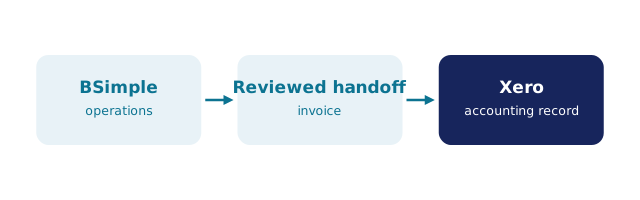
- One accounting handoff. Invoices push to Xero or MYOB for the entity; the books stay coherent.
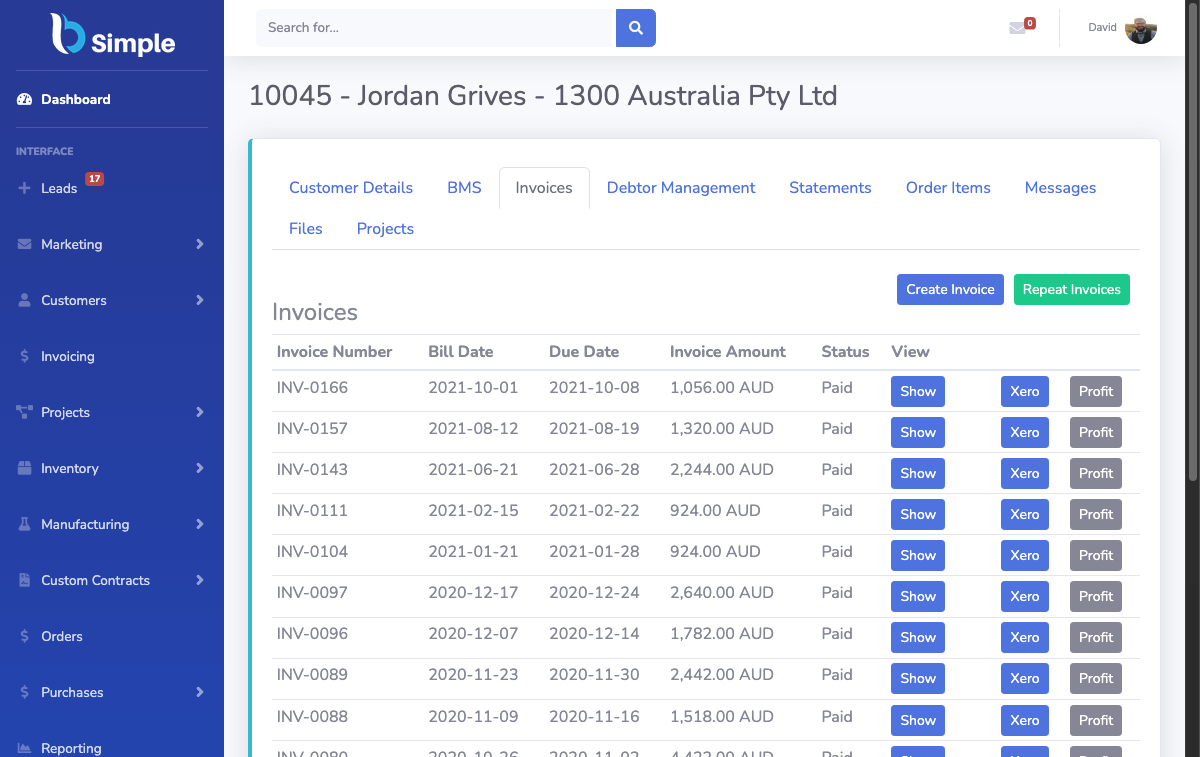
The hardware-shop example shows the branch pattern at retail scale, and the system diagram shows where locations sit in the record.
Where BSimple fits — and the line we draw
We build BSimple, so weigh that. BSimple is built for problem one: multi-location is native — quantities, transfers, counts and fulfilment per site on one record, with purchasing and the Xero/MYOB handoff behind it, from $180/month (AUD). If you run one business across several sites, that is the product's shape.
The honest line: BSimple does not claim multi-entity consolidation. Several separate companies mean several tenants — each clean and complete on its own — and consolidated reporting across them stays with your accounting group's tools. We would rather draw that line than blur it. The trial on two of your real locations settles the location case in an afternoon.
Frequently Asked Questions
What is multi-business management software?
Software for one business across many locations — shared stock, transfers, per-site counts and group reporting. Genuinely separate companies under one owner need multi-entity accounting tools instead; the two problems are routinely confused.
Does BSimple support multiple locations?
Yes — locations are native: quantities per site, transfers as recorded movements, counts and fulfilment per location, all on one record with the accounting handoff. Plans start at $180/month (AUD) with no location-count modules.
Can BSimple consolidate several companies?
No — we do not claim cross-entity consolidation. Separate companies run as separate tenants; the consolidated view belongs to your accounting group's tools. Blurring that line is how inventory vendors overpromise.
How do we test the multi-location fit?
Trial two real sites: receive stock at one, transfer to the other, count both, and fulfil an order from the wrong one on purpose. If the record survives your own edge cases, the fit is real.
BSimple