
Guide / scanning technologies
RFID and inventory management
RFID reads hundreds of tags at once, without aiming or line of sight — a genuine leap for counting. Whether it beats barcodes for your business depends on volumes and hardware budgets, and the software is the smaller half of that decision.
The key facts
- RFID's three advantages: bulk reads (no aiming), no line of sight needed, and per-item identity at speed.
- Its conditions: readers, printers and tags cost real money; metal and liquid interfere; the data still needs a truthful record to land in.
- The honest comparison: barcodes deliver the same record truth at a fraction of the cost until item volumes are very high.
- BSimple's position: barcode-first in the browser — no RFID integration claimed, no hardware partnerships, and no pretending otherwise.
- 01The key facts
- 02What RFID changes — and what it does not
- 03The barcode comparison, without the hype
- 04Where BSimple sits — plainly
What RFID changes — and what it does not
A barcode is read one at a time by a person with a scanner; an RFID tag answers when asked, and a reader asks everything in range at once. A stockroom count becomes a walk-through; receiving checks a pallet without opening it; an exit portal flags what left without a sale. Per-item identity — every unit carrying a unique tag rather than a SKU shared by a thousand units — is the deeper shift, and it is why apparel and logistics led adoption.
What RFID does not change: the record. A container of accurate reads still has to become quantities, movements and history somewhere — and if that somewhere is untrusted, RFID just produces wrong answers faster. Software is the smaller half of the RFID decision; the reader, the tags and the integration are the larger half, which is why pilots are priced as projects, not purchases.
The barcode comparison, without the hype
Barcodes win on four axes that matter below enterprise scale: cost (a scanner is tens of dollars; a usable RFID handheld is thousands), simplicity (no tuning, no interference surveys), universality (keyboard-mode scanners work with any browser, any system), and sufficiency (directional one-at-a-time scans at a desk, door or bench cover most small and mid-sized workflows — receiving, picking, dispatch, cycle counts). RFID wins when the counting itself is the bottleneck: full-store counts in retail, pallet-level verification, asset tracking where items cannot be individually handled.
The sequence most businesses should follow is unglamorous: make the record true with barcodes first, measure what full counts still cost in hours, and let that number justify readers or not. Buying RFID to fix a record problem buys faster wrong answers. The free-side view of RFID covers the hardware-economics angle, and scanning in the warehouse shows the barcode loop end to end.
Where BSimple sits — plainly
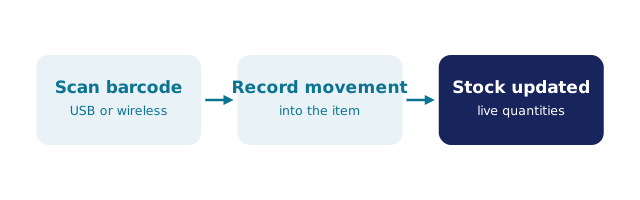
We build BSimple, so weigh that: cloud operations software for wholesale, manufacturing and distribution — live quantities across locations, batch and expiry tracking, purchasing from demand, order-to-invoice with the accounting handoff to Xero or MYOB, from $180/month AUD. Scanning is standard barcode input into the browser: any USB or Bluetooth keyboard-mode scanner works, with no proprietary hardware requirement and no RFID module. If a genuine RFID integration becomes necessary for your operation, the REST API is the designed way for reader output to reach the record — a stated boundary rather than a missing feature, and the barcode overview shows what scanning drives day to day.
The trial is the practical test: your products, a standard scanner, one afternoon. If counting pain survives a truthful record, that residual is exactly the case RFID should have to prove.
Frequently Asked Questions
Does BSimple support RFID?
Not as a claimed integration — scanning in BSimple is standard barcode input in the browser. RFID reader output would be an integration project via the REST API. We prefer a stated boundary to an implied capability.
When does RFID beat barcodes?
When many items must be counted repeatedly and fast: full-store retail counts, pallet verification, high-value asset tracking. For desk, bench and door scans, barcodes do the same job for a fraction of the cost.
How expensive is RFID to run?
Handheld readers cost thousands, tags are cheap per unit but numerous, and printers plus integration add to that. The hardware is the budget, which is why the record should be proven first.
Do we need special software for RFID?
Reader-side software comes with the hardware; the inventory record is the second half. Whatever holds your quantities must be able to receive bulk reads and keep the record true — the part no tag technology fixes by itself.
Can we start with barcodes and move to RFID later?
Yes, and that is the recommended order: a truthful record first, measured counting costs second, readers only when the residual pain pays for them. Start the trial to see how far barcodes carry you.

BSimple