
Guide / scanning technologies
RFID inventory management, free
RFID reads many tags at once, without line of sight — genuinely transformative in the right warehouse. But the reader is the cost, so "free" RFID software is free like a free car stereo. Here is what the technology needs, and BSimple's barcode-first position.
The key facts
- What RFID adds: bulk reads (hundreds of tags a second), no line of sight, and tag-level identity on every item — barcode work at a different order of speed.
- Where it pays: apparel counts in minutes, warehouse receiving by pallet, asset tracking where scanning each item is impractical.
- The "free" catch: readers, printers and tags cost real money — software is rarely the binding constraint in an RFID project.
- BSimple's position: barcode-first, browser-based, standard scanners — no RFID integration claimed, and free-tier RFID software usually means barcode software with an RFID-shaped brochure.
- The wider practice: scanning in inventory software is the hub for scanning workflows.
- 01The key facts
- 02What RFID actually buys you
- 03The "free" question, answered honestly
- 04Where BSimple sits — plainly
What RFID actually buys you
Barcodes are read one at a time, by line of sight, by a person aiming. RFID flips all three: a handheld or portal reader inventories every tagged item in range in seconds — a stockroom count that took an afternoon becomes a walk-through; receiving checks a pallet without opening cartons; a retail exit door flags items that were not purchased. The tags themselves are cheap per unit at volume; readers and printers are the capital. The results, when the use case fits — high item counts, repeated full counts, high-value assets — are dramatic, which is why apparel and logistics led adoption.
The technology is not free of conditions, though: metal and liquid interfere with reads, tag placement matters, and the data still has to land in a system whose quantities are otherwise true. RFID accelerates the count; it does not make an untrusted record trustworthy.
The "free" question, answered honestly
Search this phrase and the results are mostly free software with an RFID label attached. The honest math is different: a usable handheld RFID reader costs more than a year of most inventory software; tags and a printer add to that; and the integration — reader output into stock records — is the part free tools rarely include. So the genuine options look like this: free barcode software plus a barcode scanner delivers 90% of what most small businesses actually need at a fraction of the cost; vendor RFID pilots bundle hardware and software as a project; and free RFID software usually assumes you already own enterprise readers and only need a viewer. If the budget is the constraint, that is the answer: start with barcodes, and add RFID when item volumes prove the hardware earns it.
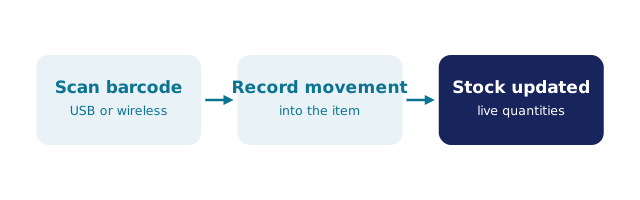
BSimple is deliberately on the barcode side of that line. It is browser-based, so standard USB and Bluetooth scanners — the keyboard-type kind — work with it directly, and the barcode-in-warehouse workflow shows the receive-pick-count loop those scanners drive. We make no RFID integration claims: connecting reader output would be an integration project, and we would rather say so than print a brochure. Free QR-code inventory software covers the free end of our own aisle.
Where BSimple sits — plainly
We build BSimple, so weigh that: cloud operations software for wholesale, manufacturing and distribution — live quantities across locations, batch and expiry tracking, purchase orders from demand, order-to-invoice with the accounting handoff to Xero or MYOB, from $180/month AUD. Scanning in BSimple is standard barcode input in the browser — no proprietary hardware requirement, no RFID module, no hardware partnerships claimed. For a business weighing RFID because counts are painful today, the honest sequence is usually: make the record trustworthy with barcodes first, measure what full counts still cost, and only then price readers against the residual pain.
The trial is the practical test: your products, a scanner, one afternoon. If cycle counts stay painful after the record is true, that is the moment RFID earns a pilot — with a record worth feeding.
Frequently Asked Questions
Is there free RFID inventory software?
There is software free to license, but RFID's real costs are readers, printers and tags, and free tools rarely include the reader integration. Most "free RFID" offers are barcode systems with RFID in the marketing — price the hardware before believing the software is the barrier.
Does BSimple support RFID scanners?
Not as a claimed integration. BSimple accepts standard keyboard-mode barcode scanners in the browser; RFID reader output would be a custom integration project. We prefer saying that to implying a capability that is not there.
When does RFID beat barcodes?
When many items must be counted repeatedly and quickly — apparel retail, warehouse full counts, high-value asset tracking. For directional one-at-a-time scans at a desk or door, barcodes do the same job for a fraction of the cost.
How much does an RFID pilot actually cost?
Enough that it should be a project, not a purchase: handheld readers, tag printers, tags per item, and integration work. That is why the honest advice is to fix the record with barcodes first and let the residual pain justify the hardware.
What does BSimple cost compared to an RFID project?
Plans run $180/$250/$399 per month AUD — typically less than one mid-range RFID reader per year. The free trial with a standard scanner shows how much of the counting problem was software, not hardware, all along.

BSimple