
Guide / the integration, end to end
How an inventory system integrates with Xero
Follow one order from allocation to the ledger and back again: what pushes, what mirrors, what reconciles — and the four tests that verify any integration claim, including ours.
The short answer
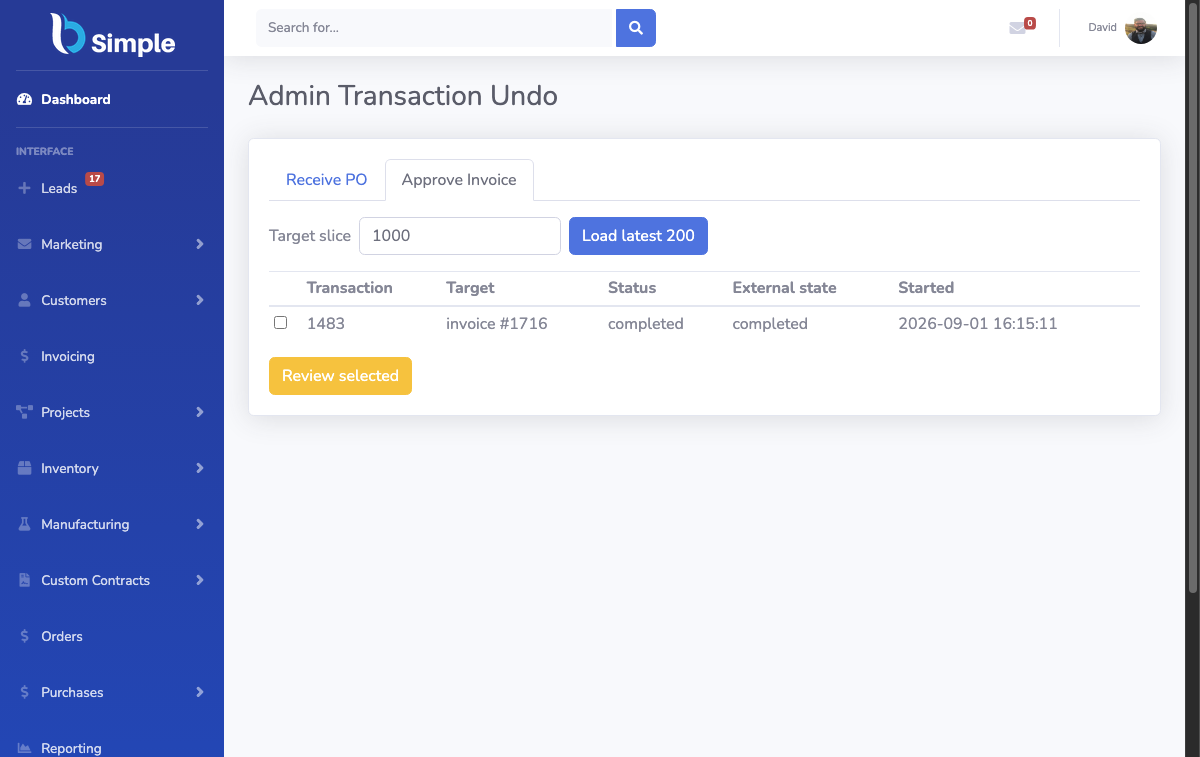
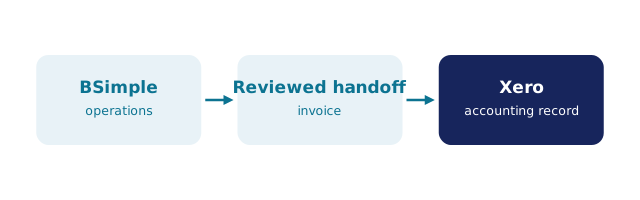
- Outbound: approved invoices push to Xero with line detail and GST treatment — on approval, not overnight.
- Inbound: payment status — paid, voided — mirrors back from Xero to the operations record.
- Purchasing: supplier bills reconcile against purchase orders and receipts, with GST-inc and ex-GST views.
- Contacts: imported selectively, not flooded.
- BSimple implements all four — and this page walks one order through the whole loop.
- 01The short answer
- 02One order, end to end
- 03The four tests for any integration claim
- 04Where BSimple fits
One order, end to end
A customer orders twenty cases. In BSimple: the order allocates from live stock, is picked and packed, and an invoice is drafted for the cases that actually shipped. It enters approval — reviewed, then approved. At approval, the invoice pushes to Xero: line detail, quantities, prices and GST treatment intact, appearing in the ledger without anyone typing. The customer pays; Xero marks it paid, and the status mirrors back into BSimple, where the sales team sees the money truth without opening the ledger. Nobody re-keyed anything; nobody reconciled two copies of one invoice.
The supply side runs the same shape in reverse: a purchase order raised from demand, goods received updating stock, the supplier bill reconciled against order and receipt with inc/ex-GST views — the three-way match becoming a review rather than an archaeology project. That is what "integration" should mean: the two systems exchanging moments, not holding copies.
The four tests for any integration claim
1. Timing: push an invoice and watch Xero receive it — instantly on approval, or does it wait for a sync job? 2. The return path: pay it in Xero and see whether the operations side learns it — mirrored status or a second source of truth? 3. Tax fidelity: does the GST treatment arrive intact, or does the BAS need rebuilding on the far side? 4. The exception: cancel an order after invoicing — does the credit flow through the same bridge, or does it become a manual conversation? Any vendor claiming Xero integration should pass all four in front of you; the compatibility checklist condenses them.
BSimple's integration is specified rather than implied — the Xero integration page documents what pushes, what mirrors and what reconciles — and the free trial exists to run these tests on your own invoices before anything is paid.
Where BSimple fits
We build BSimple, so weigh that. It is the operations system doing the integrating: live multi-location stock, orders with pick and pack and a customer ordering portal, purchasing from demand, batch traceability — and the Xero handoff as designed behaviour, with MYOB alongside and US accounting systems rolling out. The ledger stays in Xero untouched; the bookkeeper keeps their tools. Plans start at $180/month (AUD). The best-inventory-for-Xero guide weighs the pairing decision, and the bookkeeping handoff covers the bookkeeper's week.
Frequently Asked Questions
Does the integration need middleware?
No — the Xero connection is built into BSimple: approve an invoice and it pushes; pay it and the status returns. No middleware to host, no connector licence, no integration to babysit. That is the difference between an integration and an integration project.
Does stock quantity sync to Xero?
No, deliberately — quantities stay operational in BSimple; the ledger records value. Continuous quantity sync would put a second stock ledger inside Xero, and two ledgers means reconciliation forever. Values reach the books through invoices and the accounting cycle, where they belong.
What happens if Xero is unavailable?
Operations continues: orders, picks, receipts and counts run on the BSimple record, and the approved invoices queue to push when Xero returns. The point of the design is that an accounting outage is an accounting inconvenience — not a warehouse one.
How do we test the integration before paying?
The four tests in this page, on your own data, in the trial: push an invoice, pay it, check the GST arrived intact, cancel something. BSimple's trial is free and full — start here — and any vendor who resists the tests has answered a different question.

BSimple