
Guide / stock to ledger
Inventory and bookkeeping: the handoff that saves the week
The bookkeeper reconciles what the warehouse created. When stock and bookkeeping share one record, reconciliation shrinks to review. Here is what that handoff needs.
The short answer
- The bookkeeper reconciles the past; the inventory system creates it — the handoff between them decides whether reconciliation is review or archaeology.
- What bookkeepers need: invoices and supplier bills that arrive complete — GST treatment, matching documents, statuses that update themselves.
- The division of labour: operations in the inventory system, ledgers and compliance in Xero or MYOB — never two ledgers.
- BSimple is built around that handoff — invoices push on approval, payment status mirrors back, from $180/month (AUD).
- 01The short answer
- 02Why the seam hurts bookkeepers first
- 03What the clean handoff looks like
- 04Where BSimple fits
Why the seam hurts bookkeepers first
Every gap between the stock record and the books becomes bookkeeping labour. Invoices typed into the ledger from pick lists: each one a manual entry with its own error surface. Supplier bills arriving without purchase-order context: matching by memory at month end. Payment status learned second-hand: credit decisions and follow-ups running on stale answers. GST detail reconstructed from receipts: the BAS becoming detective work. None of this is the bookkeeper's failure — it is the arithmetic of two records, and the bookkeeper is simply where the two records meet.
The fix is upstream: operations and bookkeeping reading one record. The inventory-to-invoice wiring covers the sales side; the accounting question covers the division of labour from Xero's side.
What the clean handoff looks like
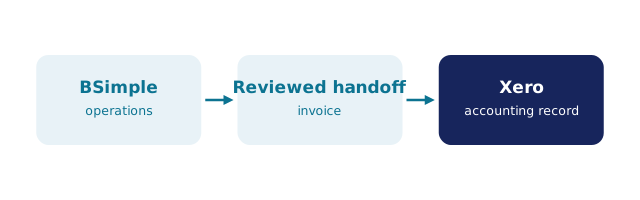
Invoices arrive complete: pushed from the inventory system on approval, with line detail and tax treatment attached — the bookkeeper reviews rather than re-enters. Payment status flows back: paid and voided mirror from Xero or MYOB, so the operations side and the books agree without anyone announcing it. Purchasing reconciles itself: supplier bills match purchase orders and goods receipts, with GST-inc and ex-GST views for Australian suppliers — the three-way match becomes a check, not a project. Stock valuation has a source: counts and movements are recorded, so period-end stock figures are drawn from the record rather than reconstructed for the accountant.
BSimple implements exactly this handoff: Xero as the established accounting integration — invoices push on approval, statuses mirror back, contacts import selectively — MYOB alongside it, and US accounting integrations rolling out. How the Xero integration works shows the boundary line by line.
Where BSimple fits
We build BSimple, so weigh that. It is the operations layer for small-to-medium wholesale, manufacturing, distribution and trade businesses: live stock, orders, purchasing and a customer portal on one record — with the bookkeeping handoff as designed behaviour, not integration homework. The ledger stays where it is; the bookkeeper keeps their tools; the reconciliation queue shrinks because the inputs stopped disagreeing. From $180/month (AUD), with the free trial to test the handoff on your own invoices.
The boundary, plainly: BSimple is not bookkeeping software. It does not file BAS, chase debtors as a ledger, or replace Xero or MYOB — it feeds them. The Australian control guide covers the GST and EOFY layer in depth.
Frequently Asked Questions
Does BSimple replace our bookkeeping software?
No — deliberately. Bookkeeping and compliance stay in Xero or MYOB; BSimple runs operations and feeds the ledger clean, complete invoices and reconciled purchasing. The bookkeeper's tools and workflow stay exactly as they are; what changes is the quality of what arrives.
How does GST flow through?
Invoices carry their tax treatment into the accounting system on approval, and supplier-side purchasing reconciles with GST-inc and ex-GST views — so the BAS inputs arrive as classified records rather than reconstructed receipts. The tax-code model extends beyond GST where the business needs it.
Can the bookkeeper see stock values for the balance sheet?
The operational record holds quantities and movements, and reporting views expose stock value from that record — so period-end figures are drawn, not rebuilt. The formal valuation in the ledger remains an accounting-cycle decision, which is where it belongs.
We use a bookkeeper monthly, not weekly. Does that matter?
It matters less, because the record no longer waits for them: invoices, receipts and statuses are in the ledger as they happen, so the monthly session becomes review and BAS rather than data entry. Businesses that reconciled weekly usually stop needing to; the records already agree.

BSimple