
Guide / Xero and stock
Does Xero have inventory management?
Xero is accounting software — it records money, and items can appear on invoices. What it does not do is run the warehouse: allocation, picking, locations, counts. Here is the boundary.
The short answer
- Xero's job is the ledger — recording sales, purchases and payments; item lines can appear on its invoices, but nothing allocates, picks or counts.
- Running stock is a different job: live quantities, orders, purchasing, stocktakes — an inventory system's work.
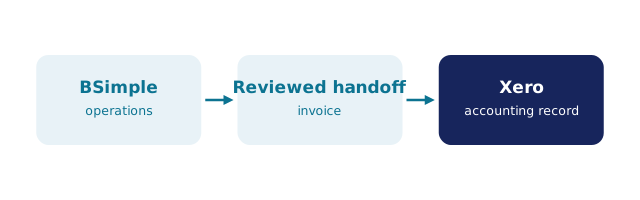
- The pairing works by division of labour: operations in the inventory system, compliance in Xero, invoices as the reviewed bridge.
- BSimple is built around that handoff — invoices push to Xero on approval, payment status mirrors back, from $180/month (AUD).
- 01The short answer
- 02What Xero does, and what it does not
- 03How the pairing works in practice
- 04Where BSimple fits
What Xero does, and what it does not
Xero records money: what was sold, what was bought, what was paid, and what the tax position is. Invoices can carry item lines, which is why Xero can look like it manages inventory — a quantity appears next to a sale. What it does not do is the operational half: it does not reserve stock for an order, sequence a pick, hold quantities per location, run a stocktake, raise a purchase order when a bestseller dips, or tell the warehouse what to load on the van tomorrow.
That is not a shortcoming — it is a division of labour. Businesses that stretch the ledger into an operations tool end up with side spreadsheets tracking what the shelf really holds, and the two records diverge from day one. The question "does Xero have inventory management" is really "should my accounting system also run my warehouse?" — and the answer that works for most product businesses is no: the inventory management overview shows what the warehouse side needs.
How the pairing works in practice
The boundary is the invoice. Outbound: the inventory system holds stock, orders and the pick/pack workflow; when an order is invoiced, the invoice pushes to Xero with its line detail and tax treatment. Inbound: payment statuses — paid, voided — mirror back from Xero, so the operations side stops chasing invoices the accountant has already settled. Purchasing closes the loop on the supply side: purchase orders raised from demand, goods received updating stock, supplier invoices reconciled — GST-inc and ex-GST in Australia — with the accounting record staying in Xero.
In BSimple this handoff is the design, not an integration afterthought: invoices push on approval with the transaction record behind them, contacts import selectively, and the Xero integration page shows the boundary in detail. MYOB works the same way, with US accounting integrations rolling out. The connection layer itself — mapping, failure modes, the daily handshake — is what inventory integration with Xero documents.
Where BSimple fits
We build BSimple, so weigh that. It is the operations layer for small-to-medium wholesale, manufacturing, distribution and trade businesses: live multi-location stock, orders with pick and pack and a customer ordering portal, purchasing from demand, batch and lot tracking, stocktakes from any phone — with Xero (or MYOB) keeping the ledger exactly as your accountant has it. Plans start at $180/month (AUD), and the free trial tests the handoff with your own invoices.
The boundary, stated plainly: BSimple does not replace Xero and does not want to. If your need is genuinely accounting-only, Xero alone is the right tool; the moment orders allocate stock and shelves need counting, the best-inventory-for-Xero guide shows what to pair with it.
Frequently Asked Questions
Can I just track inventory inside Xero?
You can record item lines on invoices, and that is where the capability ends for warehouse purposes: no allocation against orders, no locations, no pick and pack, no purchase orders from demand, no counts. For a business whose stock matters, those gaps are the daily work — an inventory system fills them and feeds the result to Xero.
Will adding BSimple change how my accountant works?
No — that is the point. Your accountant keeps working in Xero exactly as before. What changes is what arrives there: approved invoices pushed from BSimple instead of re-keyed ones, and purchase-order reconciliation with tax detail attached. Payment status flows back so operations and accounting agree without chasing.
Does BSimple sync stock levels to Xero?
No — and deliberate boundary-drawing matters here. BSimple holds the live quantities the warehouse runs on; Xero holds the financial record. The invoice carries value across on approval; quantities stay operational. Businesses needing inventory values in the ledger get them from stocktake valuations in the accounting cycle, not from a continuous quantity sync.
What about MYOB or QuickBooks?
BSimple supports MYOB alongside its established Xero integration, and US accounting integrations are rolling out. The principle is identical whichever system you use: operations in BSimple, compliance in the accounting product your bookkeeper prefers, and a reviewed invoice bridge between them — never a second ledger.
BSimple