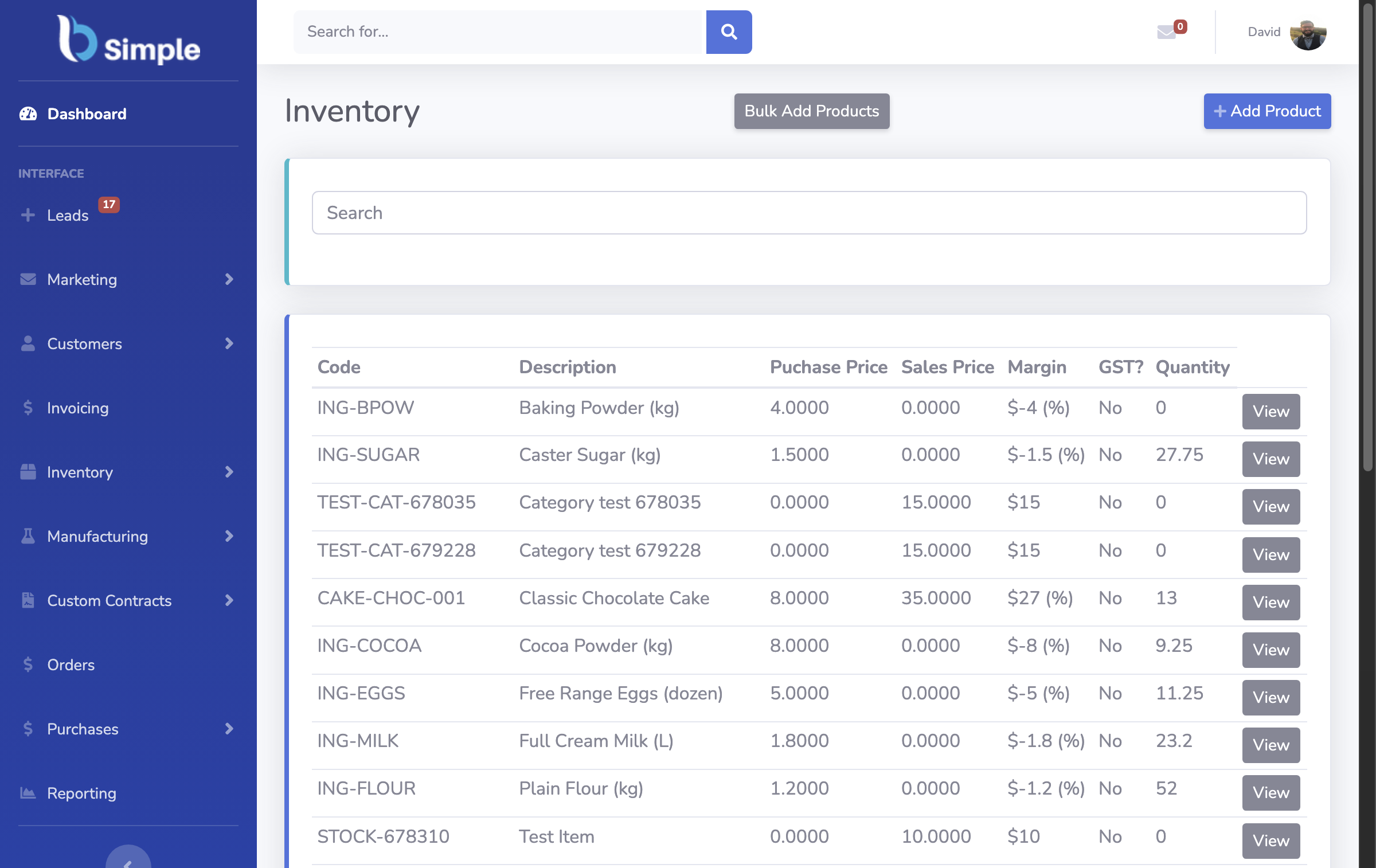
Inventory Management System On Github with Xero
Inventory Management System On Github helps Australian wholesalers and manufacturers manage inventory, orders, and purchasing. Xero integration, customer por...
- Seamless Xero integration for real-time accounting synchronisation and EOFY compliance
- Customer self-service ordering portal with real-time stock visibility and delivery tracking
- Automated purchase order generation based on intelligent reorder points and stock thresholds
- Negative inventory tracking for pre-orders and allocated stock across multiple warehouses
- Comprehensive stocktake management with variance reporting and reconciliation tools
- Just-in-time inventory optimisation to minimise working capital and storage costs
- Multi-warehouse support with location-specific stock levels and supplier management
Welcome to our guide on inventory management system on GitHub — see also our Inventory Management Software for the full picture. If you're running a wholesale, manufacturing, or distribution business in Australia, you've probably heard about open-source inventory management systems available on GitHub. While these solutions offer flexibility and customisation options, they often require significant technical expertise, ongoing maintenance, and development resources that most Australian SMBs simply don't have in-house. GitHub hosts countless inventory management projects, from basic stock tracking tools to more complex supply chain solutions. However, the reality is that downloading code from GitHub and implementing it yourself can be time-consuming, costly, and risky if you don't have a dedicated development team. Many businesses start with GitHub solutions only to realise they need professional support, regular updates, security patches, and integration with their existing accounting software like Xero. That's where purpose-built solutions like BSimple come in — offering the reliability and integration you need without the technical headaches.
Why GitHub Projects Fall Short for Real Businesses
GitHub inventory management systems appeal to many business owners because they're free and open-source. You can view the code, modify it, and theoretically deploy it yourself. Popular GitHub projects include inventory tracking applications written in Python, Node.js, or PHP. However, there's a critical difference between a project that works in a developer's test environment and one that actually performs reliably in a live business setting. Most GitHub inventory systems lack critical features that Australian wholesalers and manufacturers depend on daily: seamless Xero integration for real-time financial data synchronisation, customer ordering portals for self-service purchasing, automated purchase order generation based on stock levels, and sophisticated reporting that tracks negative inventory scenarios. Additionally, GitHub solutions require you to manage your own hosting, security updates, database backups, and system monitoring. For a Melbourne brewery managing hundreds of SKUs across multiple warehouses, or a Sydney coffee roaster coordinating seasonal inventory fluctuations, this overhead becomes a significant operational burden. You're essentially building and maintaining your own software company just to manage inventory. BSimple, by contrast, handles all the infrastructure, security, and compliance requirements so you can focus on growing your business rather than troubleshooting code.
Xero Integration That Actually Works
One of the biggest advantages of using a dedicated inventory management software solution over a GitHub project is native Xero integration. Australian businesses rely heavily on Xero for accounting, GST compliance, and financial reporting — especially around EOFY when stocktakes become critical. When you use a GitHub-based system, you'll typically need to build custom API integrations or use third-party middleware to connect your inventory data to Xero. This creates multiple points of failure, data synchronisation issues, and compliance risks. With BSimple, your inventory movements automatically flow into Xero, ensuring your stock valuations, COGS calculations, and balance sheet are always accurate. This is particularly important for manufacturing businesses where raw material inventory, work-in-progress, and finished goods need to be tracked separately and correctly valued for financial reporting. A manufacturing SMB in Brisbane can't afford to have inventory data sitting in one system and accounting data in another — that's a recipe for audit problems and incorrect financial decisions. BSimple's tight Xero integration means when you receive goods, adjust stock, or complete a stocktake, Xero knows about it immediately. This eliminates manual data entry errors and gives you real confidence in your financial position.
Customer Ordering Portals and Self-Service
Another critical feature that GitHub inventory projects struggle to provide is a proper customer ordering portal. Many wholesale and distribution businesses need their customers — whether they're retail shops, restaurants, or other businesses — to be able to place orders directly through a self-service interface. GitHub solutions might offer basic order entry functionality, but they rarely include the polish, security, and user experience that modern customers expect. BSimple's customer portal lets your clients log in, view product availability in real-time, place orders, track delivery status, and manage their account — all without your team manually processing every enquiry. For a Sydney-based wholesaler supplying hospitality venues across NSW, this self-service capability dramatically reduces order processing time and eliminates phone tag. You can also set customer-specific pricing, minimum order quantities, and delivery schedules directly in the system. GitHub projects typically require custom development to achieve this level of functionality, which means ongoing coding work and testing whenever you need to make changes. BSimple's built-in features are designed specifically for wholesale and distribution workflows, so you get exactly what you need without paying developers to reinvent the wheel. The portal also integrates with your inventory system, so customers only see stock that's actually available, preventing overselling and the awkward conversations that follow.
Smart Inventory Logic for Modern Supply Chains
Just-in-time inventory management and negative inventory tracking are sophisticated features that separate professional inventory systems from basic GitHub projects. JIT inventory is crucial for Australian manufacturers trying to minimise storage costs and working capital requirements — a manufacturing business in Adelaide might need to trigger purchase orders automatically when stock drops below a certain threshold, ensuring materials arrive just as production needs them. GitHub solutions might have basic reorder point functionality, but they lack the nuanced logic needed for complex supply chains. BSimple handles this elegantly, allowing you to set reorder points per product, per warehouse, and even per supplier. The system automatically generates purchase orders when stock hits those thresholds, which can then be sent directly to your suppliers. Negative inventory tracking is equally important — sometimes you'll sell stock before it arrives from your supplier, or you'll need to allocate inventory to customer orders before receiving goods. Basic systems either prevent this or handle it poorly, creating frustrating bottlenecks. BSimple tracks negative inventory intelligently, showing you exactly what's committed, what's on hand, and what's on order. This visibility is essential during stocktake periods and EOFY reconciliation when you need to understand your true stock position. A Perth distribution centre managing thousands of line items across multiple locations simply can't operate with a system that doesn't handle these scenarios properly. That's why choosing a purpose-built solution rather than a DIY GitHub project matters so much for operational efficiency. For a closer look at how these capabilities fit together, our warehouse management software guide ties it all together, and the guide to on walks through the practical details.
Frequently Asked Questions
Is it cheaper to use a free GitHub inventory system instead of BSimple?
While GitHub projects are free, the total cost of ownership includes hosting, security, backups, development time, and ongoing maintenance. Most businesses find that a purpose-built solution like BSimple costs far less than DIY development and eliminates hidden operational risks.
Can I integrate a GitHub inventory system with Xero?
Some GitHub projects offer Xero integration, but it's rarely seamless or fully supported. You'll typically need custom development work, which requires ongoing maintenance and creates compliance risks during audits and EOFY stocktakes.
Do GitHub inventory systems include customer ordering portals?
Most GitHub projects lack professional customer portal functionality. Building a secure, user-friendly portal yourself requires significant development work and ongoing security updates to protect customer data and payment information.
What happens if a GitHub inventory project becomes unmaintained?
Many GitHub projects are abandoned by their creators, leaving you without security updates, bug fixes, or feature improvements. You'd then need to hire developers to maintain the code yourself, which is expensive and risky.
Can GitHub inventory systems handle just-in-time ordering?
Some GitHub projects have basic reorder point functionality, but they lack the sophisticated logic needed for true JIT inventory with automatic purchase order generation and negative inventory tracking that professional systems offer.
Is BSimple suitable for Australian GST compliance and EOFY stocktakes?
Yes, BSimple is specifically designed for Australian businesses. It integrates seamlessly with Xero, handles negative inventory tracking, and provides detailed stocktake management features essential for EOFY reconciliation and GST compliance.
What's the difference between open-source GitHub solutions and SaaS inventory software?
GitHub solutions require you to manage hosting, security, and updates. SaaS solutions like BSimple handle all infrastructure, security, backups, and compliance automatically, letting you focus on growing your business instead of managing servers.