
Guide / for builders
A stock management system project — planned so it finishes
The projects that fail skip planning and start with screens. The scope, the movement-first data model, and the phase order that ships — whether it is coursework or an internal tool.
The key facts
- Plan the record before the screens: products, locations, parties, movements — with quantities derived, never stored.
- Phase order that ships: record → receipt/issue → counts → reports → reorders → auth. Screens last; the tail (auth, backups, import) is the project.
- Scope honestly: a trustworthy single-site system is a real project; multi-location and batch tracking double it — cut scope, not quality.
- The buy alternative exists — BSimple is commercial (not open source), from $180/month AUD with a trial; this page plans the build route honestly.
- The wider system: inventory management end to end maps the whole record this page sits in.
- 01The key facts
- 02Scope: what the project must decide first
- 03The data model, planned first
- 04The tail — and the buy alternative, priced honestly
Scope: what the project must decide first
Three questions, answered in writing before any code. Who uses it? One user, a team, or the public (customers ordering)? Each multiplies the project — concurrency, roles, and portals are not features, they are phases. What counts as stock? Single units, or boxes of cases? Batches with expiry, or shelf-stable items? Each yes adds a schema layer. What is the accounting story? Invoices produced here and exported, or a handoff to a real ledger? The answer defines the boundary — and pretending there is none is how homemade systems grow a bad second ledger.
A trustworthy single-site, single-stock-type, export-to-accounting system is a genuinely finishable project. Multi-location, batch tracking and customer self-service are each a second project — cut scope, not quality. The source-code landscape shows what finished projects of each size look like.
The data model, planned first
Products (SKU, description, unit, par level), locations (even if there is one — the schema survives the second site), parties (customers and suppliers as one abstraction with roles), and movements — the append-only heart: direction, quantity, product, location, actor, timestamp, reason. Quantities are derived by query, never stored as editable fields; the audit trail is then automatic, and "why does it say 3?" has an answer forever. The class-diagram reasoning justifies every table; the project-on-GitHub checks show what happens to projects that skipped it.
Build order that ships: record + receipt/issue first (a system that can record truth), counts second (variance review, adjustments as movements), reports third (on-hand, reorder needs), reorders and auth last. Screens come with each phase, not before — a beautiful screen over an unsound record is a demo, not a system.
Get started with BSimple
The tail — and the buy alternative, priced honestly
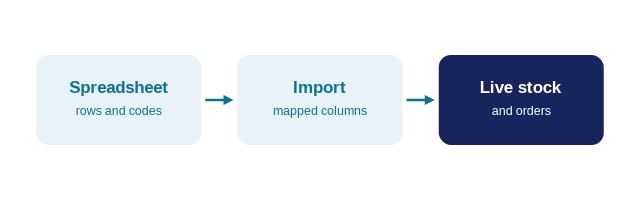
The phases above are the visible project. The tail is invisible and larger than it looks: authentication and roles, backup and restore that actually gets tested, import of the spreadsheet the business runs today, reconciliation reports, and deployment that survives holidays. Budget the tail at least equal to the core; it is where homemade systems usually stop. The build-vs-buy arithmetic applies the same maths.
We build BSimple, so weigh that: it is the finished version of this project — live multi-location stock, batches, purchasing from demand, portals, invoices to Xero or MYOB (US integrations rolling out) — maintained by its vendor, from $180/$250/$399 per month AUD, with the trial as the full product. For coursework, build; for a business, price both paths before the first migration script.
Frequently Asked Questions
How do I plan a stock management system project?
Decide users, stock types and the accounting boundary in writing; model products, locations, parties and movements with derived quantities; build record-first (receipt/issue, then counts, then reports, then reorders and auth); and budget the tail — auth, backups, import — as half the project.
What is the most common project mistake?
Storing editable quantities. It makes the first week easier and the record permanently unauditable — two users, one overwritten cell, and no way to explain anything. Movements first, always.
Which features should the first version skip?
Multi-location, batch tracking, customer portals and barcode scanning — each is a second project. A truthful single-site record with counts and a reorder report beats a half-finished everything.
How long should the project take?
For the scoped-down single-site version: weeks for the core, months for the tail — and the tail estimate is where projects are won or abandoned. Compare that to a subscription before committing either way.
When is buying the better project decision?
When the business needs a dependable record maintained by someone else — multi-user truth, guardrails, audit — and the tail estimate starts resembling a salary. The trial prices that alternative on your products in an afternoon.

BSimple