
Guide / just-in-time
Inventory systems for just-in-time
JIT is not a software feature — it is a discipline: small buffers, reliable suppliers, and a record that never lies. Here is what the system must do to support it, and the honest risks.
The key facts
- JIT means minimal buffers: stock arrives close to when it is consumed — capital released, waste cut, and zero slack for error.
- What the record must do: live quantities, movements in real time, reorder signals tuned to lead times, shortage visibility before runs and orders.
- The honest risks: JIT amplifies any inaccuracy — a stale record or a late supplier stops production, not just a shelf.
- BSimple is JIT-capable, not JIT-magic: reorder levels, shortage checks and live stock from $180/month (AUD); the discipline is yours.
- The wider system: inventory management end to end maps the whole record this page sits in.
- 01The key facts
- 02What JIT demands from the record
- 03The honest risks — and what software cannot fix
- 04How BSimple supports JIT
What JIT demands from the record
Just-in-time raises the stakes on record accuracy, because the buffer that used to absorb error is gone. Four requirements follow:
- Live quantities. Not "roughly right by Friday" — the number at 9am must include the receipt at 8:55 and the issue at 8:58.
- Real-time movements. Every receipt and issue recorded where it happens — scanning from a phone browser is the standard answer, because manual entry always lags.
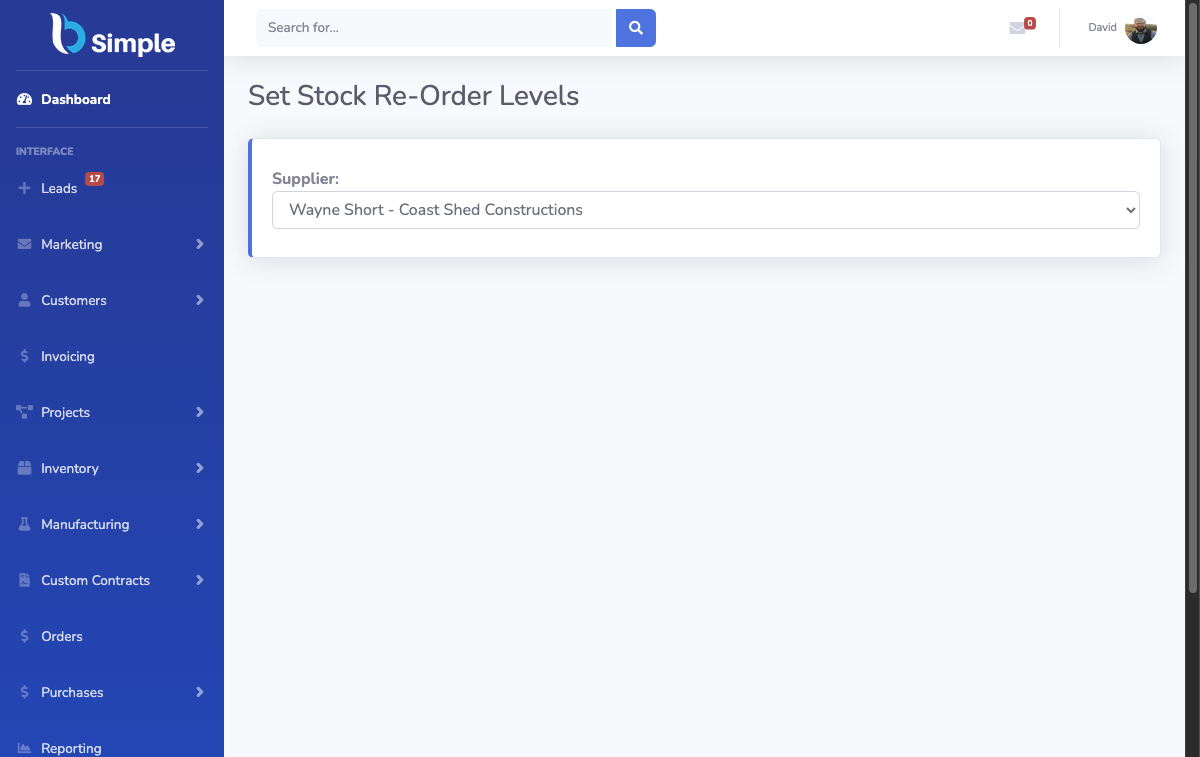
- Lead-time-aware reordering. Reorder points set to supplier lead times, so the purchase order fires while production can still wait for it.
- Shortage visibility before commitment. A production run or a customer order checked against live quantities — the shortfall becomes a supplier conversation, not a stop.
The shortage-check and purchasing mechanics cover this for production; the stock-record fundamentals cover the rest.
The honest risks — and what software cannot fix
JIT removes slack, so it amplifies everything: a supplier's bad week, a freight delay, a keying error, a mis-pick. Software fixes the record-shaped risks — stale quantities, unnoticed shortfalls, reorder guesses — and cannot fix the world-shaped ones. The honest prerequisites for JIT are supplier reliability, stable demand for the lines you run lean, and the discipline to record movements as they happen. Without those, buffers are not waste; they are insurance, and lean is a gradual negotiation, not a switch.
This is also why we do not sell JIT as a feature: no system makes suppliers reliable. What BSimple does is make the discipline cheap to keep — movements recorded by scan, counts from any phone browser, purchase orders raised from reorder levels the moment they breach, and shortage checks at planning time so runs and orders know before they start. The forecasting boundary is worth reading alongside: reorder-driven planning is the auditable cousin of lean.
How BSimple supports JIT
We build BSimple, so weigh that. The JIT loop lives on one record: receive by scan the moment goods land, issue as work happens, count by cycle without stopping the floor, and let reorder levels raise purchase orders from demand — with shortage checks before production runs and orders, and the Xero or MYOB handoff behind it all. Plans start at $180/month (AUD), everything in the core plans.
The honest test: run one lean line — set the reorder point at lead time plus a day, receive, issue, and watch the purchase order fire. If the record keeps up with the discipline, JIT is viable; if not, the buffers stay.
Frequently Asked Questions
What is a JIT inventory management system?
A system that supports just-in-time operations: live quantities, real-time movements, lead-time-aware reorder levels, and shortage checks — so minimal buffers stay safe. JIT is the discipline; the system keeps the discipline cheap.
Does BSimple do JIT?
BSimple supports JIT practice: live stock, scan-recorded movements, reorder-driven purchasing, shortage checks before runs. We do not sell JIT as a magic feature — supplier reliability and recording discipline remain yours.
Is JIT risky for a small business?
It amplifies every error, so start narrow: one or two stable lines with reliable suppliers, run lean while the rest keeps buffers. Software accuracy is the precondition — the trial shows whether your record can carry it.
What does BSimple cost for JIT practice?
Plans start at $180/month (AUD) with reorder levels, shortage checks, scanning and counts in the core plans. The trial runs one real line lean before you commit.

BSimple