Shopify Inventory Management Software with Native Sync
What BSimple adds to your Shopify store beyond native inventory:
- Real-time bi-directional stock sync — Shopify and BSimple always in agreement
- Purchase order management and goods-in receiving (Shopify can’t do this)
- Wholesale B2B customer portals running from the same inventory as your Shopify store
- Xero integration with accurate COGS — not just basic invoicing
- Multi-location inventory across warehouse and Shopify locations
- Manufacturing and batch tracking for businesses that produce before they sell
Shopify handles ecommerce beautifully. But Shopify’s built-in inventory management was designed for straightforward online retail — not for Australian businesses running wholesale B2B alongside their Shopify store, managing stock across a warehouse and multiple Shopify locations, or trying to get Shopify sales to sync cleanly into Xero without manual reconciliation.
That gap — between what Shopify does natively and what a growing product business actually needs — is where inventory management software with native Shopify sync earns its place. BSimple connects to Shopify in real-time, syncing stock and orders bi-directionally, while also managing wholesale B2B operations, supplier purchasing, and Xero accounting from one system.
If you’re running simple DTC ecommerce on Shopify with light inventory, Shopify’s native tools may be enough. If you’re doing real volume, running wholesale alongside ecommerce, or need Xero to actually reflect your inventory position accurately — you need the integration.
Shopify's Native Inventory vs. Proper Inventory Management Software
Most businesses discover the limits of Shopify’s native inventory after they’ve outgrown it. Here’s the honest comparison:
What Shopify inventory does well:
- Track stock levels for Shopify products and decrement on sale
- Show low-stock warnings in the Shopify admin
- Manage inventory across Shopify locations
- Basic inventory history for Shopify orders
Where Shopify inventory runs short:
- No purchase order management — Shopify doesn’t help you order from suppliers, track incoming stock, or manage goods-in receiving
- Limited Xero integration — Shopify’s Xero app handles basic invoicing but doesn’t properly account for COGS or inventory valuation
- No B2B wholesale — Shopify’s B2B features require Shopify Plus. BSimple gives any Shopify business a wholesale customer ordering portal.
- Single channel gaps — if you also sell at trade shows, via phone orders, or direct invoices, those transactions don’t feed back into Shopify’s inventory. Your real stock position constantly diverges from Shopify’s numbers.
- No production or batch tracking — if you manufacture or process products before selling them, Shopify can’t track raw materials consumed or finished goods created
The question isn’t whether Shopify’s inventory is bad — it’s whether it was designed for what you’re actually doing.
How Shopify Inventory Integration Works in Practice
The integration between Shopify and BSimple runs via Shopify’s API in real-time — not nightly batch files or manual exports. Here’s what happens under the hood:
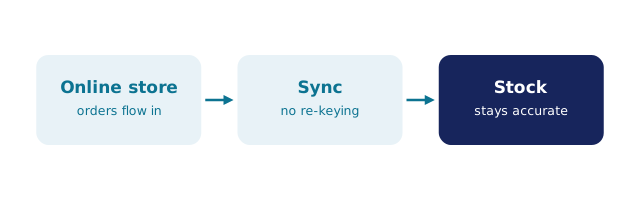
Orders: When a customer orders on Shopify, it flows into BSimple immediately. BSimple allocates stock, creates a fulfilment task, and decrements inventory. Once fulfilled, tracking information syncs back to Shopify and the customer receives their shipment notification automatically.
Stock levels: When you receive new stock into BSimple — matched against a supplier purchase order — Shopify inventory updates immediately. Whether you received 50 units or 500, Shopify reflects the correct available quantity as soon as BSimple records the receipt.
Products and variants: Products can be created in BSimple and pushed to Shopify. Shopify variants (sizes, colours, styles) map to individual BSimple SKUs with their own inventory tracking. Inventory changes at the variant level sync specifically — not just at the parent product level.
Wholesale running alongside Shopify: Your wholesale customers order through their BSimple portal. Those orders draw from the same inventory pool as Shopify. When a wholesale order is placed, Shopify available inventory updates — no overselling because you forgot a wholesale order was in progress.
Shopify + BSimple + Xero: The Complete Australian Business Stack
For Australian businesses, the complete operational stack is Shopify (ecommerce), BSimple (inventory and operations), and Xero (accounting). Each platform does what it does best:
Shopify processes consumer transactions and provides a best-in-class storefront. BSimple manages inventory, purchase orders, wholesale customer portals, and order fulfilment workflows. Xero handles accounting, GST, BAS, and financial reporting.
The data flows automatically: Shopify orders flow into BSimple (stock allocated, fulfilment processed), which flows into Xero (invoice created with correct COGS and GST). Supplier purchase orders enter BSimple (stock received), which flows into Xero (bill matched and approved). No manual entries, no end-of-month reconciliation, no spreadsheets bridging systems that won’t talk to each other.
For Australian retailers on Shopify doing both DTC and wholesale — a very common model in food, beverage, homewares, and fashion — this integration stack removes the operational friction that otherwise forces businesses to choose between growing their Shopify channel and managing their wholesale relationships. You don’t have to choose. Both run from the same inventory.
See also our guides to order management software and inventory management software for Australian wholesale and manufacturing businesses.
Managing inventory can be a real headache for wholesale and manufacturing businesses, but the right Inventory Management System Php can make it a breeze. BSimple’s software seamlessly syncs with your Shopify store, giving you real-time visibility of stock levels and the ability to automate ordering and fulfilment. Plus, our handy Inventory Management System Flowchart Example makes it easy to optimise your processes. With BSimple, you can spend less time on inventory and more time growing your Australian business.
Frequently Asked Questions
What’s the best inventory management software for Shopify in Australia?
For Australian businesses using Shopify alongside wholesale B2B, BSimple provides native Shopify integration with real-time inventory sync, Xero integration for accounting, and customer portals for wholesale ordering. This enables unified inventory management across Shopify retail and wholesale channels from one platform. Alternatives include Cin7 and Unleashed, both with Shopify integration and Australian presence.
Does Shopify’s built-in inventory management work for wholesale businesses?
Shopify’s native inventory works for ecommerce-only businesses but lacks functionality for wholesale operations: no customer-specific pricing, limited B2B ordering workflows, no purchase order management for suppliers, and no proper Xero COGS integration. Australian businesses doing both Shopify and wholesale need dedicated inventory management software that handles multi-channel operations with proper B2B features.
How does inventory sync between Shopify and BSimple?
The integration uses Shopify’s API for real-time bi-directional sync. Shopify orders flow into BSimple immediately, BSimple stock movements update Shopify inventory in real-time, fulfilment status syncs back to Shopify for customer notifications, and product details can be pushed from BSimple to Shopify. This happens via API — not manual exports or overnight batch processes.
Can I manage Shopify and wholesale B2B inventory in one system?
Yes. BSimple manages both Shopify retail and wholesale B2B from unified inventory. Shopify orders and wholesale portal orders both allocate from the same stock pool with real-time synchronisation. This prevents overselling across channels while providing profitability analysis by channel — which is more profitable after accounting for Shopify fees versus wholesale margins.
Does Shopify inventory software integrate with Xero properly?
BSimple provides native Xero integration where Shopify orders (and wholesale orders) automatically create Xero invoices with correct GST, line items, and COGS. Inventory valuations update in Xero when stock is received or sold. This eliminates manual invoice creation and ensures Shopify revenue flows correctly into Australian accounting for BAS reporting and financial statements — proper accounting, not just basic invoice sync.
How much does Shopify inventory management software cost?
Inventory management platforms with Shopify integration typically cost $150–$500 per month based on business size and transaction volume. BSimple pricing starts around $150/month with unlimited users and Shopify integration included. This is in addition to Shopify subscription costs ($39–$399/month) and Xero ($32–$70/month). Contact us for a quote based on your specific SKU count and transaction volume.