
Guide / jewellery trade
Inventory management software for jewellery
Jewellery breaks ordinary inventory assumptions: one design exists in many sizes, a piece ships inside nested packaging, and materials are precious enough to trace. Here is what that demands from software, and where BSimple fits — and does not.
The key facts
- Multi-level stock is the trade's core problem: pieces nest into boxes, sleeves and cases — each level needs its own quantity and barcode.
- Unique and batch pieces differ: one-off commissions behave like projects; production lines behave like batches with materials to trace.
- BSimple's fit: makers, manufacturers and wholesalers of jewellery — multi-level stock, batch tracking, projects for custom jobs, invoicing with accounting handoff.
- The boundary: no counter POS for retail storefronts — front-of-shop sales need a point-of-sale system alongside.
- 01The key facts
- 02What jewellery inventory actually involves
- 03How BSimple covers the trade
- 04The honest boundary
What jewellery inventory actually involves
Three properties make the trade different from general retail stock. Nesting: a finished necklace is issued with a box, a sleeve and a shipping case — sell one piece and every level decrements, so "how many can we ship tomorrow?" means asking three quantity questions at once. Software needs multi-level stock that tracks boxes, sleeves and cases as stock in their own right, not as a note field. Uniqueness: commissions and one-off pieces have no SKU twins — they behave like jobs, reserved when quoted and consumed when invoiced, with the customer's history attached. Material value: gold, silver and stones are stock worth tracing by batch — which supplier lot went into which production run — for both costing and provenance answers.
Add the ordinary demands underneath — live quantities across a workshop, a showroom and a vault; purchase orders against reorder levels; stocktakes that find the pieces a spreadsheet lost — and the requirement list is complete.
How BSimple covers the trade
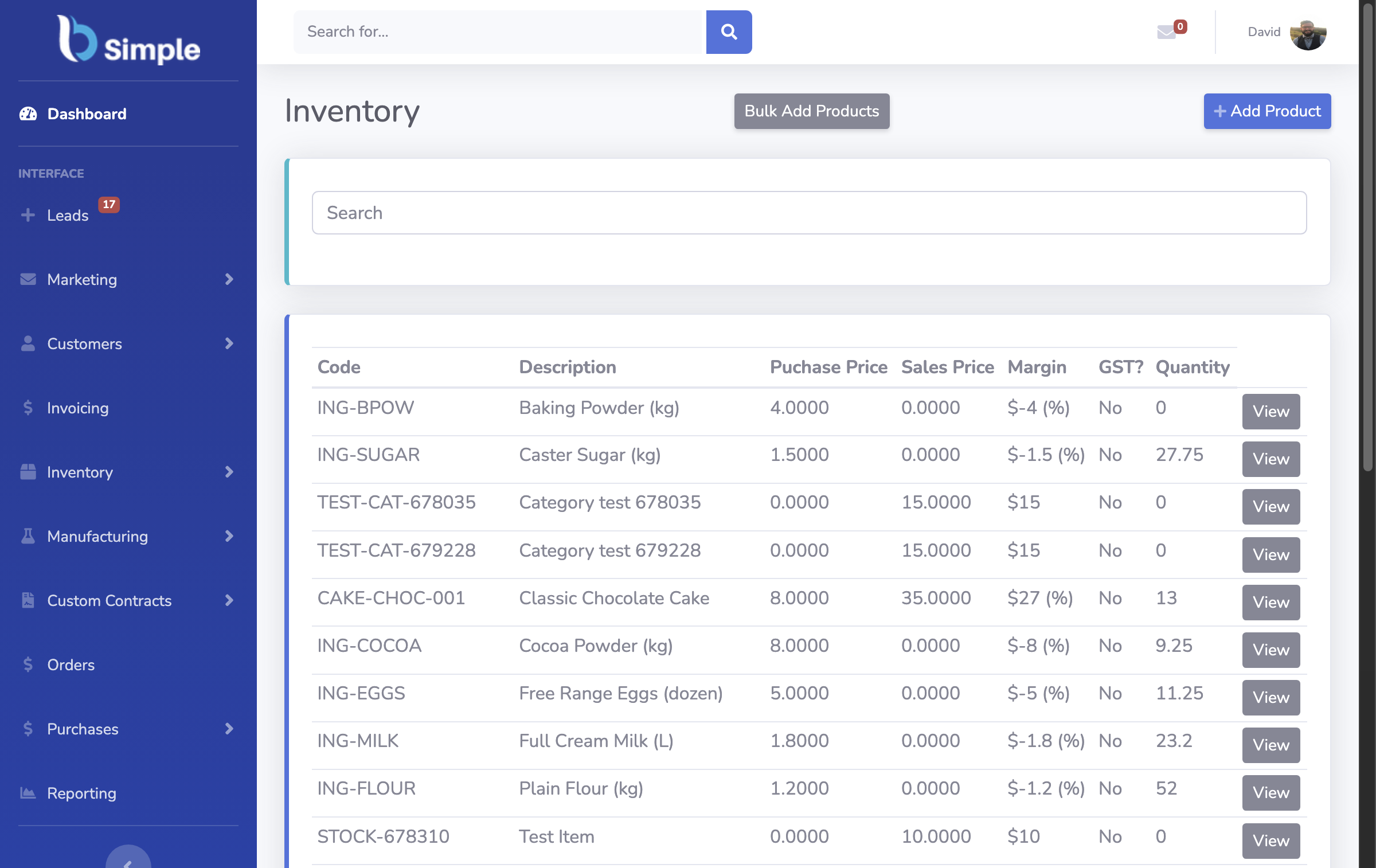
We build BSimple, so weigh that. The pieces that match jewellery directly:
- Multi-level stock — boxes to sleeves to cases as tracked levels, the exact nesting problem above.
- Batch and lot tracking — materials traced from receipt into production runs, and traceability search throughout for costing and provenance questions.
- Projects — a custom commission reserves items without consuming stock, then consumes them on invoice approval, with the job's history kept against the customer. The same machinery used for trade installations fits one-off pieces.
- Recipes and production runs — bills of materials for a design in each size, shortage checks before a run starts.
- The record, finished — approved invoices push to Xero or MYOB with payment status mirroring back; US accounting integrations are rolling out.
Plans start at $180/month AUD with all of it in the core plans, and the trial is the honest test with your own catalogue.
The honest boundary
BSimple has no counter point-of-sale. A retail storefront selling walk-in customers needs a POS system for the till, and BSimple will not pretend to be one — the shop floor and the stock record are different jobs. Where BSimple sits is everything behind the counter: the workshop, the stockroom, the wholesale side supplying other stores, and the online flow — Shopify orders import by webhook into the same record. If you are mapping the wider question, tracking system examples across industries and the types of inventory system show how the trade compares, and the inventory management pillar holds the whole picture.
Frequently Asked Questions
Can software track boxes and sleeves separately from the pieces?
Yes — that is multi-level stock: each packaging level is a tracked item with its own quantities and barcodes, so selling a piece and its nested packaging decrements every level together.
How do one-off commissions work in BSimple?
As projects: reserve materials against the job without consuming stock, consume them when the invoice is approved, and keep the job's history against the customer. The flow was built for trade installations and maps directly to commissions.
Can we trace which gold lot went into which batch?
Yes — batch and lot tracking follows materials from receipt through production runs, and traceability search answers "which lots went into this run" both directions. It is the same machinery food producers use for recalls.
Does BSimple run a jewellery shop counter?
No — there is no point-of-sale till. Retail walk-in sales need a POS; BSimple runs the workshop, wholesale and online-side record behind it.
What does it cost?
Starter $180, Professional $250 and Organisation $399 per month (AUD). Multi-level stock, batch tracking, recipes and projects are all in the core plans — no trade module surcharge.

BSimple