
Guide / what it changes
Inventory management software can help businesses by…
…replacing re-typed numbers with one accurate stock record. It keeps the on-hand figure true through logged movements, raises purchasing from real demand, and makes the count, the order book and the accounting system agree — each mechanism below, honestly weighed.
The key facts
- True stock, by construction. Every change is logged as a movement and quantities are derived from it — the figure stops depending on whoever typed last.
- Reordering becomes a rule, not a memory task. Reorder levels and purchase orders raised from demand replace the mental note and the Friday stock-check ritual.
- Customers self-serve. An ordering portal gives each customer their own products and pricing, which removes the email-and-phone order relay entirely.
- The count and the books agree. Stocktakes become routine corrections and invoices flow to the accounting system instead of being re-keyed.
- What it does not do: replace the accounting system, plan production schedules like an MRP module, or fix a process nobody follows.
By keeping the stock figure true
The first change is quiet but structural: stock on hand stops being a stored number and becomes a derived one. A sale, a receipt, a production run, a damaged item — each is recorded as a movement with a who, a when and a why, and the quantity on the shelf is summed from that history. Drift still happens in the physical world, but it can no longer happen silently in the record.
That property is what the later benefits stand on: a figure with an audit trail can be trusted at the moment of sale, and guardrails catch the impossible — selling stock that is not there — before it reaches a customer. The inventory management pillar covers how the record itself works.
- 01The key facts
- 02By keeping the stock figure true
- 03By turning reordering into a rule
- 04By giving customers a self-serve lane
- 05By making the count and the books agree
By turning reordering into a rule
In spreadsheet-run businesses, reordering lives in someone's head, and the failure mode is famous: the item runs out the week nobody checked. Software replaces the memory task with a rule — a reorder level per product, checked continuously against live quantities, with purchase orders raised from that demand instead of from a hunch.
The purchasing side tightens too. Orders arrive with the supplier's price on record, so an invoice that does not match the order is a flag rather than an overpayment discovered at reconciliation. Received goods update stock the moment they are checked in, so the on-order picture and the shelf picture never have to be reconciled by hand. Businesses living on supplier lead times feel this first — the benefits page lists what else changes.
By giving customers a self-serve lane
A large share of daily admin is customers asking what is in stock, what their price is, and whether the order arrived. An ordering portal answers all three without a phone call: each customer gets their own link showing their own product list and their own pricing, and the order lands in the same record the warehouse works from — no re-keying, no transcription errors, no "did you get my email?"
For wholesale relationships this changes the texture of the week: orders arrive at any hour already structured, staff work on exceptions rather than entry, and the customer sees their own order status instead of waiting for a reply.
By making the count and the books agree
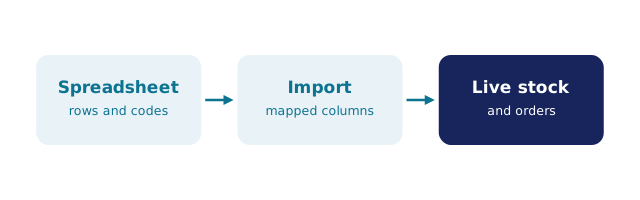
Two reconciliations eat month-end in spreadsheet-run businesses: count versus record, and record versus accounting. Inventory software shrinks both. Stocktakes — full or cycle counts — become correction movements with reasons attached, so the annual count stops being a data-repair archaeology project. And when the finished invoice pushes to the accounting system rather than being typed in again, the accountant's numbers and the warehouse's numbers are the same numbers.
The boundary matters: the software connects to accounting, it does not replace it. In BSimple, Xero and MYOB (US integrations rolling out) stay the system of record, and BSimple hands them finished work.
Frequently Asked Questions
Can inventory management software help businesses by cutting costs?
Yes, through mechanisms rather than magic: fewer duplicate orders, less over-ordering against uncertain counts, less write-off at stocktake, fewer hours re-keying. The size depends on how much waste exists today — only your own before-and-after is an honest number.
What is the first benefit a small business actually feels?
Almost always the end of the re-keying relay: orders stop being retyped into invoices and stock stops being adjusted from memory. It shows up within the first weeks because it removes work that happens every day, while deeper benefits — cleaner stocktakes, tighter purchasing — compound over months.
Does it help by replacing accounting software like Xero?
No, and a tool that claims to is blurring an important line. Accounting systems stay the record for compliance, tax and payments. Inventory software helps by making the operational record accurate and handing the accounting system finished invoices and reconciled purchasing.
When does inventory software not help?
At very low volume — a handful of orders a week handled end to end by one careful person — the discipline of a simple spreadsheet is genuinely enough. It also cannot help where the process itself is missing: software enforces a way of working, it does not design one.
How can a business test these claims before buying?
Load real products into a trial and run one true order through the whole path — order, pick, pack, invoice, stock update. The trial is the full product, so every mechanism above can be checked against your own numbers.
BSimple