
Product / projects
Inventory and project management software
Most tools do one or the other: stock software without the job, project software without the shelf. BSimple's Projects group inventory and on-site assets under a customer — reserve without consuming, install and consume on invoice approval, keep warranty history after.
The key facts
- The gap this fills: project tools track tasks but not stock; inventory tools track the shelf but not the job. BSimple's Projects put both on one record.
- How Projects work: inventory and on-site assets are grouped under a customer for the job's lifetime — items reserve without consuming stock, and consume when the invoice is approved.
- The lifetime part: warranty, maintenance and service history attach to the project, so the record answers the customer's call years later.
- Typical fits: trade installations, equipment jobs, boom-gate-style installs — any business that supplies, fits and services product at a customer's site.
- The full picture: how the inventory record works is the hub page for everything above.
- 01The key facts
- 02Why stock and the job must share a record
- 03How Projects work in BSimple
- 04Who this fits — and who it does not
Why stock and the job must share a record
Businesses that install product at customer sites live with a specific failure: the stock system says a unit is on the shelf, the project plan says it is promised to a job, and the truth is discoverable only by asking someone. Every reservation held in a spreadsheet, every piece allocated by sticky note, becomes a double-promise waiting for the week both jobs ship.
Sharing the record fixes the arithmetic and the history. Reserving against a project adjusts what is promiseable without pretending the unit has left the building — the shelf count stays honest, the commitment becomes visible, and the same unit cannot be sold twice. And because the consumption is tied to invoicing, the financial record and the physical record agree by construction rather than by reconciliation.
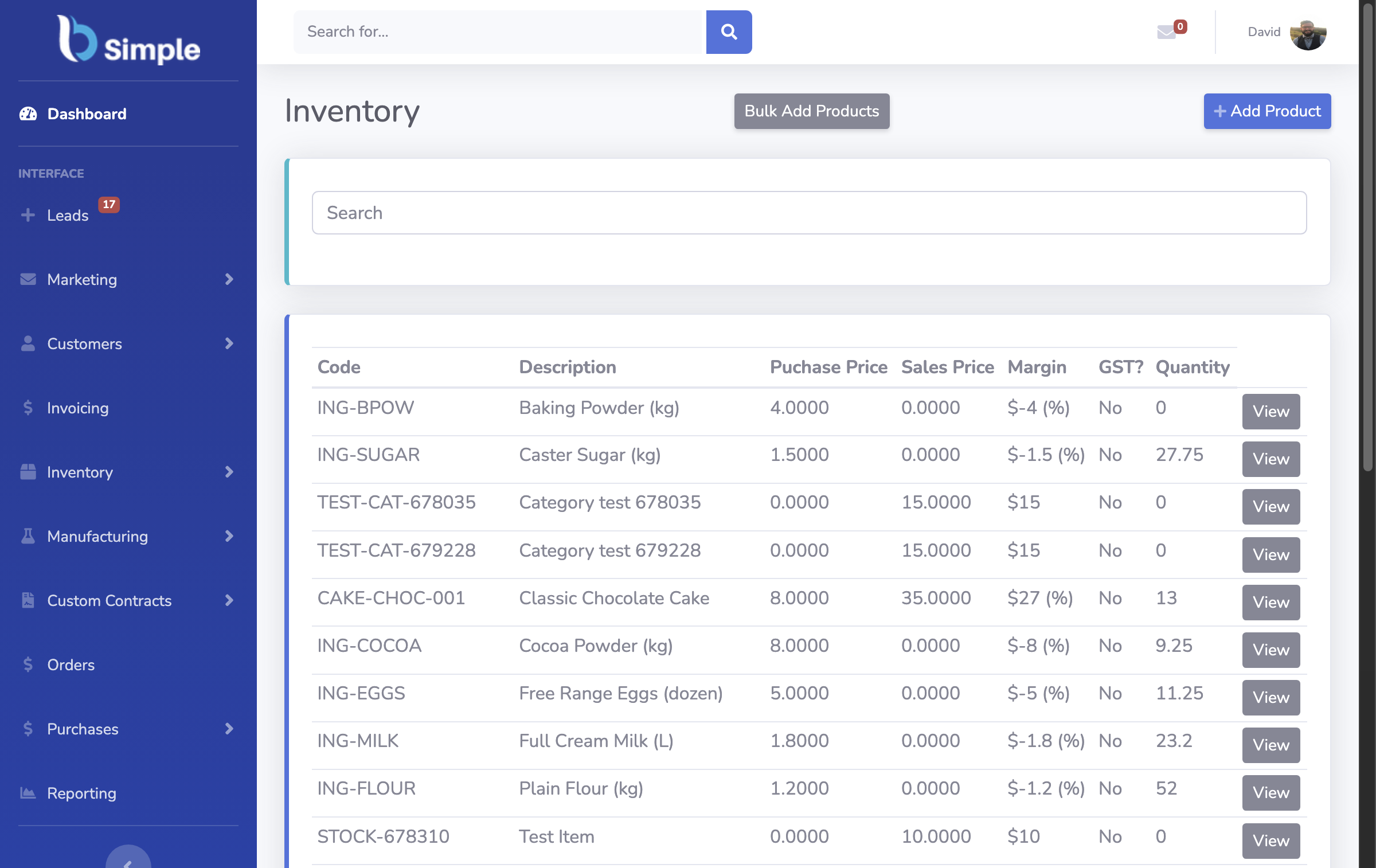
How Projects work in BSimple
A project is opened under a customer and holds the inventory and on-site assets for that job's lifetime. Reserve: pieces are allocated to the project without consuming stock — the warehouse count stays true, and the reserved pieces cannot quietly sell to someone else. Install and consume: when the job completes and the invoice is approved, the reserved items are consumed against the project and the invoice — carrying the quantities, the pricing and the tax codes — pushes to the accounting system with payment status mirroring back.
The history stays: warranty, maintenance and service records attach to the project for the asset's lifetime, so the call two years later — which batch, which parts, what was serviced — is a lookup rather than an investigation. Around the project loop sit the usual pieces of the record: purchasing raised from demand for what the job needs, live quantities across locations, and customer ordering portals for repeat reorders. The production side covers jobs that start with making the product, and the trade-business fit describes the pattern for contractors specifically.
Who this fits — and who it does not
The pattern that fits: businesses that supply, install and service physical product at customer sites — trade installations, equipment and security jobs, fit-outs — where the unit of work is a job with a location, a customer and a lifetime of service after handover.
The pattern that does not: pure task-and-time project management. There are no Gantt charts, no timesheets, no task boards — if the "projects" are software deliverables or consulting engagements with no inventory, a project-management tool is the right purchase and BSimple is not. The honest test: if the job consumes stock you own, this layer earns its keep; if it only consumes hours, it does not. The trial settles it on your own jobs — reserve one, consume it through an invoice, and check the history it leaves behind. From $180/month AUD with projects in the core plans.
Frequently Asked Questions
What does project management mean in BSimple?
The job-level grouping of inventory and on-site assets under a customer: reserve items without consuming stock, consume them on invoice approval, and keep warranty, maintenance and service history for the asset's lifetime. It is physical-job management, not task boards.
How does reserving stock differ from consuming it?
Reservation commits the pieces to the project — they cannot sell elsewhere — while the shelf count still shows them on hand. Consumption happens when the invoice is approved: stock deducts, and the financial and physical records move together.
Can it track assets installed at a customer site?
Yes — that is the "on-site assets" half: installed pieces stay under the customer's project with their history, so warranty and service queries are answered from the record years after the install.
Does this replace a project-management tool like task boards?
No — no timesheets, Gantt charts or task boards, by design. BSimple manages jobs that consume inventory; pure task-and-time projects belong in a dedicated PM tool, and pretending otherwise would waste your trial.
What does it cost?
Projects are in the core plans — $180/$250/$399 AUD monthly, no separate module. The trial is the full product: open a project, reserve stock, consume through an invoice, and see the history.

BSimple