
Guide / tools and their data
A list of business management tools
This is not study material — your course owns that. What follows is the working list of classic business tools, with the honest annotation of which ones software can run, which need a human, and what data each one is starving without.
The key facts
- Strategy tools (SWOT, PESTLE, Ansoff, Porter): human judgement frameworks — software feeds them evidence, never conclusions.
- Finance tools (break-even, cash-flow forecast, ratios): computable — and only as honest as the record feeding them.
- Operations tools (reorder levels, stock control, Gantt/job tracking): directly implementable — this is the layer software genuinely runs.
- BSimple's annotation: the operations tools are live in the product; the rest consume the record it keeps.
- The full picture: how the inventory record works is the hub page for everything above.
- 01The key facts
- 02Strategy tools: judgement frameworks, fed by evidence
- 03Finance and operations tools: where software earns its keep
Strategy tools: judgement frameworks, fed by evidence
SWOT, PESTLE, Ansoff's matrix and Porter's five forces are structured thinking — ways of forcing a look in directions bias avoids. No software "does" a SWOT; what software does is starve or feed it. A SWOT listing "strong supplier relationships" is opinion until the record shows on-time delivery rates and price-variance history; "growing demand" is a hunch until order history backs it. The practical annotation for every strategy tool: write the claim, then ask which record would prove it — and notice how often the answer is "we do not keep that".
Finance and operations tools: where software earns its keep
Break-even analysis, cash-flow forecasts and ratio analysis are pure computation — the tool is a spreadsheet or an app, and the quality of the output is exactly the quality of the inputs. Stock turnover computed from a year-end guess is a fiction; computed from a live movement ledger it is a decision. Cash-flow forecasts live or die on knowing which invoices are approved, paid and overdue — continuous data, not month-end reconstruction.
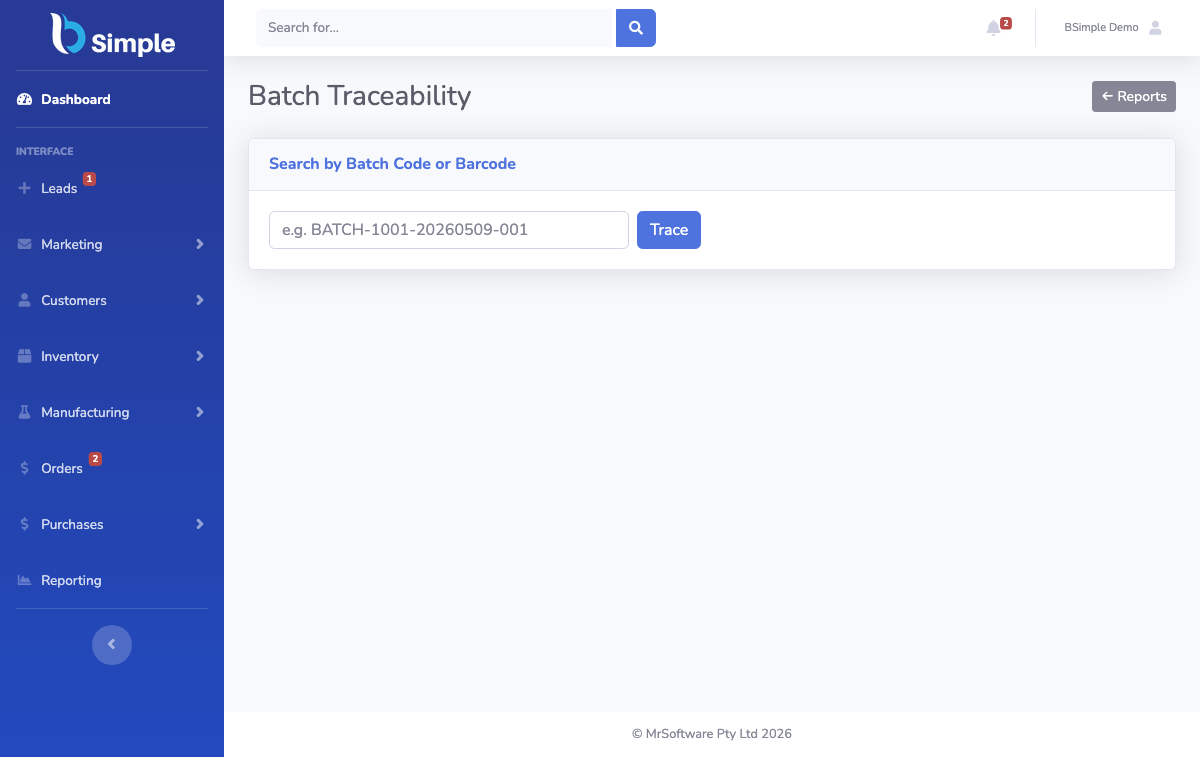
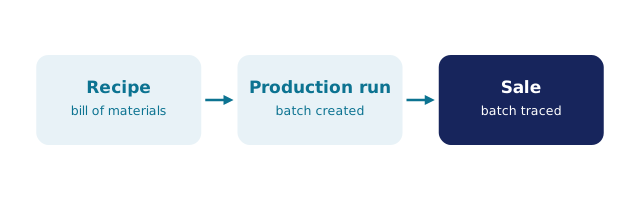
Operations tools are the layer software genuinely runs: reorder levels and buffer stock (the trigger fires from live quantities), stock control methods (perpetual tracking, cycle counts, batch and expiry discipline), Gantt-style job tracking (projects and work orders), and capacity planning at the light end. These are policies enforced by a system — the difference between a rule in a manual and a rule that cannot be forgotten. We build BSimple, so weigh that: the operations row of this list ships in the product — live quantities, reorder automation, batch traceability, projects with service history — from $180/month AUD, and the trial runs the tools on your own products. The IB tools, applied to software covers the theory-to-practice mapping in more depth, the business software definition frames the record, and management software by type sorts the shelf.
Frequently Asked Questions
What are the main business management tools?
Strategy frameworks (SWOT, PESTLE, Ansoff, Porter), finance tools (break-even, cash-flow forecast, ratio analysis), and operations tools (stock control, reorder levels, job tracking). The first group is human judgement; the second two are where software earns its keep.
Can software run a SWOT or Ansoff analysis?
No — they are judgement frameworks. Software's role is feeding them evidence: real order history, supplier performance, stock turn. A SWOT built on a record is analysis; one built on memory is a mood board.
Which tools does BSimple implement?
The operations set: perpetual stock tracking, reorder levels and buffer stock, batch and expiry control, cycle counts, job and project tracking — all on one record, from $180/month AUD.
Why do these tools matter for a study course?
Because seeing one run on live data separates recital from understanding — a reorder level firing a purchase order is buffer stock made real. The trial is the field trip.

BSimple