
Guide / the free list, sorted
The free inventory software list, explained honestly
Every entry on a free list is one of four things. Name the thing, and the choice makes itself: template, open source, capped tier, or trial.
The four things on every free list
- Templates — spreadsheet structures: free forever, manual forever, one maintainer.
- Open-source tools — free licences, self-hosted: you run the server, the upgrades and the seams.
- Free tiers — capped versions of paid products: real software with a ceiling, and an upsell path.
- Free trials — the full product for a testing period: the only free entry that shows the joined record.
- Context: the full inventory system holds the wider system, this page one stop in it.
- 01The four things on every free list
- 02What each entry is, honestly
- 03Where BSimple fits
What each entry is, honestly
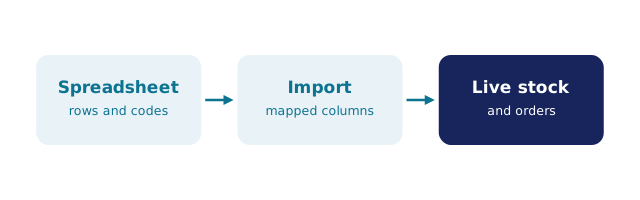
Templates are the most useful free thing in the category: a two-sheet structure (products, movements) with derived on-hand gives a small operation a real record. They scale to exactly one maintainer. Building the template and adding a scanner to it are covered properly elsewhere on this site. Open-source tools trade licence cost for hosting, maintenance and integration work — solid when technical capacity is in-house. Free tiers are demos with good manners: real software, real caps — find the cap, check the export, expect the upsell. Trials are the free entry that matters most: the full product, including the parts no free tier ever includes — allocation, purchasing, the accounting handoff, the portal.
The reason this page sorts the list instead of ranking it: a ranking of mixed categories compares incomparable things. A template, an open-source project, a capped tier and a trial are answers to four different questions — and the first question is which one you are actually asking.
Where BSimple fits
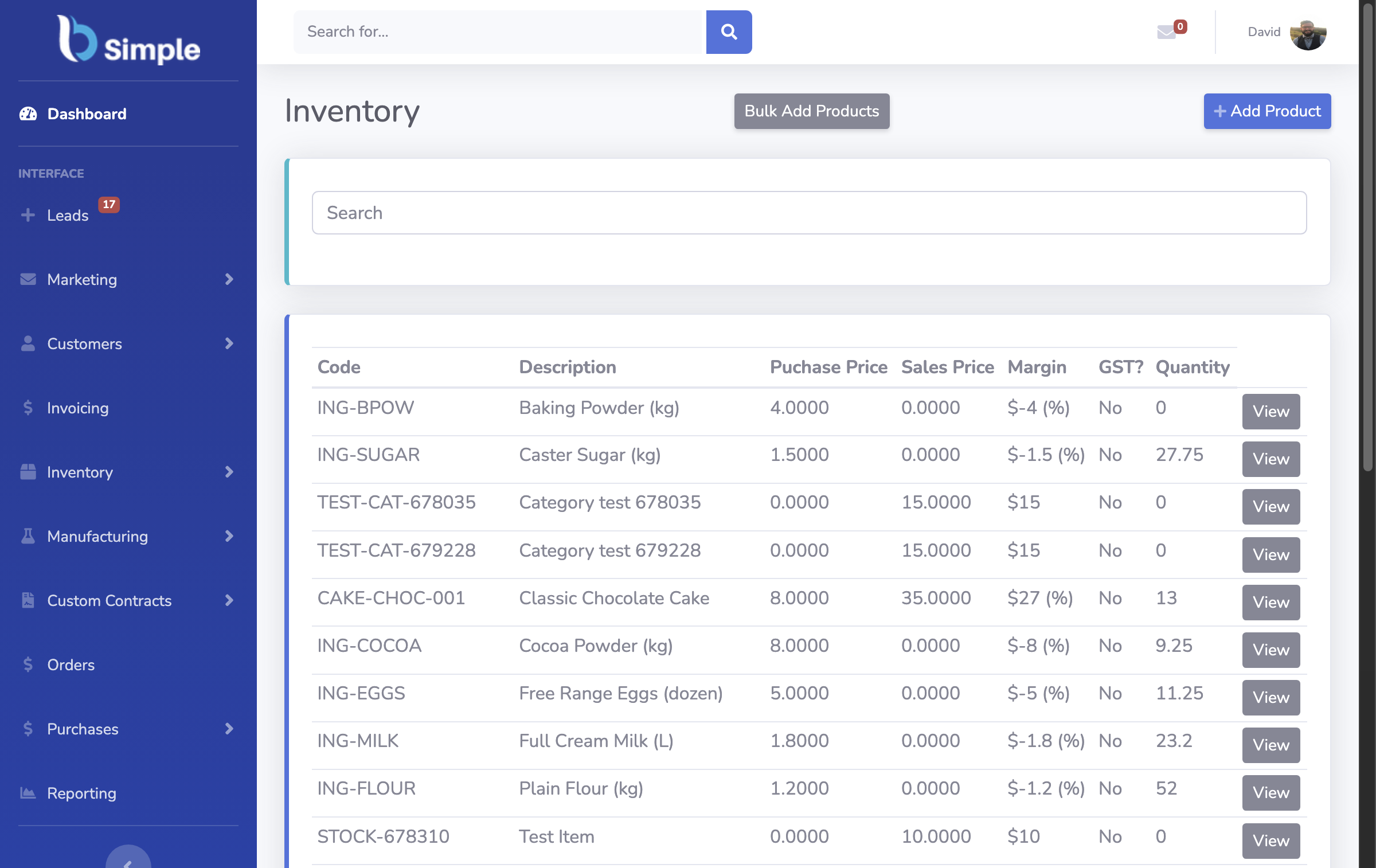
We build BSimple, so weigh that: it appears on free lists only as a trial — the full product, free, before plans from $180/month (AUD) begin. It is not a template, not open source, not a free tier, and this page will not dress it up as one. The trial exists to show the joined record — stock, orders, purchasing, invoicing, portal on one live record — against your own products: start here.
How to leave any free list: pick the entry type that matches your stage. Below the crossover, the template or open-source route is honest value. At it, the trial is the only entry that answers the fit question — the free ladder marks the crossover, and the vendor guide turns the trial into a test.
Frequently Asked Questions
What is the best free option on the list?
The one matching your stage: a template for one person starting out, open source for teams with technical capacity, a capped tier for a bounded need, a trial for anyone deciding on paid software. "Best" without the stage is the question that fills free lists with mixed things.
Is BSimple on the free list?
As a trial — the full product, free, before plans from $180/month (AUD). Not as a template, open-source project or perpetual free tier. Sorting that out plainly is this page's whole point: free lists blur categories, and the blur costs evaluation time.
How do we spot a capped tier pretending to be free software?
Ask three things: what is the record limit, what happens to our data at it, and is the accounting handoff in or out? A real free tool answers comfortably; a capped tier answers vaguely or charges for the exit. The pattern is consistent across the market.
Can we mix entries from the list?
During a phase, yes: a template now, a trial when the crossover hits. Permanently, the mix recreates the seams — copies of the truth drifting between free things. The end state worth aiming at is one record, whichever entry type you graduate to.

BSimple