
Guide / spreadsheets, honestly
Free inventory management in Excel and PDF
Excel is the most successful inventory software ever shipped, and it is free if you already own it. Here is the template that works, the formulas that earn their keep — and the point where the spreadsheet must become a record.
The key facts
- What the sheet needs: one row per product, one per movement — not one row per product updated in place.
- The formulas that matter: running quantity from movements, not manual subtraction; conditional flags for low stock.
- PDF's real role: an output format — pick lists, count sheets, reports — never the live record.
- BSimple's relationship with Excel: import, not replacement — the spreadsheet starts the record, the trial runs it.
- Where it fits: this page is one branch of the inventory management guide.
- 01The key facts
- 02The template that actually works
- 03Where PDF fits — and where it does not
- 04From spreadsheet to record, without throwing it away
The template that actually works
Most Excel inventory templates fail for one structural reason: the quantity lives in the product row and gets edited in place. Every correction is a guess, nothing carries evidence, and the file quietly stops being trusted. The structure that works splits into two tables: products (code, description, cost, reorder level) and movements (date, product code, quantity in or out, reason, who). Quantity then becomes a formula — sum of movements per product — and the sheet turns from a list into a ledger: every quantity traceable to the rows that justify it, and errors visible as discrepancies instead of invisible as overwrites.
Add two formulas and the template earns its keep: a running quantity per product (SUMIF over movements) and a low-stock flag (conditional formatting when quantity falls under the reorder level). Add a barcode column and a scanner, and the spreadsheet becomes scan-entry capable — still free, still honest, still a spreadsheet.
Where PDF fits — and where it does not
PDF is an output, not a system: the pick list that goes to the floor, the count sheet that goes to the shelf, the report that goes to the accountant. Printing a view of the sheet at a moment in time is genuinely useful — paper survives the stockroom, and a count sheet with spaces for actuals is the cheapest counting tool ever invented. What PDF cannot be is the record itself: it does not update, sum, flag or reconcile. If "inventory in PDF" is the requirement, the real requirement is "a report I can print" — and any competent spreadsheet or system produces one.
The same honesty cuts at Excel's ceiling, which arrives predictably: two people editing (concurrency), quantities trusted only after a count (no live deduction from orders), and the books (manual re-entry into accounting). None is a formula problem; all three are the reasons a record exists.
From spreadsheet to record, without throwing it away
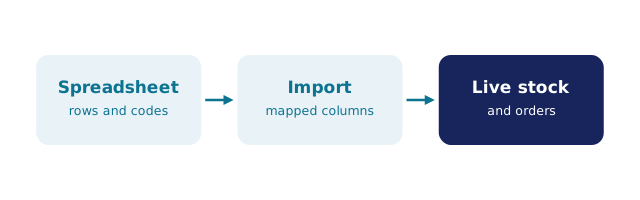
We build BSimple, so weigh that: it is built to work alongside Excel, not against it — your product list imports rather than being re-typed, and the movement ledger the spreadsheet was approximating becomes the system's native shape: every movement attached to its evidence, live quantities across locations, purchase orders raised from demand when reorder levels are touched, and the accounting handoff to Xero or MYOB ending the month-end re-entry. The PDF outputs you built by hand — pick lists, count sheets, reports — become views the system produces. Plans run $180/$250/$399 per month AUD with everything in the core plans.
The upgrade trigger is structural, not emotional: the second editor, the first oversell, or the count that surprised everyone. Until then, the spreadsheet is the correct price. The free-to-use ladder places Excel among the options, Excel-based inventory systems cover the template-and-macro approach, and the trial imports your sheet so the comparison runs on your own products.
Frequently Asked Questions
Is Excel good enough for inventory management?
For one person, honest updating, and modest volume — yes, genuinely. It stops being enough at concurrency (two editors), live deduction (orders draining stock), and the accounting handoff — three structural limits no formula fixes.
What is the best free Excel inventory template?
The one you build from two tables: products plus movements, with quantity as a formula over movements. Downloaded templates with quantities typed in place look finished and fail silently — the ledger structure is what makes a sheet trustworthy.
How does PDF fit into inventory management?
As output: pick lists, count sheets and reports printed from the sheet or system at a point in time. PDF never updates or reconciles — it is paper for the floor, not the record.
Can we import our Excel sheet into BSimple?
Yes — importing the product list is the designed start. Your movements ledger maps to how the system already works, so the record begins where the spreadsheet ends: the trial proves it on your own products.
When should we move off Excel?
At the second editor, the first oversell, or the month the re-entry into accounting costs more than the software would. Those are structural signals — the free-to-use ladder shows what each upgrade stage buys.

BSimple