
Guide / reading vendor sites
Judging a company management system by its website
The website is the first demo. Here is what a good one shows — real screens, real prices, stated boundaries — and how to read any vendor site, including ours, with that checklist.
The short answer
- A vendor website is a first demo, not a brochure — it should show screens, prices and boundaries, not just claims.
- Three things to look for anywhere: real product screenshots with honest captions, prices without a call-us wall, and boundaries stated plainly.
- BSimple's site aims at that standard: product captures of real screens, plan prices in the open, and the not-an-ERP boundary in writing.
- The trial remains the only verdict — the website's job is to earn it.
- The full picture: how the inventory record works is the hub page for everything above.
- 01The short answer
- 02What a good vendor website shows
- 03How BSimple presents itself — by that standard
What a good vendor website shows
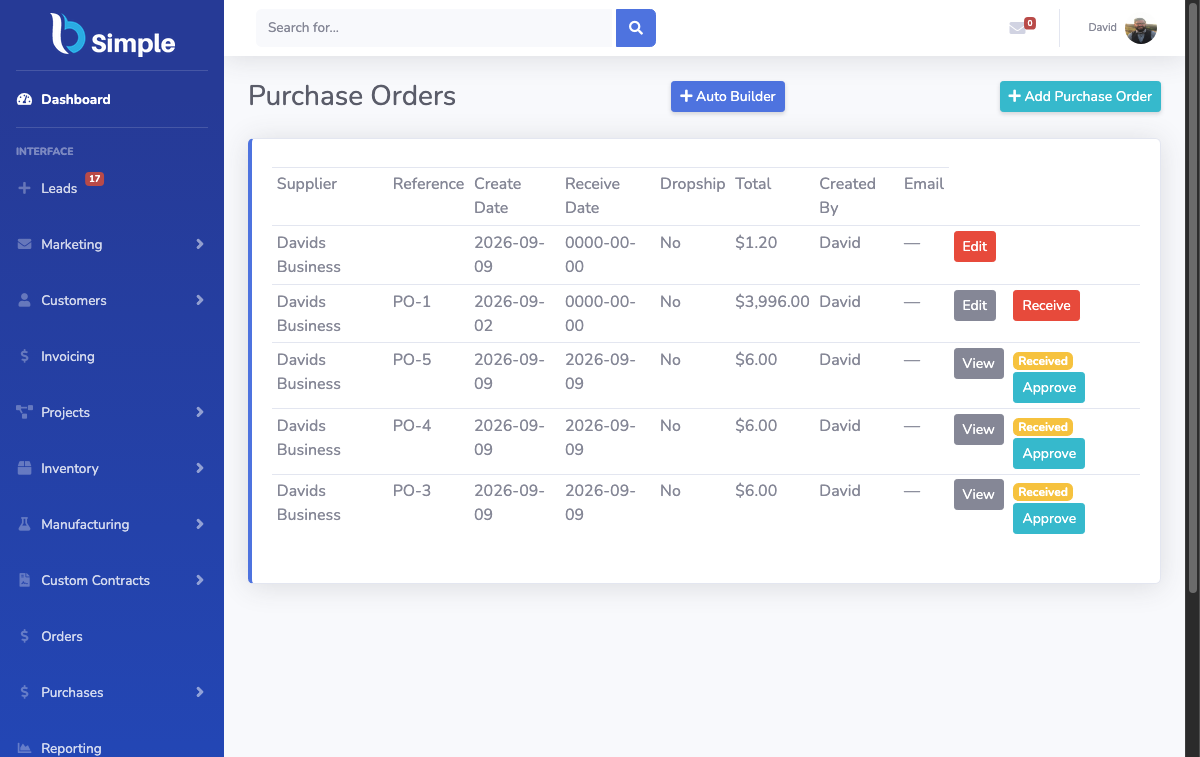
Real screens, honestly captioned. Genuine captures of the actual product — an inventory list, a reorder view, a stocktake — labelled as what they are. Stock photography of happy people in warehouses tells you nothing; screenshots tell you the interface exists and roughly how it thinks. Prices in the open. Plan prices, metered extras, and what happens as you grow. A pricing page that ends in "contact us" is a pricing page that expects you to negotiate blind. Boundaries in writing. What the product does not do — no HR, no payroll, no MRP, no offline — stated before the trial, because a vendor confident in its scope can afford the honesty.
The integrations, specified. "Works with Xero" is a claim; what pushes, what mirrors back and when is a specification — look for the detail, because the detail is the difference between integration and marketing. The vendor evaluation guide turns all of this into a trial process.
How BSimple presents itself — by that standard
We build BSimple, so weigh that with extra scepticism. The site shows real product captures with plain captions — the operations dashboard, the inventory list, the reorder view, a production run — because the screens are the argument. Pricing is published: plans from $180/month (AUD), SMS the only metered extra at $0.20 per segment. Boundaries are in writing on pages like this one: not an ERP, no HR or payroll, no MRP scheduling, not free, cloud-only. The Xero integration is specified — invoices push on approval, payment status mirrors back, purchase orders reconcile with GST handling — and the Xero page shows the detail.
Where a website always falls short: fit. Screens and prices narrow the field; only the trial on your own products decides it — the free trial is the real call to action, and the types guide helps you know which category you are shopping in before you get there.
Frequently Asked Questions
Can we judge software from its website alone?
You can judge transparency, not fit. The website should earn the trial — real screens, published prices, stated boundaries — and the trial should earn the decision. Sites that fail the first test (no screenshots, hidden prices, vague capability claims) have told you something already.
Does the BSimple website show real screenshots?
Yes — product captures with captions describing exactly what each screen shows: the dashboard, the inventory list, reorder views, stocktakes, batch tracing. No stock photography standing in for software, because the screens are what you are buying.
Why do vendors hide their prices?
Usually because pricing depends on negotiation — per-user counts, modules, discounts — or because the number scares off the wrong-fit buyer. Both are legitimate strategies that shift work onto you. Published pricing, like BSimple's from $180/month (AUD), lets you disqualify yourselves early, which is kinder than a demo designed for a budget you do not have.
What should the website answer before we trial?
Three things: what the product is (category and boundaries), what it costs (plans and metered extras), and how it hands off to your accounting system. Everything else — fit, workflow, feel — is what the trial is for.
BSimple