
Guide / IB Diploma
Business management tools in the IBDP
IBDP here means the International Baccalaureate Diploma Programme — not a software acronym, whatever other pages claim. Where Business Management sits in the diploma, the tools the course teaches, and how they connect to real operations.
The key facts
- The acronym, honestly: IBDP is the International Baccalaureate Diploma Programme — a two-year pre-university qualification. Any page expanding it into a software term is inventing.
- The course's place: Business Management sits among the diploma's individuals-and-societies subjects, studied at Standard or Higher Level.
- The toolkit: SWOT, Ansoff, STEEPLE, BCG, decision trees, fishbone, Gantt-style frames — applied to case studies and the internal assessment research project.
- The bridge: the course's operations and decision concepts run in real software daily; the operations side shows the running version.
- 01The key facts
- 02What the IBDP is, and where the course fits
- 03The tools, inside the diploma's structure
- 04From the diploma to the operations floor
What the IBDP is, and where the course fits
The International Baccalaureate Diploma Programme is a two-year, pre-university qualification built around six subject groups plus the diploma core (an extended essay, theory of knowledge, and creativity-activity-service). Business Management sits in the individuals-and-societies group as an applied social science: the study of how organisations make decisions under constraint, assessed at Standard or Higher Level.
Because the diploma is broad, business management competes for a student's hours — which shapes how its tools should be studied: not as a catalogue to memorise but as a compact set of frames to be fluent in. The course's designers clearly agree; the assessment consistently rewards application depth over frame count.
The tools, inside the diploma's structure
The analytical frames — SWOT, Ansoff, STEEPLE, BCG, decision trees, fishbone diagrams, Gantt-style planning — serve the course's through-line: structured decision-making. In the diploma context they appear in three places: the case-study papers, where a tool organises stimulus facts into an argued answer; the internal assessment, where a student's research project on a real (or realistic) business applies the toolkit to a genuine decision; and the connective tissue between syllabus units, where the same frames recur at larger scale.
The study advice that survives every syllabus revision: anchor tools in evidence, interpret rather than decorate, and end in a decision. The tools catalogue itemises the frames with usage notes, and the HL-depth page covers how expectations scale between levels. One caution for searchers: several pages on this topic invent software meanings for "IBDP" — the diploma-programme reading is the honest one.
From the diploma to the operations floor
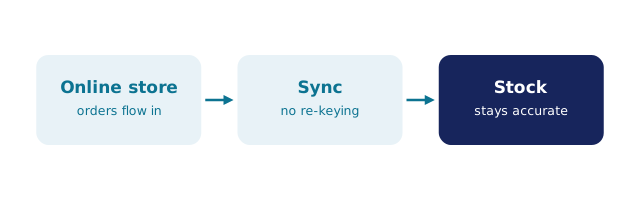
The course teaches operations concepts — stock control, capacity, scheduling, quality — on paper, because paper is where the structure becomes visible. In a running business the same concepts execute inside software: the reorder point is a standing decision rule, the production plan a living schedule, the quality investigation a fishbone with costs attached. For a student deciding between study and work, that continuity is the useful discovery — the toolkit does not expire at graduation; it changes format. A worked order example shows the operational version of the classroom material, and the course-versus-practice comparison maps the distance.
We build BSimple, so weigh that: it is operations software for wholesale, manufacturing, distribution and trade businesses — the systems layer where the course's ideas run for real, from $180/month AUD with a full-product trial. It is not study material, and this site is not affiliated with the IB organisation.
Frequently Asked Questions
What does IBDP stand for?
The International Baccalaureate Diploma Programme — the two-year pre-university qualification. Some pages expand it into software acronyms; that is invention, and this page will not join it.
Is Business Management hard in the IBDP?
It rewards application depth over memorisation, which suits some students and not others. The tools are learnable; the skill — anchoring them in evidence and finishing in a decision — takes practice against fresh case studies.
What tools do I need for the internal assessment?
Whichever frames genuinely fit the business decision you research — typically a small set used deeply, with their limitations acknowledged. The research project rewards real evidence over frame count.
Are the course's operations concepts used in real businesses?
Daily, inside software: reorder points, production schedules and quality investigations run as features in operations systems. The worked example shows one end to end.
Is this page affiliated with the IB?
No — BSimple is business management software, independent of the IB organisation. The course framing here is explanatory; for syllabus specifics, the official IB guides are the authority.

BSimple