
Product / features
BSimple features
One integrated record for the day-to-day operations of a wholesale, manufacturing, distribution or trade business — inventory, orders, purchasing and production. Here is what is in the box, and what is deliberately not.
The key facts
- One record, not a tool collection: inventory, orders, purchasing and production share a ledger — what the picker sees is what the portal promised and what the books receive.
- In the box: live multi-location stock, batches and traceability, purchasing with variance flags, customer ordering portals, recipes and production runs, projects, reporting, API and MCP access.
- Deliberately not: point-of-sale, payroll or HR, a native storefront, or tax filing — the boundaries are design, not omissions.
- Pricing: Starter $180, Professional $250, Organisation $399 AUD monthly, every feature in the core plans, full-product trial.
- 01The key facts
- 02Inventory and stock control
- 03Orders and customer portals
- 04Purchasing and production
- 05Reporting, integrations — and the boundaries
Inventory and stock control
The core of the product: live quantities across locations, multi-level units (boxes to sleeves to individual items), and a movement-based record with an audit trail — stock on hand is derived from history, never typed. Negative-inventory guardrails catch the impossible before it reaches a customer, reorder and par levels turn the record into a purchasing signal, stocktakes run as EOFY full counts or rolling cycle counts with variances investigated rather than painted over, and batch/lot tracking adds expiry dates and traceability search — from a finished batch back to its inputs, or from a suspect lot to everything it touched.
Orders and customer portals
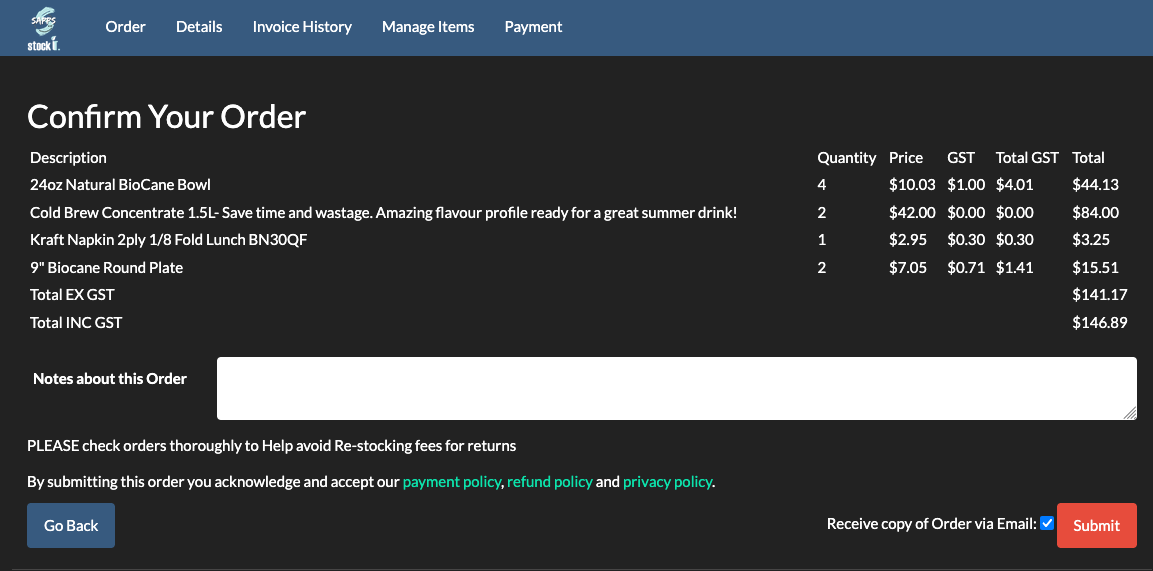
Orders live as stateful records — received, validated, allocated, picked, packed, invoiced, paid — on the same record the warehouse works from. Each customer gets a private ordering portal with their own product list and custom pricing via a unique link, order invitations go out by SMS or email, and pick-and-pack flows to delivery slips and an approval step where quantities commit and stock deducts. Finished invoices push to the accounting system — Xero and MYOB established, US integrations rolling out — with payment status mirroring back rather than being re-keyed.
Purchasing and production
Purchasing runs from demand: reorder levels raise purchase orders, goods receipts update stock on arrival, partial deliveries split without losing the thread, and supplier price variances are flagged at reconciliation instead of silently absorbed. The production layer is in the core plans, not a module: multi-level recipes with versioning, production runs with shortage checks, batches created with use-by dates, and mass-balance reporting used by existing customers for organic certification (ACO, NASAA, OFC). Projects group inventory and on-site assets under a customer for the job's lifetime — reserve without consuming, install and consume on invoice approval, warranty history after.
Reporting, integrations — and the boundaries
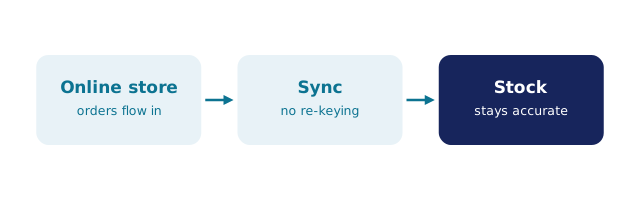
Reporting covers the operations dashboard (order, invoice and stock values), reporting views, and the mass-balance and traceability reports compliance demands. Integration is an open surface: Shopify order import by webhook, a public REST API with scoped keys (read projections for suppliers, locations, reorder levels, stocktakes, purchase orders and transfers), and an MCP endpoint so AI assistants can query the record — the automation overview maps the seams. Alongside Excel, not replacing it: import to start, export to analyse.
The boundaries are deliberate: no counter point-of-sale, no payroll or HR, no native storefront (Shopify syncs instead), and no tax filing — accounting compliance stays in the accounting system. The features page is the guided tour, the inventory pillar the deep dive, and the trial the full product on your own data.

Frequently Asked Questions
What features does BSimple include?
Inventory with live multi-location stock and batch traceability, orders with customer portals and pick-and-pack, purchasing with variance flags, recipes and production runs, projects, reporting, and API/MCP access — all in the core plans, from $180 AUD monthly.
Is there a separate manufacturing module?
No — recipes, production runs, batches and mass-balance reporting are part of the core product. The pricing page reflects that: no module paywalls between plans, only capacity.
Does BSimple replace my accounting software?
No, deliberately. Invoices push to Xero or MYOB (US integrations rolling out) with payment status mirroring back; the accounting system stays the system of record for compliance and tax. BSimple keeps the operational side accurate enough to hand over finished work.
Does BSimple have a point-of-sale for counters?
No — no till or walk-in scanning. Businesses with a counter run a POS in front and BSimple underneath as the stock and invoicing record; e-commerce arrives via Shopify order import rather than a built-in storefront.
How can I see the features with my own data?
The trial is the full product: import your product list, run a test order through picking to invoice, run a production, and connect the accounting handoff before any money changes hands.
BSimple