
Guide / free and assets
Free asset inventory software — the honest version of this page
What you can genuinely track for nothing (a spreadsheet gets far), what free tiers actually include, and the boundary stated plainly: BSimple is not free — it is a paid operations product with a trial.
The key facts
- For a small asset register, free really is enough: a spreadsheet with item, location, photo, purchase date and value covers the insurance and audit basics.
- Open-source asset trackers exist — free software, but you own the hosting and the maintenance.
- Freemium tiers are free until the asset register is the one thing you need — check what the paid wall actually gates before committing your data.
- BSimple is not free: $180/month AUD upward, no free tier, a full-product trial instead. Where asset tracking is the whole job, it may be the wrong tool.
- The wider system: inventory management end to end maps the whole record this page sits in.
- 01The key facts
- 02What asset tracking actually needs (less than you think)
- 03The genuinely free routes, and their price tags
- 04Where BSimple sits — and where it does not
What asset tracking actually needs (less than you think)
Assets differ from stock in one structural way: they do not flow. A laptop, a compressor or a delivery van is bought once, used for years, and eventually disposed of — so the register needs to answer where it is, who has it, what it cost and when it needs servicing. A spreadsheet does all of that honestly up to a few hundred assets, and photos plus a purchase-receipt column make it insurance-ready. The free answer is real, and pretending otherwise to sell software would be exactly the dishonesty this site tries to avoid.
The register outgrows the spreadsheet at the point custody starts changing hands constantly: equipment checked out to staff, tools moving between jobs, IT gear reassigned. Then you need check-out/check-out history — an audit trail of possession — and that is where purpose-built tools earn their keep.
The genuinely free routes, and their price tags
The spreadsheet. $0, fully in your control, no vendor risk. Its cost is discipline: the register is only right when someone updates it, and spreadsheets have no scan-in/scan-out to make that easy. For stable asset lists, that cost is small.
Open source. Free and open-source asset and inventory projects include capable asset trackers — the software is free and the data is yours, but the server, updates and backups are yours too. The IT-asset open-source angle covers the technology flavour specifically. Free software with paid sysadmin time is a trade, not a magic trick.
Freemium tiers. Genuinely useful starting points, designed to convert. The question to ask before loading your register: what does the paid wall gate — user count, asset count, or the check-out history you specifically came for? The broader free-inventory comparison applies the same honesty to stock-side tools.
Where BSimple sits — and where it does not
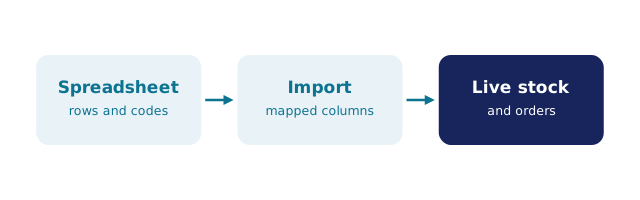
We build BSimple, so weigh that. It is not free and has no free tier: plans run $180/$250/$399 per month AUD with a free trial of the full product. Its centre of gravity is flowing stock for wholesale, manufacturing and distribution businesses — live quantities, purchasing, orders, batches, invoicing to Xero and MYOB. It can hold assets as non-depleting stock records with locations and a transaction history (that is how the asset-tracking angle works), and projects group on-site assets under a customer for lifetime management.
But if your whole requirement is a check-in/check-out asset register with no stock flowing, a free route above is probably the better match — a paid operations system is an expensive way to track fifty laptops. The enterprise-asset vendor angle covers the heavy end if the fleet is the business.
Frequently Asked Questions
Is there a truly free version of BSimple?
No — the trial is the full product but the software is a paid subscription from $180/month AUD. We will not dress a trial up as a free tier; this page exists partly to say that plainly.
Can a spreadsheet really manage our assets?
Up to a point, honestly: a few hundred stable assets with clear ownership, yes. When custody changes daily — tools out to jobs, laptops reassigned — the update discipline breaks, and a system with check-out history becomes the cheaper option in time alone.
What is the best free asset tracking software?
For most small registers: the spreadsheet. For server-owned control: an open-source asset tracker from the open-source comparison. "Best" depends on whether you would rather maintain discipline or a server.
Can BSimple track assets as well as stock?
Yes — assets as stock records that are not consumed, with locations and full transaction history, and projects grouping on-site assets under a customer. It is a secondary strength; the asset-management angle explains the mechanics.
Why do paid tools gate free tiers on exactly the useful features?
Because that is the conversion model — the free tier demonstrates value and the wall sits where your dependency forms. Nothing dishonest about it, but read the gate before importing your register, not after.
BSimple