
Guide / free, without the spin
Free and open source inventory management software
Free is a real category with real trade-offs, and open source is the serious end of it. Here is what genuinely exists, what self-hosting actually costs, where the free ladder stops — and our own position on it, plainly stated.
The key facts
- The free ladder has four rungs: spreadsheets, free tiers, open source you host, and paid systems — each for a different stage.
- Open source is real software: ERPNext, Odoo Community, Snipe-IT (assets) — the license is free; the operation is not.
- Where free stops: multi-user truth, live deduction at the moment of sale, accounting handoff, and anyone accountable when it breaks.
- BSimple's position: not free and not open source — $180/month AUD up, full-product trial, and no criticism of staying free longer than you need to.
- 01The key facts
- 02What genuinely exists at the free end
- 03The real cost of self-hosting
- 04BSimple's rung on the ladder
What genuinely exists at the free end
Spreadsheets remain the most successful inventory software ever shipped: free, flexible, and honest for one person with a handful of products. They fail at concurrency (two editors), truth (quantities corrected weekly, not at the moment of sale) and memory (no history beyond what someone remembers to note). Free tiers of paid products give a taste of real structure — usually capped by orders or stripped of the features that matter most at scale: multi-channel stock, pick lists, accounting export. Open source is the deep end of free: ERPNext and Odoo Community are full business suites you self-host; asset trackers like Snipe-IT are excellent at their specific job; smaller inventory projects vary widely. The license costs nothing; hosting, updates, backups and every integration are your hours.
The free-to-use ladder in full walks this choice stage by stage, and what the Reddit open-source discussion actually settles adds the practitioner view.
The real cost of self-hosting
Self-hosting converts licence fees into responsibilities, and the honest accounting looks like this: a named maintainer (who patches, upgrades and reads release notes), a host (a server with backups you have actually restored from), an integrator (accounting, scanners, your store — each a custom connection you own), and a roadmap (every feature you need that the project did not ship is your team's to build or do without). None of that is a reason to avoid open source; it is a reason to enter it deliberately. A business that self-hosts without naming the maintainer has not adopted software — it has adopted a future outage with a date it cannot see.
The pragmatic rule: open source fits when the job is close to what the project already does, someone on the team genuinely wants the ownership, and the volumes are low enough that a week of downtime would hurt pride more than the business. Outside those conditions, the paid rungs of the ladder are cheaper than they look.
BSimple's rung on the ladder
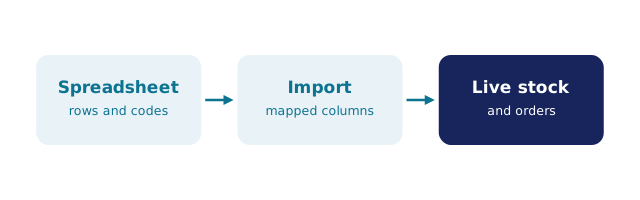
We build BSimple, so weigh that. It is neither free nor open source: plans run $180/$250/$399 per month AUD with every feature in the core plans — recipes, batches, mass balance, the customer portal — and the trial is the full product, because inventory software is only worth judging against your own stock. What the money buys over the free rungs is the whole job on one record: live quantities across locations, orders deducting stock the moment they are approved, purchase orders raised from demand, batch and expiry traceability, and the accounting handoff to Xero or MYOB with payment status mirroring back.
If you are early, stay free with our blessing — the spreadsheet phase is legitimate, and the upgrade trigger is the first oversell or re-key that costs real money, not a marketing deadline. Free inventory for laptops and desktops covers the budget end in detail, and the inventory management pillar shows what a complete paid record contains.
Frequently Asked Questions
Is open source inventory software really free?
The licence is free; the operation is not — hosting, updates, backups and integrations are your hours. For a capable hobbyist or a small team with IT skills it can still be the cheapest route; for everyone else the total cost usually surprises.
Which open-source inventory projects are worth a look?
ERPNext and Odoo Community as full business suites, Snipe-IT for IT assets, and smaller dedicated projects depending on the trade. Match the project to how close your job is to its default shape — customisation is where the hours multiply.
Does BSimple have a free plan or an open-source edition?
Neither, deliberately. Plans start at $180/month AUD, every feature included, with a full-product free trial. Our contribution to the free conversation is honesty about when free is enough — and it often is, for longer than vendors admit.
When should we move from free to paid?
At the second person editing the record, the first oversell, or the first month the accountant re-keys an export. Each is a real cost arriving on a schedule; together they quickly outgrow any licence saving.
Can we export from BSimple back to open source later?
Your data is yours, and the REST API provides read access to stock, orders and purchasing projections for exactly this kind of movement. No system is a one-way door; test the exit in the trial if it matters to you.

BSimple