
Guide / careers
Warehouse management software jobs
What the job titles mean, which skills the hiring actually tests — stock accuracy, cycle counting, order workflows, data discipline — and how to get hands-on with real inventory systems. No salary figures invented here, and no job board pretences.
The key facts
- The common roles: warehouse operator, inventory controller, warehouse supervisor, logistics coordinator, supply/operations analyst, and software-adjacent implementation and support roles.
- The skill hiring tests: stock accuracy discipline — cycle counts, variance investigation, receiving against POs — plus spreadsheets and at least one real system.
- The honest boundary: BSimple is not a jobs board and publishes no employment listings or salary data; this page explains the work, not the market.
- The fastest entry: operational fluency — the person who can run a count, chase a variance and keep the record true is the one promoted near the software.
- 01The key facts
- 02The roles, and what each actually does
- 03The skills that show up in every posting
- 04Getting hands-on without a job first
The roles, and what each actually does
Warehouse operator / storeperson. The floor end of software: receiving against purchase orders, picking from lists the system generates, recording what actually happened rather than what should have. Every upstream number in the software is only as good as this discipline.
Inventory controller. Owns the record: cycle counts, variance investigation, adjustments with reasons, obsolete stock identification. This is the role where "the system says" meets "the shelf says", and the controller is the referee.
Warehouse supervisor / manager. Runs the operation the software models: labour, space, throughput, and the process design that makes scanning and picking actually work. Uses the system's data to find bottlenecks rather than opinions.
Logistics / supply chain coordinator. The outbound and procurement side: supplier lead times, purchase orders raised from demand, backorders, and the communication between warehouse and customers.
Analyst and implementation roles. Reporting, dashboards, and — on the vendor side — implementing and supporting the software itself. These roles reward people who have done the floor work and can tell a data artefact from a real stock problem.
The skills that show up in every posting
Under the title words, the same competencies recur. Stock accuracy discipline — the habit of counting regularly, investigating variances to a cause, and never "fixing" a number without a reason code. Receiving and purchasing literacy — POs, goods receipt, supplier invoice matching. Order workflow fluency — pick, pack, dispatch status, and what an audit trail is for. Spreadsheet competence — filtering, pivoting and reconciling, because the warehouse-adjacent world still runs on exports. And one real system, whatever the brand: the concepts transfer, and employers know it.
None of these require a degree; all of them require access to a real record. The list of warehouse software shows the vendor landscape, and the software-adjacent sales-and-support roles are a separate path worth reading if you prefer the vendor side.
Getting hands-on without a job first
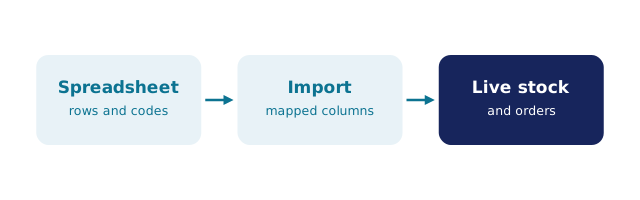
The concepts behind warehouse software — movements, derived stock, reorder levels, count corrections — can be learned directly. The inventory management pillar explains the record that every system keeps, and trials exist precisely so a candidate can walk a real order flow: BSimple's free trial is the full product, so receiving a PO, picking an order, running a count and chasing a variance can all be practised on real data before any interview. Interviewers consistently rate demonstrated system fluency over vague familiarity — being able to narrate why a stock variance happened is worth more than a list of logos.
What this page will not do is quote salaries or job-market statistics: those change by region and year, and invented numbers help nobody. The broader small-business software landscape is the other half of the picture — understanding why businesses buy these systems is what makes a candidate good at running them.
Frequently Asked Questions
What jobs involve warehouse management software?
Operator, inventory controller, supervisor, logistics coordinator, analyst, and vendor-side implementation or support roles. The software is the connective tissue: every role either feeds the record, trusts it, or is hired to make it true.
Do I need a qualification for these roles?
Formal qualifications matter less than demonstrated discipline with stock and systems: accurate counts, clean receiving, variance chasing. Experience with any real system plus strong spreadsheets is the combination most postings actually describe.
Which skills matter most for inventory control jobs?
Cycle counting and variance investigation to root cause — not just adjustment. An inventory controller who can explain why the count was wrong is protecting the business's money; one who only types corrections is painting over it.
How can I get experience with inventory software?
Use a trial on real-world scenarios: receive a purchase order, pick and dispatch an order, run a stocktake, investigate the discrepancy you planted. The full-product trial lets you rehearse exactly the workflow the job will test.
Does BSimple hire for these roles?
BSimple publishes product information, not employment listings, and this page is a career guide rather than a job board — check current openings with any company directly rather than taking this page as a listing.

BSimple