
Guide / warehouse software
Which warehouse software belongs on your list?
Warehouse software comes in four categories, from full WMS platforms to spreadsheets. Here is what each one is for, the jobs it must do, and how to cut a long list to a shortlist.
The facts about warehouse software
- Warehouse software has one job: keep the stock record true while goods move — receiving, picking, packing, dispatch and counting.
- The category splits four ways: standalone warehouse management systems (WMS), SMB inventory-and-operations systems, ERP suites, and spreadsheets.
- A full WMS adds slotting, wave picking and labour planning — depth most small warehouses do not need yet.
- The integration that matters most is accounting. Invoices should reach Xero or MYOB without re-entry.
- BSimple sits in the SMB category: multi-location stock, pick/pack, purchase orders and stocktakes on one record — not a full WMS.
- Plans start at $180/month (AUD) with a free trial.
- 01The facts about warehouse software
- 02The four categories on any honest list
- 03The jobs warehouse software actually has to do
- 04How to cut the list to a shortlist
- 05Where BSimple fits — and where it does not
The four categories on any honest list
Standalone WMS platforms. Built for large, complex warehouses: directed put-away, wave picking, labour management, dock scheduling. Powerful — and heavy. If you run a distribution centre, this is your lane; if you run a stockroom with a forklift and a packing bench, you are paying for depth you will not use.
SMB inventory-and-operations systems. The category BSimple sits in: inventory, orders, purchasing and invoicing on one record, with warehouse work — receiving, picking, packing, counting — handled against that record. Typically the right size for wholesalers, manufacturers, distributors and trade businesses.
ERP suites. Warehousing bundled into a whole-business system, with the cost and administrators that implies. The right answer when warehousing is one part of a much bigger transformation.
Spreadsheets and paper. How almost everyone starts. Fine for one person and a few hundred lines; the failure arrives with a second person and a second location.
The jobs warehouse software actually has to do
Strip away the marketing and the job list is short:
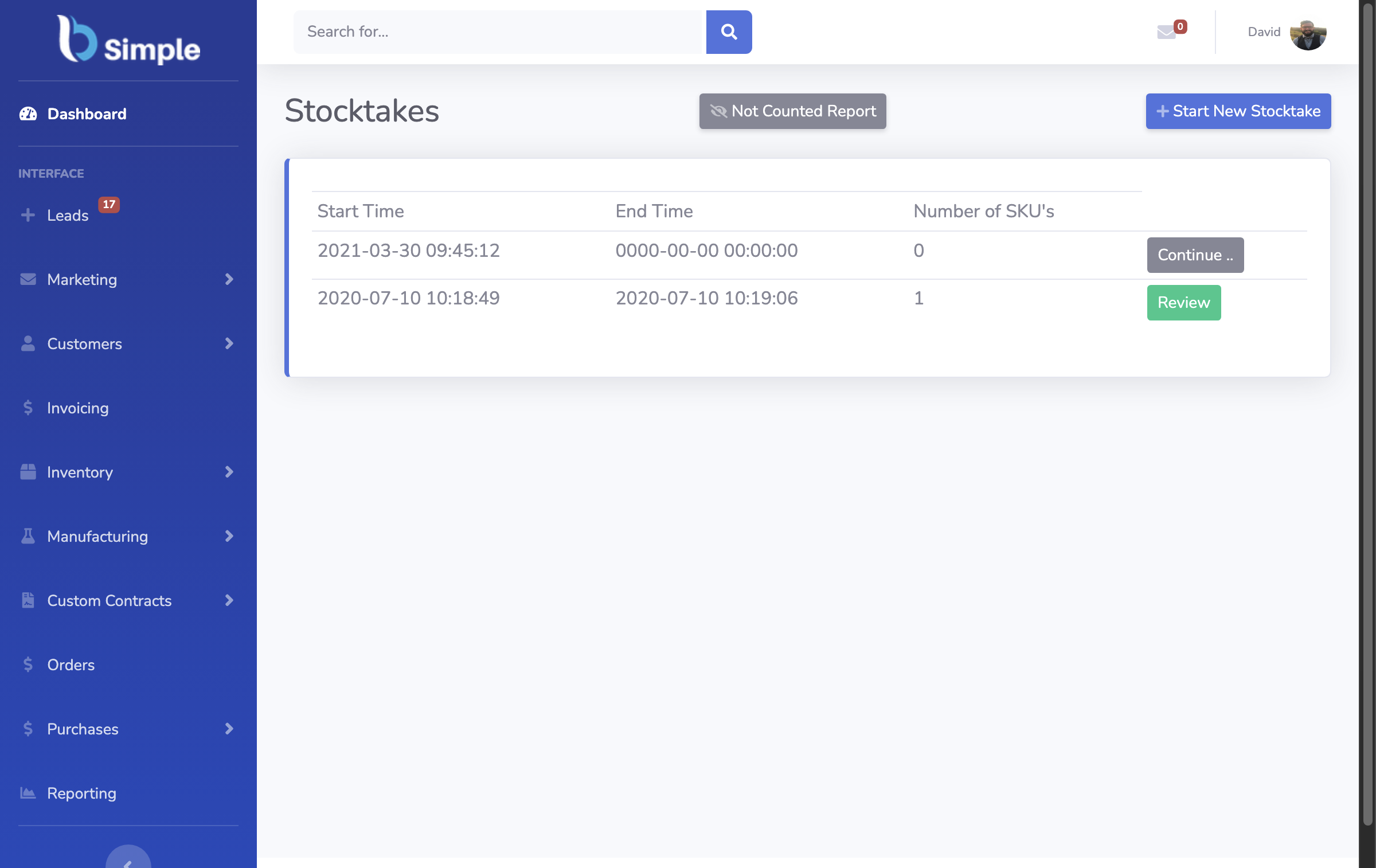
- Receiving. Goods arrive against a purchase order and the stock record updates the moment they are counted in — BSimple raises purchase orders from demand and goods receipts update stock.
- Put-away and locations. Knowing not just that you have 40 units, but which shelf or site they sit on. Multi-location stock is the entry price here.
- Picking and packing. The order turns into a pick list and a packing slip without anyone re-typing it.
- Counting. Cycle counts and EOFY stocktakes that do not shut the business down — BSimple supports both, plus batch/lot tracking with expiry where traceability matters.
- Selling from the same record. Overselling happens when the channel taking the order cannot see the stock. This is why barcode-driven inventory and a shared record beat a clipboard every time.
If a product on your list cannot do all five against one live record, the list has a gap.
How to cut the list to a shortlist
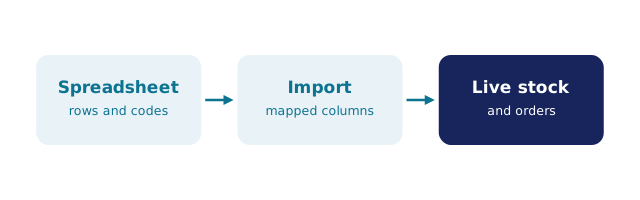
Three questions remove most candidates politely. First: does it hand off to your accountant, or does someone re-key invoices into Xero or MYOB at month end? Second: is the stock record live — updated at the moment of sale and receipt — or corrected after the fact? Third: does the warehouse team work from the same record the salesperson did, or does the order travel by email?
We compare the SMB options in more detail in the warehouse software guide for small business, and the stock management list covers the narrower inventory-only tools. If your warehouse exists to feed an online store, the eBay inventory guide shows how channel syncing changes the requirements.
Where BSimple fits — and where it does not
We build BSimple, so weigh that. It covers the warehouse jobs above — receiving against purchase orders, multi-location stock, pick/pack with packing slips, stocktakes and batch tracking — inside the same system that handles orders, invoicing and a customer ordering portal, with accounting handed to Xero or MYOB. For wholesale, manufacturing, distribution and trade businesses, that is usually the whole job. The inventory management page shows how the pieces connect.
Be honest about the boundary: BSimple is not a full WMS. There is no directed slotting, wave picking or labour management. If your operation is a distribution centre measured on lines picked per hour, a dedicated WMS will serve you better. If it is a growing warehouse that needs the stock record to be true and the paperwork to stop being retyped, start the free trial and put your own products through a receiving-and-picking cycle.

Frequently Asked Questions
What is warehouse management software?
Software that keeps the stock record true while goods move through the building: receiving against purchase orders, put-away to locations, picking and packing against orders, dispatch, and counting. Good systems do all of it against one live record that sales and accounting also see.
Is warehouse software the same as inventory software?
They overlap. Inventory software keeps the record of what you own and what it is worth; warehouse software manages the physical movement of that stock. SMB systems like BSimple combine both — the warehouse works against the same record the invoices do — while large operations often run a dedicated WMS alongside a separate business system.
Does BSimple do warehouse management?
The core jobs, yes: multi-location stock, receiving via goods receipts that update stock, pick/pack with packing slips, stocktakes, and batch tracking with expiry. It is not a full WMS — no directed slotting or labour management — so very large distribution operations will want a dedicated WMS instead.
How much does warehouse software cost?
Standalone WMS platforms are usually quoted enterprise-style after a sales process. SMB systems publish prices: BSimple plans start at $180/month (AUD) with all warehouse and inventory features included — no separate module fee — and a free trial to test the fit with your own products.
BSimple