
Guide / spreadsheet route
Stock inventory management system in Excel
Excel can run an honest stock system — if it is built as a movement log with derived quantities rather than an editable list of totals. The design that works, the formulas that matter, and the four walls you will hit as the business grows.
The key facts
- The one design rule: log every stock change as a row in a movements table and derive on-hand quantities with SUMIFS — never type a stock total by hand.
- The minimum build: Products, Movements, and (optionally) ReorderLevels sheets, one formula for stock on hand, conditional formatting for low stock.
- The four walls: multiple simultaneous users, no audit trail without discipline, manual stocktake reconciliation, and no accounting handoff.
- The honest exit: BSimple works alongside Excel — import your product list — and keeps the record live once the spreadsheet stage breaks.
- The full picture: how the inventory record works is the hub page for everything above.
- 01The key facts
- 02The build that stays accurate
- 03What the spreadsheet does well, honestly
- 04The four walls, in the order you will hit them
- 05Stepping up without losing the work
The build that stays accurate
Sheet 1 — Products. One row per SKU: code, description, unit, cost. Resist extra columns; the movements carry the history.
Sheet 2 — Movements. One row per stock event: date, product code, location, signed quantity (positive in, negative out), reference and reason. Purchases, sales, adjustments, wastage — all the same shape. This table is the system; treat it as append-only.
The derived column. Stock on hand lives in a SUMIFS over the movements, never in a typed cell: =SUMIFS(Movements!D:D, Movements!B:B, A2) where A2 is the code and D the signed quantity. The moment someone edits a derived number to "fix" it, the system has become a diary.
Low-stock formatting. A ReorderLevels sheet joined by lookup, and conditional formatting to highlight derived stock beneath the floor. That is the whole control system — the free-in-Excel template route and the stocktake patterns extend it.
What the spreadsheet does well, honestly
For one location, one careful person, and a weekly habit of reconciliation, the movement-based sheet is a genuine system: transparent, adaptable in seconds, and free. It teaches the discipline that later software enforces — because the owner can see the movements, drift gets noticed, and the derived figure earns trust. Businesses that skip this stage usually also skip learning why their numbers went wrong; the spreadsheet at least makes the mistake visible in a filterable row.
The failure arrives with the second person. Two editors in one workbook means file locks, overwritten rows and versions named "final_v3" — and no amount of formula skill fixes a concurrency problem.
The four walls, in the order you will hit them
Concurrency — a second editor breaks the single-file model; the fixes (shared workbooks, online sheets) reintroduce it as slow, fragile or conflict-prone.
Audit — Excel rows can be edited silently; tracking changes is optional and trivially defeated. A business that needs to explain a stock figure to an auditor, an insurer or a tax office needs a record that cannot be quietly rewritten.
The count — stocktakes mean exporting, counting, and hand-reconciling discrepancies back into movements, every time. What a real inventory system does with that same event is record it as a correction with a reason.
The handoff — invoices and costs still get re-keyed into accounting, because a spreadsheet is not a system the accounting platform can talk to. That re-keying is the monthly tax of the free route; the worked comparison totals it honestly.
Stepping up without losing the work
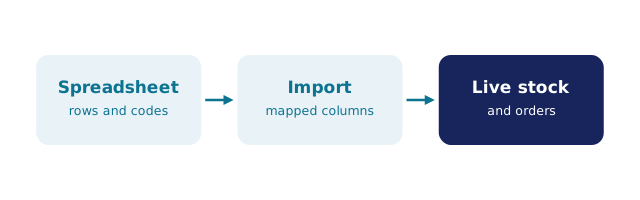
The movement sheet is a specification, not a dead end: the product list imports directly, the movement history explains how the business actually works, and the reorder levels become configuration. BSimple imports from Excel and keeps the model — products, locations, movements, derived stock — as a live multi-user record with purchasing, customer ordering portals and invoices handed to the accounting system. The trial runs alongside your sheet long enough to verify the counts agree before anything is switched off.

Frequently Asked Questions
Can Excel really handle stock inventory management?
Yes, within limits: one location, one or two careful users, and movement-based design rather than typed totals. It fails at concurrency, audit trails and accounting handoff — the walls arrive with growth, not with sheet size.
What formulas do I need for a stock system in Excel?
One SUMIFS per product to derive stock on hand from the movements table, a lookup to join reorder levels, and conditional formatting for low stock. Everything else is optional; a pile of complicated formulas is usually a sign the movements table is being designed by committee.
How do I track stock in and out in Excel?
One movements sheet with a signed quantity per row: positive for receipts and returns, negative for sales, wastage and adjustments — each with date, product code and reason. Never edit old rows; corrections are new rows.
When should a business move from Excel to inventory software?
When a second person needs to edit at the same time, when audit history matters, or when re-keying into accounting costs more than software would. Those are the moments the spreadsheet stops being free — the trial route tests the alternative with the same data.
Is a template better than building my own sheet?
Templates save an evening and cost a week when their hidden structure does not match how the business moves stock. The movement design above is small enough to build honestly in an hour, and you will understand every formula in it.
BSimple