Guide / honest comparison
Sortly alternatives: an asset tracker is not a sales system
Sortly tracks what you own with photos and QR labels. If what you have is stock you sell — wholesale orders, invoices, reordering — that is a different job, and this page draws the line honestly.
The short answer
- Sortly fits tool rooms, job sites and equipment loans. It is a photo-first asset and supplies tracker: items in folders, QR labels, check-in and check-out. It does not run sales orders, and it does not claim to.
- If you sell the stock, Sortly is the wrong tool — not because it is bad at its job, but because quotes, partial shipments, backorders and invoicing are outside its scope by design.
- The practical gaps for Australians: pricing is in US dollars only (free to 100 items, then US$49–299 a month), there is no Xero integration advertised, and there is no Australian presence — US company, USD billing, no local support.
- If your stock is stock you sell, BSimple covers it — wholesale orders through a customer portal, pick and pack, invoices to Xero or MYOB, stocktakes with variance review — from A$180/month (AUD, ex-GST).
- The comparison in one line: an asset tracker answers where things are; inventory software answers what you can sell, to whom, and what it did to your books. The inventory management guide covers the second job.
- 01The short answer
- 02What Sortly does well
- 03When Sortly is the right choice
- 04Where BSimple fits — and where it does not
- 05Compare further
What Sortly does well
Fair credit first, because Sortly is good at what it set out to do. Item records are built around photos, which makes an inventory legible to people who have never read a SKU in their lives. QR and barcode labels print from the app, phone cameras do the scanning, and check-in/check-out puts a name against every loaned tool or borrowed kit. Custom fields and low-code folders handle inventories that do not look like a warehouse — a school stockroom, a builder's trailer, a clinic's equipment cupboard.
Adoption is the real strength: a crew can learn it in an afternoon, the free plan covers 100 items for 1 user, and the paid floor is low. Reviewers agree the ceiling arrives — slow loading on larger inventories and a lack of inventory-engine features such as unit-of-measure and physical count modules are the documented complaints — but for its intended scale, it works.
When Sortly is the right choice
- You are tracking assets, not trading stock. Tools across job sites, equipment shared between crews, supplies that get used rather than sold — Sortly's model fits that better than any order-management system, including ours.
- Field crews need to update from phones. The mobile app is the product, and it is built for exactly that.
- The budget is near zero and the catalogue is small. Free to 100 items; a few hundred items sit comfortably in the low tiers.
- Nothing needs to reach an accounting system. If no invoice ever depends on the record, Sortly is genuinely fine — and BSimple is not the answer for you, which we would rather say plainly than talk you out of.
Where BSimple fits — and where it does not
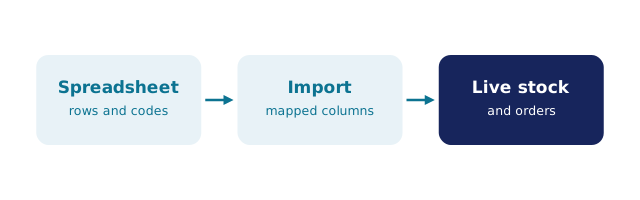
We build BSimple, so weigh that. The line between us is the word sell. BSimple is for stock that moves through orders: customers order through a portal — each wholesale account gets a unique no-password link with its own pricing and history — orders move through pick and pack, quantities update on the same record, and the approved invoice pushes to Xero or MYOB with payment status mirroring back. Stocktakes run from any phone browser with variance review before adjusting, par levels drive purchasing, and batch traceability with use-by dates covers food and beverage compliance.
Where BSimple is not the answer: a pure asset register. If nothing you track is ever sold, quoted or invoiced — the utes, the laptops, the demo kit — Sortly does the job for less, and its photo model suits it. The honest test is whether an order or an invoice ever touches the record. If yes, the stocktake and counting workflow and the ordering loop above are the territory; if no, save your money. The free trial settles it on your own data in an afternoon.
Frequently Asked Questions
Does Sortly integrate with Xero?
No Xero integration is advertised. The accounting integration in Sortly is QuickBooks Online, and it sits at the Premium tier — US$299 a month at list price. For an Australian business running Xero, that gap is usually the deciding fact: the stock record stays disconnected from the ledger, and invoices get keyed twice.
What does Sortly cost in Australian dollars?
Sortly bills in US dollars only. List prices are US$49 (Advanced), US$149 (Ultra) and US$299 (Premium) a month — roughly A$76 to A$464 at recent exchange rates — with first-year discounts that later revert, a structure reviewers have criticised. The free plan covers 100 items and 1 user. There is no AUD price list, no Australian entity and no local support; expect US-dollar billing either way.
Is BSimple a Sortly alternative?
For stock you sell — wholesale orders, a customer ordering portal, Xero or MYOB invoicing, stocktakes with variance review, batch traceability — yes, and from A$180 a month (AUD, ex-GST). For tracking assets that never sell, no: Sortly is the better-shaped tool, costs less, and would be our honest recommendation for that job.
Can Sortly manage stock I sell?
It can list items and quantities, but the selling side is out of scope: quotes, order confirmations, partial shipments, backorders and invoicing are not workflows it runs. Listing what you own and selling what you list look similar on a screen and behave differently in a business — the second one needs orders, pricing and an accounting handoff on the same record.

Compare further
If the budget is the constraint rather than the shape of the job, Zoho Inventory alternatives covers the low-cost end of real inventory software. For the full picture of the record stock deserves, start at inventory management and the stocktake workflow.
BSimple