
Guide / restaurants, honestly
Restaurant order management software, free: the boundary
Restaurant orders live in POS and kitchen-display systems — a different species from stock orders. Here is the honest split, the free ladder, and the supplier loop BSimple does run.
The key facts
- The boundary first: table orders, kitchen displays and bill printing are POS/KDS territory — BSimple does not claim them.
- Where restaurants have real order management: supplier purchase orders, wholesale accounts if you cater or supply, and the stock those orders feed.
- The free ladder: spreadsheet stock lists, capped POS free tiers, trials — the free pattern is universal.
- BSimple: the stock and supplier order layer, from $180/month (AUD), free to trial.
- The wider flow: how order management works maps the full path this page is part of.
- 01The key facts
- 02The boundary, stated plainly
- 03The supplier loop, and what free covers
- 04Where BSimple fits
The boundary, stated plainly
A restaurant's orders are mostly covers: table service, takeaway, delivery apps — fired to a kitchen display, closed out at the register. That world belongs to POS and kitchen-display software, and BSimple does not claim it: no table maps, no bill printing, no delivery-app integrations. Pages that promise free restaurant order management are usually describing free POS tiers, and the caps there land on transactions, terminals and integrations.
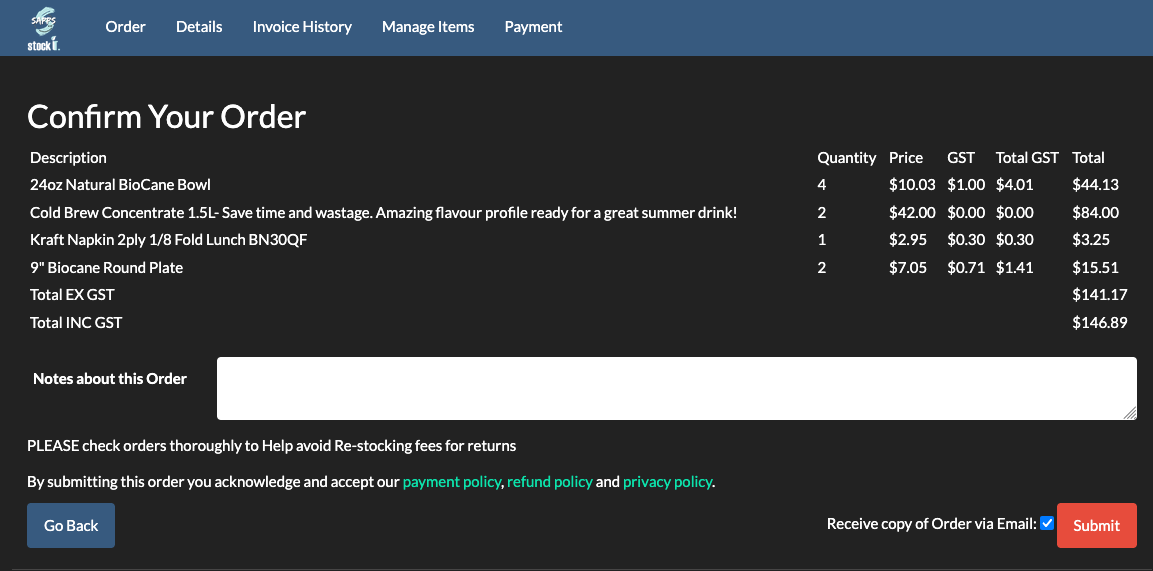
What restaurants do run as order management is the other order: supplier orders. Stock that feeds the kitchen is purchased on purchase orders raised from par levels, received against invoices, and counted in cycle counts that do not close the kitchen. That is the loop a stock record runs, and it is the one that decides food cost.
The supplier loop, and what free covers
- Par levels per store — dry store, walk-in, bar — with the gap-to-par becoming a purchase order.
- Expiry on F&B — batches dated at receipt, expiry order visible before use, waste recorded with reasons.
- Counts that do not close the kitchen — rolling counts from a phone browser, variances on an audit trail.
- The accounting handoff — approved invoices to Xero or MYOB; food cost lands where the bookkeeper works.
Free covers the spreadsheet version of the stock list — honest while one chef owns it. Free POS tiers cover the counter thinly. The traced, purchasing-connected record is the paid layer everywhere. The restaurant inventory view covers the stock side in depth, and the hospitality overview places restaurants among the venue types.
Where BSimple fits
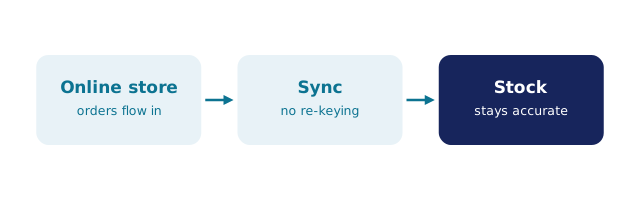
We build BSimple, so weigh that. For the kitchen's supply chain — par levels, supplier purchase orders, expiry-traced F&B, counts from any phone browser, invoicing to Xero or MYOB — BSimple runs the record, from $180/month (AUD), everything in the core plans. It does not run the floor: tables, tickets and KDS stay with your POS, and the two do not need to touch. For businesses that supply restaurants — wholesale food, beverage, equipment — BSimple is squarely the right shape: orders, portal and traced batches for B2B trade. The order-tracking view covers that wholesale side.
The honest test: trial one store — set pars, receive a delivery with expiry, raise the gap as a purchase order. If the kitchen's supply loop reads clean, the record fits; the POS question was never ours to answer.
Frequently Asked Questions
Is there free restaurant order management software?
Free POS tiers exist and cover table orders thinly, with caps on terminals and transactions. The supplier order loop — purchase orders from par levels, expiry, counts — is the paid layer; the spreadsheet is the only genuine free rung there.
Does BSimple replace our restaurant POS?
No. Tables, tickets, payments and kitchen displays are POS/KDS territory and we do not claim them. BSimple manages the stock and supplier order layer behind the kitchen, from $180/month (AUD).
Can BSimple track food expiry and waste?
Yes — F&B received with batch dates, expiry order visible before use, and write-offs recorded with reasons on the audit trail. Food cost stops being a month-end surprise.
We supply restaurants — is BSimple right for us?
That is squarely the fit: wholesale orders through customer portals, traced batches, purchasing and invoicing with the accounting handoff. The trial runs one real order end to end.

BSimple