
Guide / the parts room
Free parts inventory software, honestly assessed
A parts room is identity-heavy: thousands of similar items distinguished only by numbers. Here is what free covers, what the record needs, and the honest boundary on supersessions.
The short answer
- Parts rooms fail by identity: two similar items, one part number wrong, and the count lies confidently.
- The requirements: barcode codes on shelf and part, fast-versus-slow visibility, supplier purchasing that keeps up.
- Free: the spreadsheet phase, honestly; the joined record — scanning, purchasing, counter sales — is the paid product.
- The boundary: no automatic supersession engine in BSimple — stated before the trial, not after.
- 01The short answer
- 02What a parts room demands from the record
- 03Where BSimple fits
What a parts room demands from the record
Identity: every part carries its number in the record and on the shelf, and scanning beats reading at this scale — a mis-keyed digit is a confident lie a scan cannot tell. Movement ranking: fast movers live at the counter, slow movers tie up cash on shelves, and the split should come from reporting views over the record rather than from memory. Purchasing discipline: reorder levels against supplier lead times, because a stockout on a common part sends the customer to whoever answers the phone first. Counter and trade in one record: walk-in sales at shelf pricing and account customers at their own pricing cannot be allowed to oversell each other.
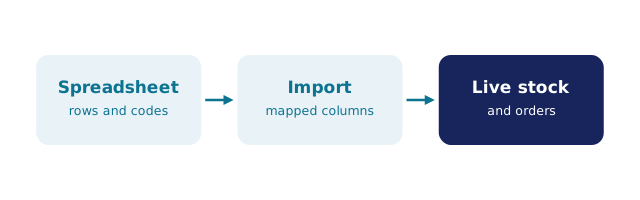
The free version is the spreadsheet phase — workable while one person knows the room. It fails at identity scale: the fitment question, the supersession, the count that cannot keep up with the shelves. The auto-parts guide covers the automotive-specific version, and the free stock audit prices the crossover.
Where BSimple fits
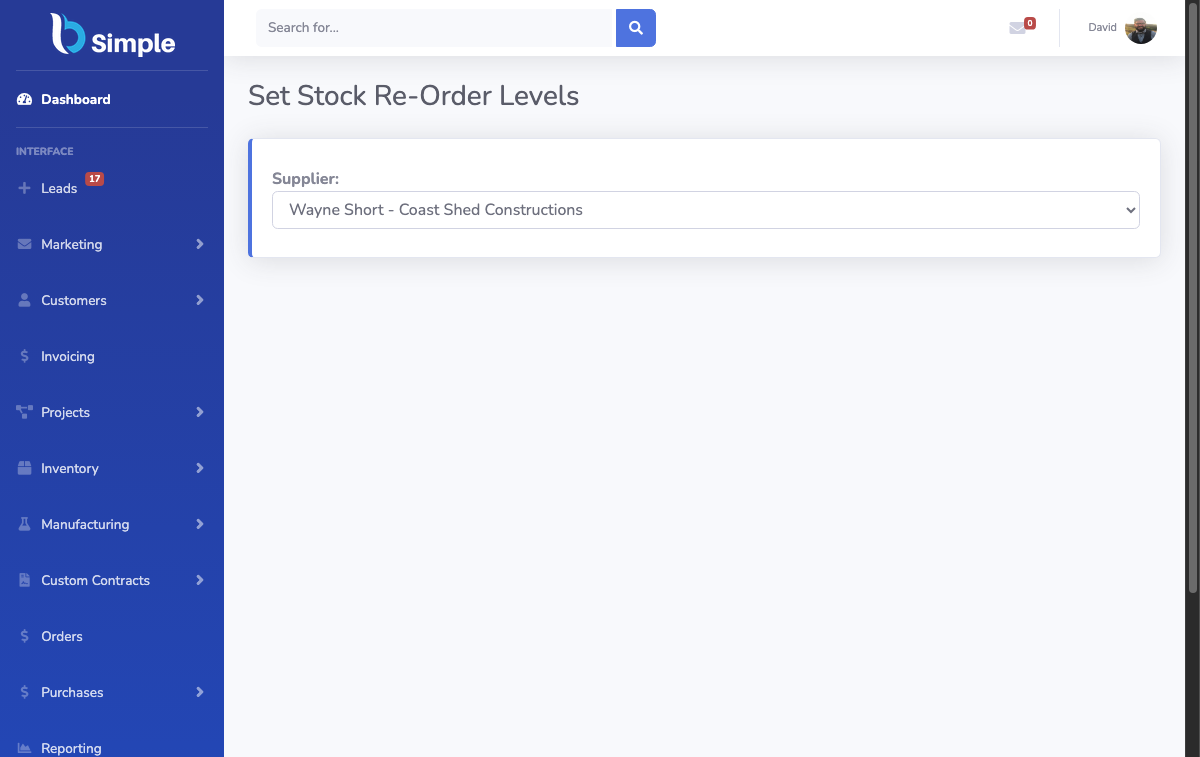
We build BSimple, so weigh that — and the boundary first: no fitment catalogues and no supersession engine. What the record does well for parts businesses: live multi-location stock with multi-level units (cartons versus eaches), scanning from any phone browser or desk wedge, reorder and par levels driving purchase orders from demand, negative-stock guardrails, a customer ordering portal giving trade accounts their own pricing through a unique link, and invoicing handed to Xero or MYOB. Plans start at $180/month (AUD), and the free trial loads a slice of the real room — one fast mover, one slow, one problem shelf.
If catalogue integration or fitment lookup is the make-or-break, start with a specialist — honestly. If the bleeding is stock truth, purchasing discipline and the counter-versus-trade mix, the inventory management overview shows how one record holds all three.
Frequently Asked Questions
Is there a free parts inventory system?
The spreadsheet, genuinely — while one person knows the room. Software with scanning, live quantities, purchasing signals and a trade portal is paid across the market; free versions are trials or capped tiers, and the cap tends to arrive with the catalogue.
Does BSimple handle part supersessions?
Superseded numbers can be recorded so staff find the successor — via tags, notes or the product record — but there is no automatic old-to-new mapping engine. If that automation is critical, that is a specialist conversation; testing it honestly beats discovering it later.
How do we handle parts with no barcode?
Label the shelf first — the bin location is where the count and the pick happen, and a location code upgrades every movement on that bin. Internal part labels can follow progressively, starting with the fast movers where the scanning payback is fastest.
What should we trial with a parts catalogue?
A meaningful slice, not the whole room: receive one delivery, count one problem shelf, sell at the counter and through a portal order. If the record stays clean through that sequence, it will hold the rest of the room — start here.

BSimple