
Guide / manufacturing
Business management software for manufacturers — without the ERP weight
A manufacturer needs the record to survive production: recipes that version, runs that check shortages, batches that trace to the sale. What BSimple runs — and where MRP territory begins.
The key facts
- The manufacturing core: multi-level bills of materials, recipe versioning, production runs with shortage checks, batch creation with use-by dates, traceability supplier-to-customer.
- The accounting boundary: invoices push to Xero and MYOB (US integrations rolling out); the plant runs on the operational record, the books stay with the accountant.
- Stated plainly: BSimple has no MRP scheduling, no shop-floor machine integration, no HR — deliberately lighter than an ERP.
- Core plans include production: recipes, batches and mass-balance reporting carry no module fee.
- Where it fits: the production layer's hub is manufacturing inventory software.
- 01The key facts
- 02What "business management" must mean for a factory
- 03What BSimple runs — and where it stops
- 04Testing any system against your factory
What "business management" must mean for a factory
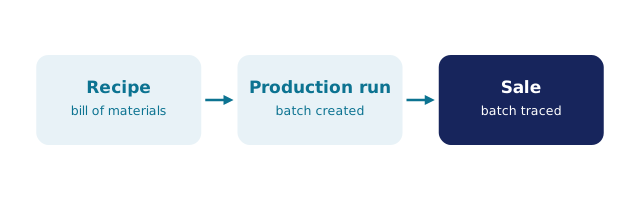
For a manufacturer, the business record is a chain of custody for transformation: raw material in, recipe applied, finished batch out, batch sold — and every link answerable months later. Software that only tracks purchasing and sales leaves the middle (the actual making) to a whiteboard, which is where the record loses the thread: which lot fed which batch, which batch went to which customer, what the yield really was.
So the non-negotiables are specific: multi-level BOMs (a recipe made of sub-recipes), versioning (the recipe that produced batch 214 is the one that was current that day), shortage checks before the run rather than mid-shift surprises, batches with use-by dates for goods with shelf life, and traceability — batch search from supplier to customer that satisfies a customer query or an auditor in minutes, not a week of spreadsheet archaeology.
What BSimple runs — and where it stops
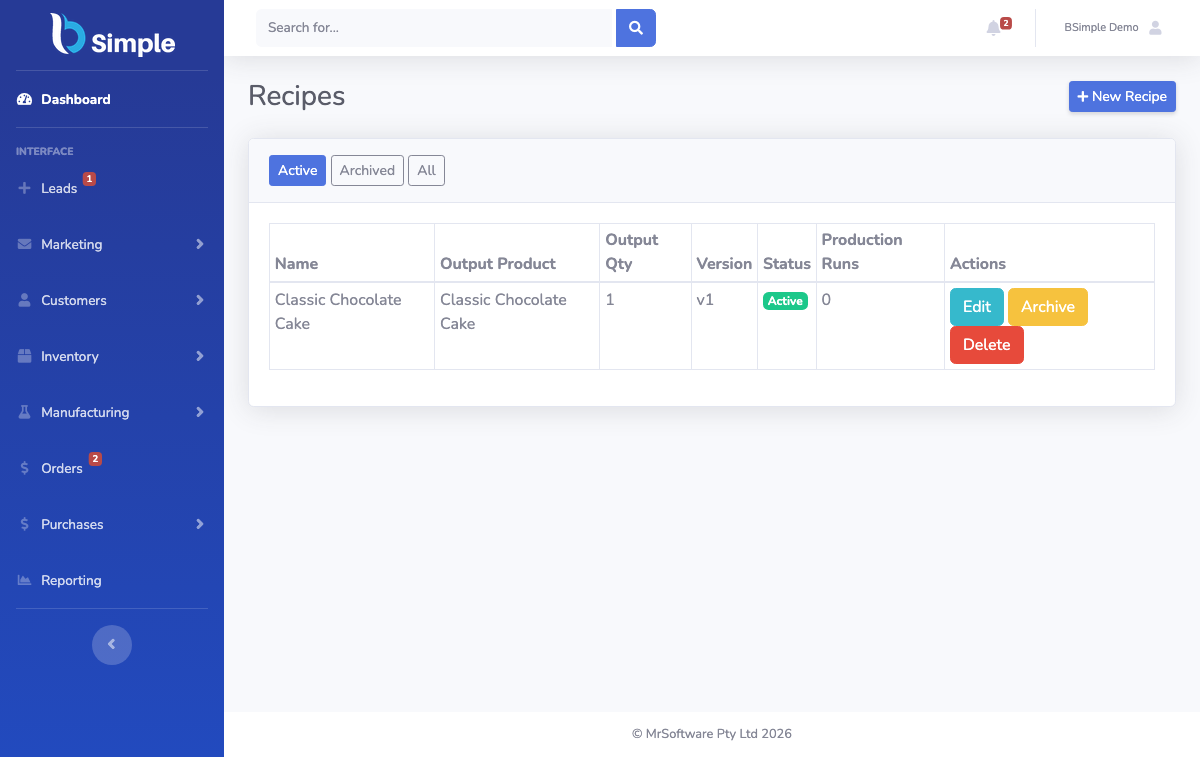
We build BSimple, so weigh that. The production core above is built in: recipes with versioning, production runs against live stock with shortage checks, batch creation with use-by dates, and mass-balance reporting — used by existing customers for organic certification under ACO, NASAA and OFC. Around it sits the rest of the business record: purchasing from demand, multi-location stock, wholesale ordering portals, pick/pack to approved invoice, and the accounting handoff to Xero and MYOB. Production carries no extra module fee — it is in the core plans.
Where it stops, stated plainly: no MRP scheduling — forward-planning production schedules from forecast demand are ERP territory; BSimple tells you what you can make now and what to buy, not a generated master schedule. No shop-floor machine integration or SCADA — the record starts and ends with people recording movements. No HR or payroll. For small-to-medium manufacturers who need a trustworthy record rather than a planning engine, that boundary is the product; the manufacturing comparison and the BOM deep-dive cover the evaluation.
Testing any system against your factory
Bring one real recipe with a sub-recipe inside it, and run the full loop: check shortages, run the batch, watch raw-material lots consume, put the finished batch on sale, then trace a customer complaint back to the input lot. Time the trace — that number is the product. Run the same loop with the trial on your recipes; the manufacturing guide and the small-manufacturer angle fill in the picture for different scales.
Frequently Asked Questions
Is BSimple ERP software for manufacturing?
No — deliberately not. It runs the operational record (inventory, recipes, runs, batches, orders, invoicing) without MRP scheduling, shop-floor machine integration or HR. For businesses that need those, an ERP is the honest answer; for those drowning in one, BSimple is the layer that makes the record true.
Does production cost extra?
No — recipes, production runs, batches and mass-balance reporting are part of the core plans ($180/$250/$399 AUD per month). There is no manufacturing module fee to unlock the middle of your factory.
Can it handle co-products and yields?
Recipes define inputs and outputs per run, and the run records what was actually produced — the basis for yield visibility. Verify your specific co-product and by-product structure in the trial before committing; that is what it is for.
We need organic certification reporting — covered?
Mass-balance and traceability reporting is built in and used by existing customers certified under ACO, NASAA and OFC. The auditor conversation runs on the record: lots in, batches out, the thread between them — not reconstructed annually.
How does this connect to our accountant?
Approved invoices push to Xero or MYOB with payment status mirroring back, and purchase orders reconcile with GST handling — US accounting integrations are rolling out. Your accountant keeps the books; the factory keeps the truth.
BSimple