
Product / integrations
Inventory software and QuickBooks integration
The honest status: BSimple's established accounting handoffs are Xero and MYOB, with US accounting integrations — QuickBooks included — rolling out. What that means practically, what real integration should do, and how to evaluate any claim.
The key facts
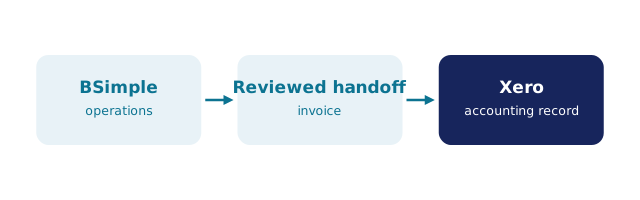
- Today's established handoffs: Xero and MYOB — invoices push with tax codes, payment status mirrors back, purchasing reconciles.
- QuickBooks status: US accounting integrations are rolling out — not generally available yet, and this page will not pretend otherwise.
- What integration should mean: finished invoices out, payment status back, purchasing reconciled — measured by counting manual steps for one real order.
- The alternative while it rolls out: the public REST API — scoped keys and read/write projections — for teams building a bridge themselves.
- 01The key facts
- 02The status, stated plainly
- 03What a real integration should do
- 04The API bridge while it rolls out
The status, stated plainly
Businesses asking about QuickBooks are usually standardised on it and need the inventory layer to hand it finished work. The plain answer: BSimple's established accounting integrations are Xero and MYOB — the Australian market it was built for — and US accounting integrations, QuickBooks among them, are rolling out. "Rolling out" is the honest phrase until general availability is confirmed: it means the capability is on its way, not that a working connector exists today, and a page that blurred the difference would be selling you an integration you cannot yet run.
What this means practically: if the business runs QuickBooks today, the current paths are the API bridge (below) or an interim export routine — and the trial is where the handoff, whatever its shape, gets tested against real orders before any commitment.
What a real integration should do
The bar is the same regardless of the accounting system. Outbound: an approved invoice arrives in the books with line items, tax codes and the customer intact — no re-entry, no CSV step, no month-end re-keying. Inbound: payment status mirrors back — paid, part-paid, voided — so the operations record closes its orders without someone typing the reconciliation twice. Purchasing: supplier bills reconcile against purchase orders and receipts, with price variances surfaced rather than silently absorbed. Tax handling: the codes survive the trip, because GST/VAT correctness is a property of the data, not of the connection.
The evaluation is one order, followed end to end, counting manual steps. The Xero integration page shows what the established handoff looks like when it works; any QuickBooks integration should be judged by the identical script the day it ships. Until then, inventory compatible with QuickBooks surveys the tools that already connect.
The API bridge while it rolls out
For teams that cannot wait, BSimple exposes a public REST API with scoped keys — read projections for suppliers, locations, reorder levels, stocktakes, purchase orders and transfers — plus an MCP endpoint for AI-assistant access. A QuickBooks-centric operation can build its own bridge: pull the finished-order data from the API, push it into QuickBooks by its own published interfaces, and own the small amount of logic in between. That is engineering work with a maintenance tail, and it should be priced honestly — but it is a real path, and unlike a claimed-but-unverified connector, its reliability is in your hands. The automation overview maps the surface, and the inventory pillar documents the record the API reads. We build BSimple, so weigh that: the status here is stated plainly precisely because integration marketing is where this category's trust usually dies — the buying guide helps you hold every vendor, including us, to the one-order test.
Frequently Asked Questions
Does BSimple integrate with QuickBooks?
US accounting integrations including QuickBooks are rolling out — not generally available yet. The established handoffs today are Xero and MYOB. We state the difference rather than blur it, because a connector that does not exist cannot reconcile anything.
Which accounting systems does BSimple work with today?
Xero and MYOB, established: invoices push with tax codes intact, payment status mirrors back, and purchasing reconciles including GST handling. US integrations are rolling out and will be announced when generally available.
Can I bridge BSimple to QuickBooks myself in the meantime?
Yes, via the public REST API — scoped keys and read projections for the operational data your bridge would move into QuickBooks' own interfaces. It is real engineering with a maintenance tail; price it before building, and test it against the trial.
How should I evaluate any claimed QuickBooks integration?
The one-order test: process a real order and follow the invoice into QuickBooks — line items, tax codes, customer, payment status returning. Count the manual steps; that count is the truth of the integration, whatever the brochure says.
What does BSimple cost if we run QuickBooks?
The same plans — $180/$250/$399 AUD monthly, features in the core plans. The integration status above is the honest variable, and the buying-guide checks are how to weigh it against alternatives.

BSimple