
Guide / manufacturing
Inventory management software for manufacturing
Manufacturing inventory is conversion accounting: inputs become traceable outputs through recipes, and the record must survive the trip. What manufacturers need from the software layer, how BSimple covers it, and where it deliberately stops.
The key facts
- The manufacturing requirement set: multi-level bills of materials, production runs with shortage checks, batches with use-by dates, and two-directional traceability.
- BSimple's coverage: versioned recipes, runs with shortage checks, batch creation with expiry, mass-balance reporting used by existing customers for organic certification (ACO, NASAA, OFC) — all in the core plans from $180/month AUD.
- The deliberate limit: no MRP — BSimple does not schedule capacity or plan labour; the record underneath scheduling is its job.
- The accounting seam: finished invoices push to Xero or MYOB (US integrations rolling out); compliance stays in the accounting system.
- 01The key facts
- 02What manufacturing inventory actually means
- 03How BSimple covers the layer
- 04The boundary, stated plainly
What manufacturing inventory actually means
Manufacturing stock exists in three states and changes between them: raw materials, work in progress, finished goods. The software problem is the conversions — "these inputs became those outputs on Tuesday, under that recipe revision" — plus the traceability tail: every finished batch must trace back to its ingredient lots, and every suspect lot forward to everything it touched. Quantity-tracking software built for resale stock cannot express any of that, which is why manufacturers outgrow retail tools so abruptly.
Around the conversion core sit the operational pieces: purchasing that reacts to real demand (reorder levels, lead times), stock across warehouse and production locations, and the invoicing handoff that keeps the books aligned with what the factory actually did.
How BSimple covers the layer
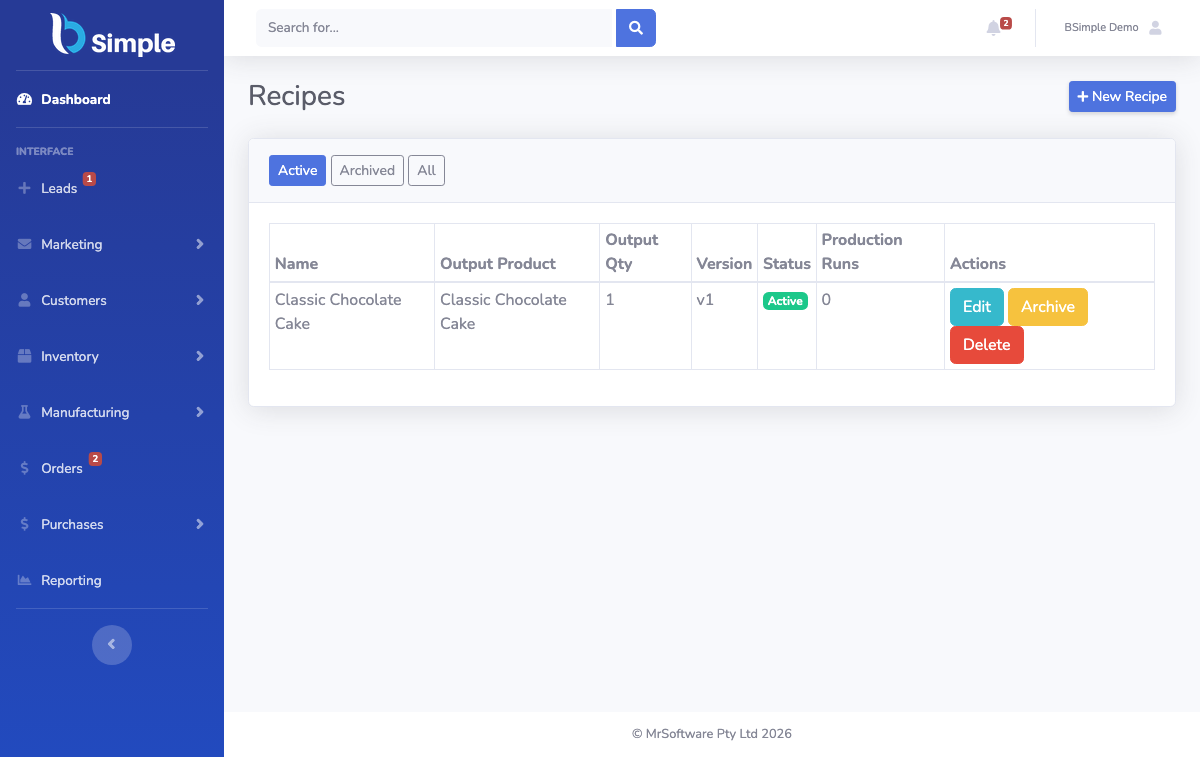
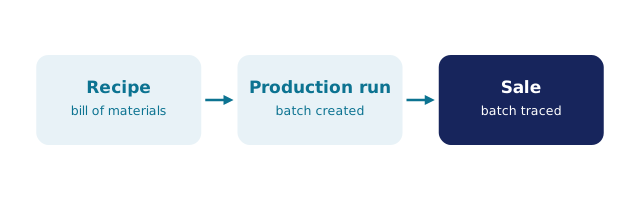
Recipes are versioned multi-level bills of materials — sub-assemblies inside finished goods, quantities per output, revisions preserved so an old batch traces to the formula that actually made it. Production runs consume inputs and create outputs in one transaction, with a shortage check before the run commits: missing inputs are flagged against live quantities, so a run does not start on hope. Batches carry use-by dates and identity through every transfer and sale; traceability search runs both directions for recalls and audits. Mass-balance reporting accounts inputs against outputs across a period — the report certification auditors request, and one existing BSimple customers use in ACO, NASAA and OFC organic audits.
Around the core: purchasing raised from demand with supplier price-variance flags, ordering portals for trade buyers, live quantities across locations, and stocktakes as corrections with reasons. Recipes, batches and mass balance sit in the core plans — no separate manufacturing module. The deeper capability walkthrough covers the layer function by function, and the manufacturing capability page shows the operational detail.
The boundary, stated plainly
BSimple is not an MRP system and does not pretend to be one: no production-capacity scheduling, no job sequencing on machines, no labour planning. Businesses needing that depth run an ERP or a dedicated MRP tool — with BSimple underneath keeping the materials, batches and order record accurate, which is what any scheduling layer requires to be honest. And the accounting system (Xero or MYOB, US integrations rolling out) stays the system of record for compliance; BSimple hands it finished invoices rather than absorbing its role.
The honest test of the layer is the same for any vendor: load one real recipe, run one production with a deliberate shortage, trace one batch backwards, and follow one invoice into the books. The trial is the full product — that script runs in an afternoon, and the open-source comparison applies the same script to the free route if that is the alternative under consideration.
Frequently Asked Questions
What features does manufacturing inventory software need?
Multi-level bills of materials, production runs with shortage checks, batch tracking with expiry, two-directional traceability, and purchasing tied to real demand. Everything else — portals, reporting, accounting handoff — sits on that base.
Does BSimple include recipes and production runs?
Yes, in the core plans from $180/month AUD — versioned multi-level recipes, runs with shortage checks, batches with use-by dates, and mass-balance reporting. No separate manufacturing module to buy.
Can it handle batch recalls?
Traceability search runs both directions: from a customer's batch back to the ingredient lots and run that made it, or from a suspect input forward to every finished batch that consumed it. That is the recall answer in minutes.
Does it schedule production capacity?
No — BSimple is deliberately not an MRP system. It keeps materials, batches and orders accurate underneath whatever scheduling process the business runs; capacity planning belongs to an MRP or ERP layer.
How do I evaluate it against my products?
The trial is the full product: build a real recipe, run a production with a deliberate shortage, create and trace a batch. One afternoon of that against your own materials settles the question honestly.
BSimple