
Guide / BSimple
Inventory Management System Pdf for Manufacturing
A proper inventory management system PDF typically covers the fundamental concepts that every Australian business owner should understand: stock level monitoring, reorder points, safety stock calculations, and demand …
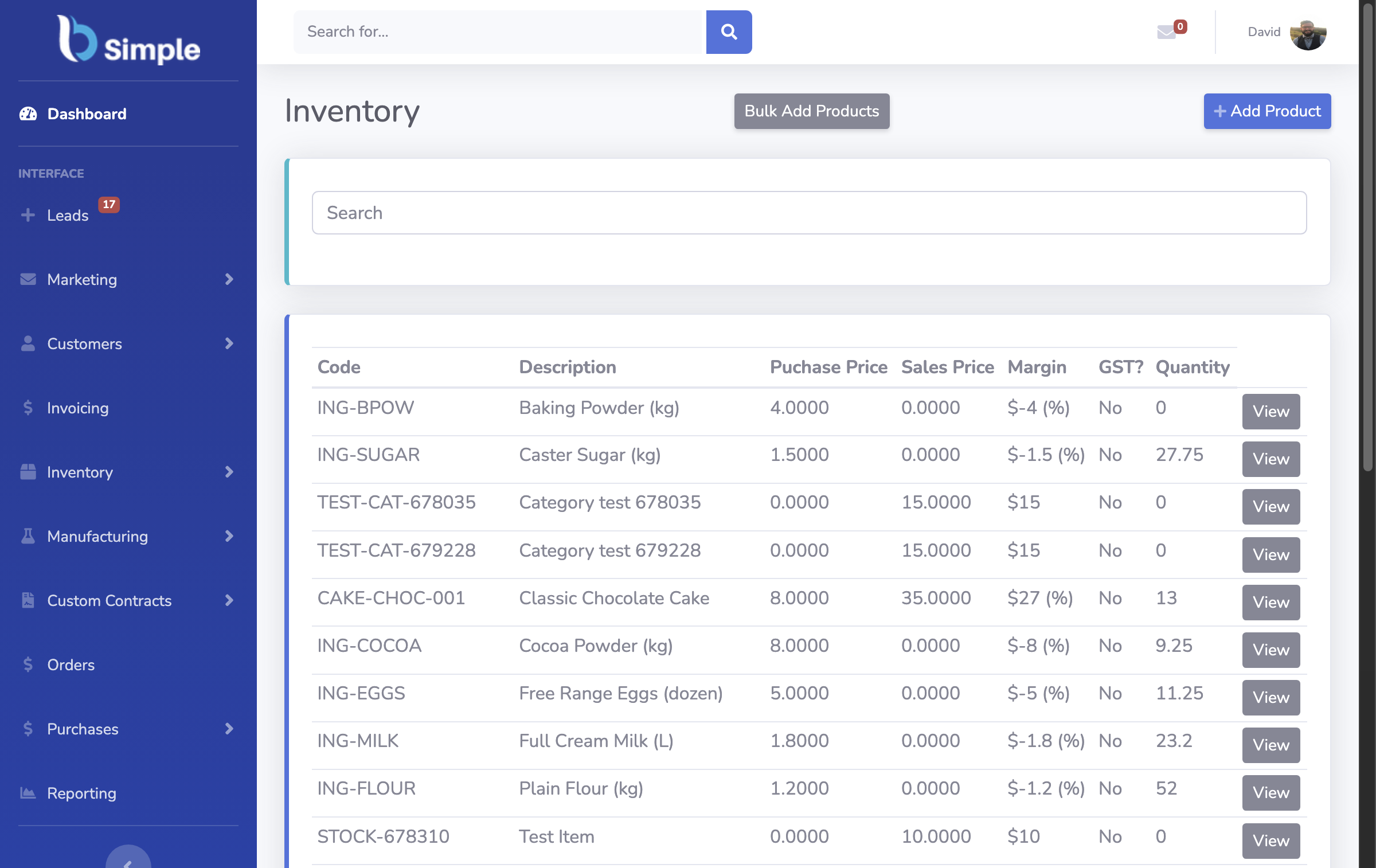
- Real-time inventory tracking with live stock level visibility across multiple warehouse locations and SKUs
- Automated purchase order generation based on stock levels, supplier lead times, and historical usage patterns
- Negative inventory tracking enabling pre-orders and backorders while maintaining accurate stock records
- Seamless Xero integration ensuring every inventory movement updates financial records automatically for GST compliance
- Customer ordering portals providing clients direct access to stock availability and enabling self-service order placement
- Intelligent stocktake management with cycle counting, variance reporting, and reconciliation workflows for EOFY accuracy
- Just-in-time inventory optimisation reducing carrying costs while maintaining service levels for manufacturing and distribution operations
When it comes to managing inventory effectively for manufacturing and wholesale operations, understanding how an Inventory Management Software works is essential—and that's where a comprehensive inventory management system PDF becomes invaluable. Many Australian manufacturers and distributors still rely on spreadsheets, email chains, and manual stocktakes, which inevitably lead to costly errors, overstocking, and missed sales opportunities. A properly structured inventory management system PDF provides the foundational knowledge you need to understand stock control principles, best practices, and how modern cloud-based solutions can streamline your operations. Whether you're running a Sydney coffee roastery managing bean stock rotation, a Melbourne brewery tracking ingredient levels, or a distribution centre coordinating multiple SKUs across warehouses, the principles outlined in inventory management documentation remain consistent. The challenge isn't understanding the theory—it's implementing a system that actually works for your business without requiring a finance degree to operate. BSimple's approach combines practical inventory management with seamless Xero integration, automated purchase order generation, and real-time stock visibility, so you can move beyond PDF guides and into actionable, automated systems that grow with your business.
- 01Understanding Modern Inventory Management Beyond PDFs
- 02Why Traditional PDF Guides Fall Short for Modern Manufacturing
- 03Implementing Real-Time Inventory Control Across Your Business
- 04Moving Beyond Documentation to Actionable Inventory Strategy
Understanding Modern Inventory Management Beyond PDFs
A proper inventory management system PDF typically covers the fundamental concepts that every Australian business owner should understand: stock level monitoring, reorder points, safety stock calculations, and demand forecasting. However, reading about these concepts in isolation doesn't solve your real-world problems. When a Melbourne brewery suddenly needs to increase production for summer demand, or a Sydney wholesaler receives an unexpected bulk order, you need a system that responds instantly—not one that requires manual recalculation in a spreadsheet. Modern inventory management systems integrate directly with your accounting software, eliminating the double-entry data that wastes countless hours. BSimple's cloud-based platform goes beyond traditional PDF-style documentation by offering live inventory tracking, automated stock alerts, and intelligent reorder suggestions based on your actual sales patterns. The system learns from your business behaviour, whether you're managing seasonal fluctuations typical of Australian agricultural suppliers or handling consistent B2B orders. What makes this approach superior to static PDF resources is the dynamic nature of cloud software—your inventory data updates in real-time as sales occur, purchases are received, and stocktakes are completed. For Australian SMBs managing EOFY stocktakes and GST compliance, this real-time accuracy is not just convenient; it's essential for maintaining accurate financial records and avoiding costly tax mistakes.
Why Traditional PDF Guides Fall Short for Modern Manufacturing
Why Traditional PDF Guides Fall Short for Modern Manufacturing
Most inventory management system PDFs you'll find online were created years ago and don't account for the complexity of modern wholesale and manufacturing operations. They typically assume a single warehouse, straightforward product lines, and predictable demand patterns—none of which reflect the reality of Australian businesses scaling rapidly. A manufacturing facility producing components for multiple clients needs to track not just finished goods, but raw materials, work-in-progress inventory, and supplier lead times. Traditional PDF resources rarely address the nuances of just-in-time inventory management, which requires precise coordination between production schedules and material arrivals. This is where cloud-based inventory management solutions become transformative. BSimple's platform handles negative inventory tracking—critical for businesses that sell items before they're physically in stock—and provides customer ordering portals that let your clients place orders directly, reducing manual order entry and communication delays. The system automatically generates purchase orders based on stock levels and supplier lead times, ensuring you're never caught short. For Australian distribution businesses managing multiple customer locations, regional warehouses, and complex supply chains, this level of automation is what separates thriving operations from those struggling with manual processes. A PDF guide might explain the theory, but only integrated software can execute the strategy efficiently.
Implementing Real-Time Inventory Control Across Your Business
Implementing Real-Time Inventory Control Across Your Business
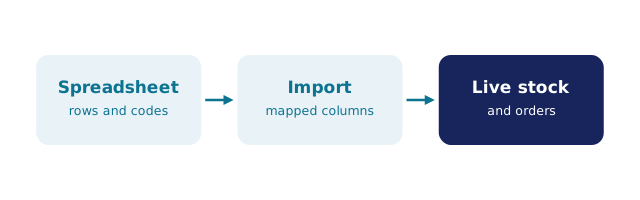
The transition from PDF-based learning to practical implementation requires a system that your entire team can use intuitively. Many Australian manufacturers and wholesalers hesitate to adopt new inventory management systems because they fear disruption—but the reality is that poor inventory control causes far more disruption than any transition period. When your sales team can't tell customers accurate stock availability, when your warehouse team doesn't know what needs to be ordered, and when your accounting department is reconciling discrepancies between physical counts and system records, your business is already suffering. BSimple's customer ordering portals eliminate the first problem by giving clients real-time visibility into stock levels and the ability to place orders themselves. This reduces communication friction and allows your team to focus on fulfilling orders rather than processing them manually. The automated purchase order generation feature addresses the second challenge by analysing stock levels, supplier lead times, and historical usage patterns to suggest optimal reorder quantities. For Australian EOFY stocktakes, this level of accuracy means your physical counts align with system records, reducing the stress and time required for year-end reconciliation. The Xero integration ensures that every inventory movement flows seamlessly into your accounting records, maintaining GST compliance and providing your accountant with accurate data from day one. Rather than viewing inventory management as a burden, these integrated systems transform it into a competitive advantage, giving you visibility and control that competitors relying on spreadsheets simply cannot match.
Moving Beyond Documentation to Actionable Inventory Strategy
For a closer look at how these capabilities fit together, our warehouse management software guide ties it all together, and the guide to php walks through the practical details. Moving Beyond Documentation to Actionable Inventory Strategy
Reading an inventory management system PDF might give you theoretical knowledge, but applying that knowledge to your specific business requires understanding your unique constraints and opportunities. A Sydney coffee roaster has different inventory challenges than a Melbourne brewery, which differs again from an Australian automotive parts distributor. Each business has distinct seasonality patterns, supplier relationships, product shelf-life considerations, and customer expectations. Rather than trying to adapt generic PDF advice to your situation, a modern inventory management platform lets you configure the system to match your actual business processes. BSimple allows you to set custom reorder points based on your supplier lead times and sales velocity, implement stocktake management routines that fit your warehouse operations, and generate reports that highlight the metrics that actually matter for your business. The platform's negative inventory tracking feature is particularly valuable for Australian businesses that operate on pre-order or made-to-order models, where you might need to confirm stock availability before accepting customer orders. By combining real-time inventory data with Xero integration, you gain complete visibility into how inventory decisions impact your cash flow and profitability. Rather than treating inventory management as a compliance checkbox, you can use accurate inventory data to optimise your working capital, reduce carrying costs, and improve your ability to respond to market opportunities. This shift from theoretical knowledge (what a PDF provides) to practical, data-driven decision-making (what integrated software enables) is what transforms inventory from a cost centre into a strategic advantage for growth-focused Australian businesses.

Frequently Asked Questions
What should a comprehensive inventory management system PDF include?
A quality PDF should cover stock level monitoring, reorder points, safety stock calculations, demand forecasting, warehouse organisation, and best practices for stocktakes. However, modern businesses benefit more from integrated cloud software that automates these processes rather than static documentation.
How does cloud-based inventory management improve on traditional PDF guides?
Cloud systems provide real-time stock visibility, automated alerts, intelligent reordering, and seamless integration with accounting software like Xero. Unlike PDFs, they adapt to your business and eliminate manual data entry errors that plague spreadsheet-based approaches.
Is inventory management software suitable for small Australian manufacturers?
Absolutely. Cloud-based platforms like BSimple are designed specifically for SMBs, offering affordable, scalable solutions without requiring IT expertise. They're particularly valuable for managing seasonal demand, EOFY stocktakes, and GST compliance requirements.
How does negative inventory tracking benefit wholesale businesses?
Negative inventory tracking allows you to accept pre-orders and backorders while maintaining accurate stock records. This is essential for businesses operating on made-to-order models or those managing customer demand that exceeds current stock levels.
Can inventory management software integrate with my existing accounting system?
Yes. BSimple seamlessly integrates with Xero, ensuring every inventory movement automatically updates your financial records. This eliminates double-entry data, reduces errors, and maintains accurate GST compliance for Australian businesses.
What features are most important for EOFY stocktake management?
Look for systems offering automated stocktake workflows, variance reporting, cycle counting capabilities, and real-time reconciliation between physical counts and system records. These features dramatically reduce EOFY stress and ensure accurate financial reporting.
How do customer ordering portals improve inventory management?
Customer portals give clients direct access to real-time stock levels and enable self-service ordering. This reduces manual order processing, minimises communication errors, and provides accurate demand data that improves your inventory forecasting and planning.
BSimple