
Guide / manufacturing stock
The inventory system inside a manufacturing company
A manufacturer's stock is a chain — raw material, work in progress, finished batch — and the system must hold every link. What that requires, what BSimple runs, and where planning software begins.
The key facts
- Manufacturing stock is three inventories at once: raw materials, work in progress, finished goods — plus the links between them.
- The non-negotiables: multi-level BOMs, recipe versioning, shortage checks before a run, batches with use-by dates, lot traceability supplier-to-customer.
- BSimple runs that chain as core — recipes, production runs, batches and mass-balance reporting in every plan, no module fee.
- The boundary, plainly: no MRP scheduling and no shop-floor machine integration — the record, not the planning engine.
- The wider guide: the manufacturing inventory guide maps the production record end to end.
- 01The key facts
- 02The three inventories — and the links between them
- 03What BSimple runs for a manufacturer
- 04The test that decides fit
The three inventories — and the links between them
Raw materials. Received against purchase orders, held per location and lot, consumed by production. The system must know what is incoming as well as on hand, or purchasing double-orders every time a delivery runs late.
Work in progress. The moment a run starts, materials are no longer shelf stock and not yet product. A system that jumps from "raw" to "finished" loses the middle — and with it, yields, WIP value, and the answer to what happened in last Tuesday's run.
Finished goods. Created as batches with their own identity: which recipe version, which input lots, which use-by date. Sold as orders against live quantities, traced back on demand.
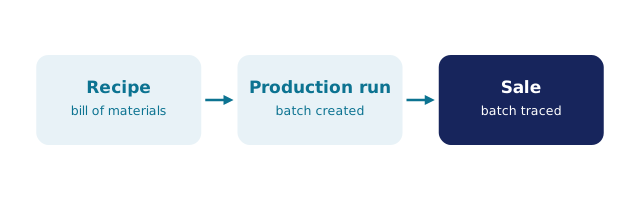
The links are the product: input lot → run → output batch → customer. That thread is what turns "we had a complaint" into "this batch, from these lots, to these four customers — here is the trace", in minutes.
What BSimple runs for a manufacturer
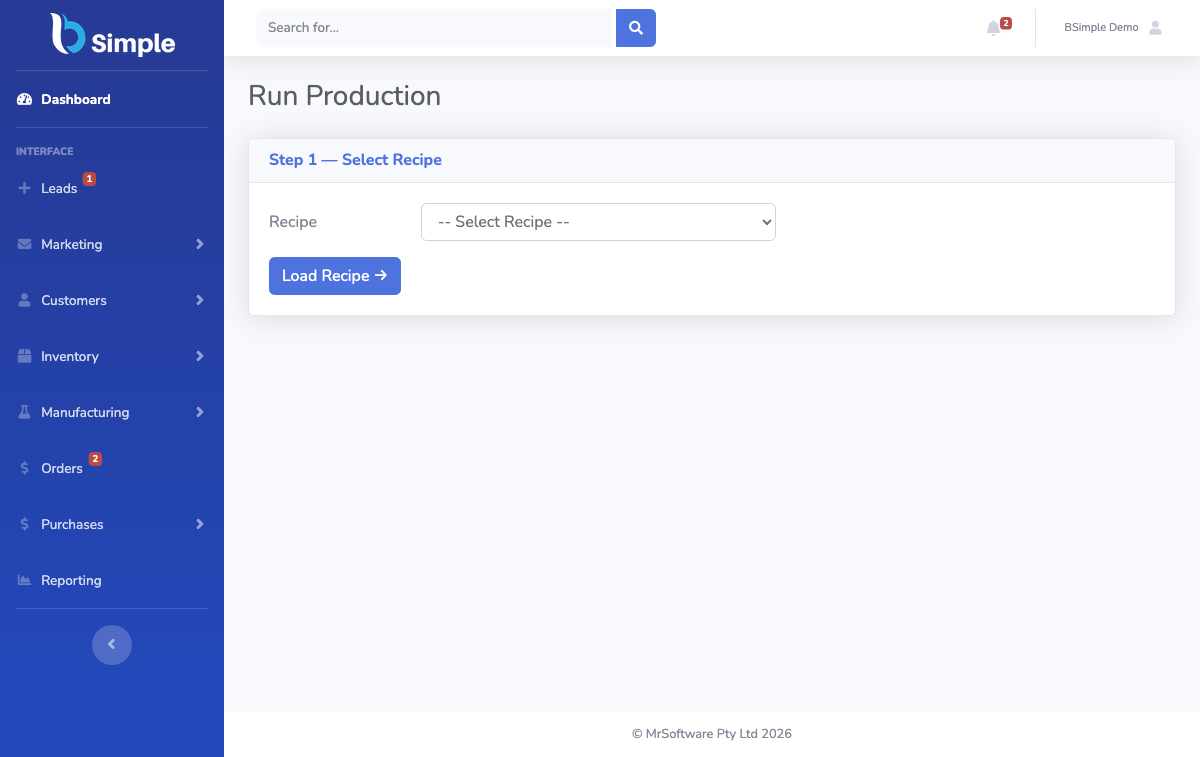
We build BSimple, so weigh that. The production chain above is core: multi-level bills of materials (recipes made of sub-recipes), versioning so the recipe that made a batch is recoverable, production runs with shortage checks before materials are committed, batch creation with use-by dates, and mass-balance reporting — used by existing customers for organic certification under ACO, NASAA and OFC. Around it: purchasing from demand with supplier reconciliation, multi-location stock, and invoices that push to Xero and MYOB (US integrations rolling out).
The boundary, stated plainly: no MRP scheduling — BSimple tells you what you can make now and what to buy, not a forecast-driven master schedule; no shop-floor machine integration — people record movements, machines do not (yet) talk to it. The manufacturing software scope and the BOM deep-dive cover both sides of that line, and the comparison page frames the market.
The test that decides fit
Bring one real recipe — with a sub-recipe inside it — to a trial and run the loop: shortage check, run, lot consumption, batch on sale, then trace a "customer complaint" back to inputs. Time the trace. A system that cannot complete this loop is a distribution system wearing a manufacturing badge, and no feature list will compensate. BSimple's trial exists for exactly this loop, and the India-specific manufacturing angle covers a common geographic variant of the question.
Frequently Asked Questions
What is an inventory management system in manufacturing?
The system holding all three inventories — raw materials, WIP, finished goods — and the links between them: which lots fed which run, which recipe version produced which batch, which batch shipped to which customer. Distribution-only stock tools do not carry the middle link.
Does BSimple handle work in progress?
At the run level: a production run commits materials against a recipe and produces a batch, so WIP is visible as the run in progress. It is not a minute-by-minute shop-floor tracking system — that granularity sits with MES-class tools, stated plainly.
Can it manage co-products and by-products?
Recipes define inputs and outputs per run and the run records what was actually made — the basis for yield visibility. Verify your exact co-product structure in the trial; that is what trials are for.
Do we need MRP before we need a record?
Almost never in that order. A trustworthy record — quantities, lots, batches, shortages checked before runs — is the foundation MRP assumes; planning on top of an untrusted record automates the errors. Earn the record first.
What does it cost?
Plans are $180/$250/$399 per month AUD, and production — recipes, runs, batches, mass-balance — is in every plan with no module fee. The trial runs the full loop on your recipes before you commit.

BSimple