
Guide / the factory flow
Inventory systems in a manufacturing company
Walk the factory floor and the inventory system touches five stops: supplier receipts into stores, issues to production, runs and batches, finished goods, and dispatch to customers. Here is each stop, and how BSimple covers it.
The key facts
- Five stops, one record: receipt into stores, issue to production, production runs, finished goods, dispatch to customers.
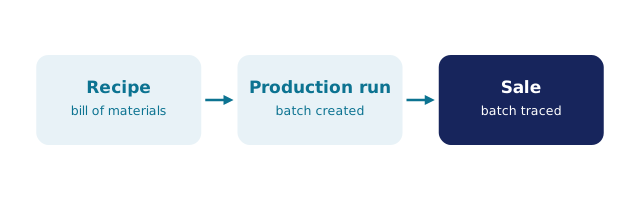
- The thread between stops: recipes (multi-level bills of materials) — the difference between a factory record and three unrelated stock lists.
- The compliance stop: batches with use-by dates and lot traceability — which lots went in, where the output went.
- BSimple's coverage: all five stops plus purchasing from demand, mass-balance reporting, and the accounting handoff — no MRP scheduling, stated plainly.
- The wider guide: the manufacturing inventory guide maps the production record end to end.
- 01The key facts
- 02The five stops, walked in order
- 03How BSimple covers the flow
The five stops, walked in order
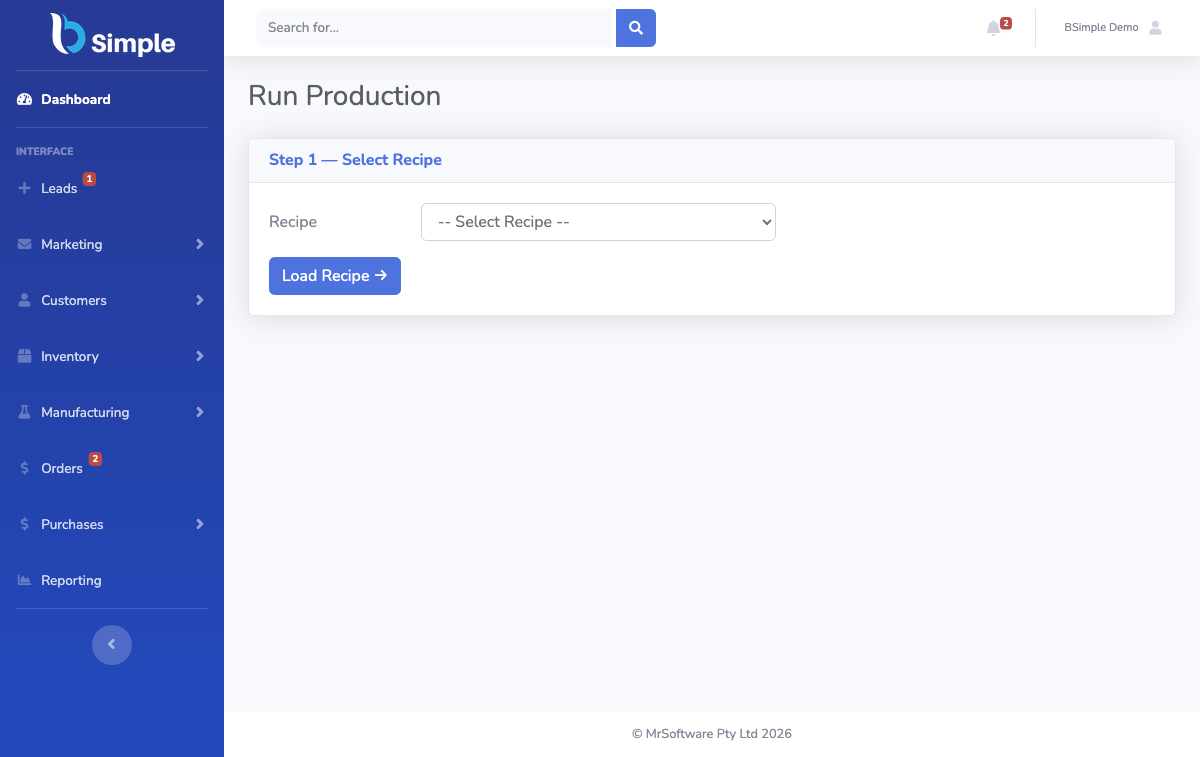
Stop 1 — receipt into stores. Raw materials arrive against purchase orders raised from demand; goods receipt updates quantities and captures lots and expiry dates. Stop 2 — issue to production. The recipe (bill of materials) defines what a run consumes; issues draw from stores against that recipe, with shortage checks before the run starts rather than mid-shift. Stop 3 — the run. Production converts materials into output; the run records what was actually consumed, which is sometimes not exactly what the recipe planned — and the record must survive that honesty. Stop 4 — finished goods. Output arrives back as batches carrying use-by dates and the trace of their inputs. Stop 5 — dispatch. Customer orders draw from finished stock, each delivery traceable to the batch — and back through the recipe to the lots that made it.
The system's job is that the five stops are one flow: quantities that move between them without re-entry, and a history that answers both directions — "which lots went into this batch?" and "which customers received it?".
How BSimple covers the flow
We build BSimple, so weigh that. Recipes with versioning — multi-level bills of materials, changes recorded as history. Production runs with shortage checks — a run starts knowing it can finish. Batch creation with use-by dates and traceability search — the compliance stop, answered in seconds. Mass-balance reporting — used by organic-certified producers reporting against ACO, NASAA and OFC requirements. Around the flow: purchasing from demand against reorder levels, live quantities across stores and warehouses, stocktakes, the customer ordering portal for buyers, and the accounting handoff to Xero or MYOB with payment status mirroring back. From $180/month AUD, everything in the core plans — no manufacturing module surcharge.
The stated boundary: no MRP scheduling — planning production across capacity constraints is ERP territory, and the factory page draws that line, production and inventory together covers the recipe depth, and the inventory management pillar the whole record. The trial runs one of your real recipes through all five stops in an afternoon.
Frequently Asked Questions
What does an inventory system do in a manufacturing company?
It keeps one flow honest: receipts into stores, issues to production against recipes, runs recorded as they happened, finished goods as traceable batches, and dispatch against customer orders — with purchasing triggered by real demand.
Can it handle multi-level recipes?
Yes — recipes with versioning and sub-assemblies within recipes, so a design change is recorded history and shortage checks run before the production starts, not during it.
How does traceability work across the flow?
Every receipt captures its lot; every run records its inputs; every batch carries use-by dates; and traceability search answers both directions — inputs of a batch, destinations of a lot. It is the recall-answer machinery.
Does it replace our ERP or MRP?
It replaces neither — BSimple has no MRP scheduling, stated plainly. It runs the inventory and production record for factories that need truth on the floor; scheduling across capacity constraints is a different tier.
What does it cost a manufacturer?
The same as everyone: $180/$250/$399 per month AUD, recipes and production included in the core plans. Start the trial and run a real recipe end to end.

BSimple