
Guide / repos
Inventory and billing software on GitHub
Adding billing to an inventory project raises the stakes: tax codes, invoices and money move in. What the GitHub repos really contain, the checks that matter more when billing is involved, and the honest route to a system that can be trusted with both.
The key facts
- What the search finds: mostly student and portfolio CRUD apps pairing an inventory table with an invoice generator — fine for learning, risky as a record.
- Billing raises the stakes: tax codes, invoice numbering, part-payments and reconciliation are compliance-adjacent — the features repos most often get wrong.
- The checks: commit history, licence, movement-based schema, and the billing test — one invoice followed into the books, manual steps counted.
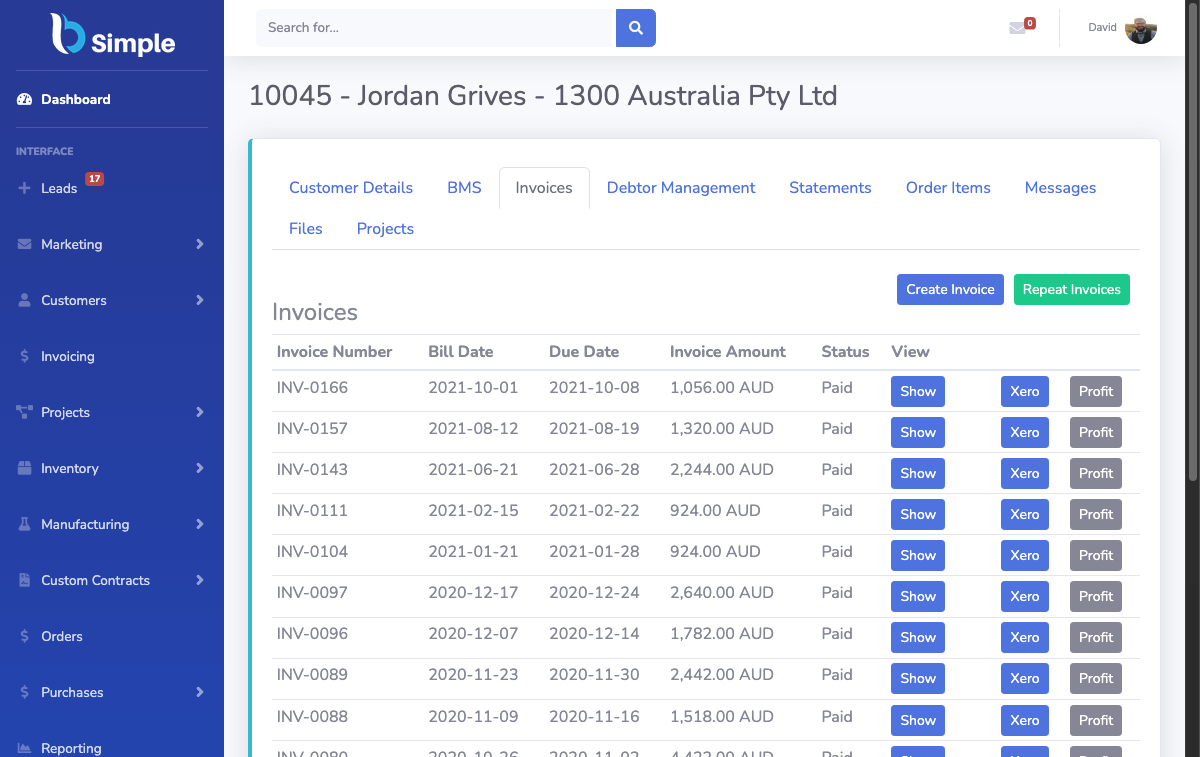
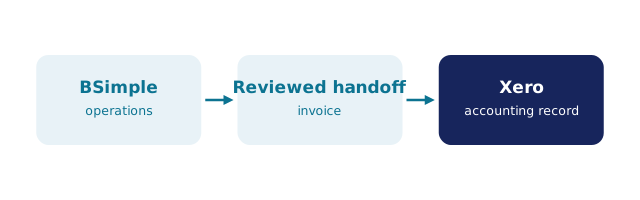
- BSimple's position: not on GitHub — commercial software whose billing output is the invoice pushed to the accounting system; the trial shows the handoff.
- The wider system: inventory management end to end maps the whole record this page sits in.
- 01The key facts
- 02What the repos actually contain
- 03The checks, sharpened for billing
- 04The honest route for each intent
What the repos actually contain
Search GitHub for inventory-plus-billing and the results sort into familiar piles. Coursework — CRUD over products and invoices, seeded data, a PDF bill: the majority, and harmless as homework. Portfolio projects — better dressed, same bones, abandoned after the job hunt. Maintained projects — real commit history and issues, rare, and rarely strong at both halves: the billing side tends to be a template invoice rather than a tax-aware document.
The billing half is where the stakes rise, because an invoice is not a document — it is a compliance-adjacent record with sequential numbering, tax codes per line, inc/ex pricing, part-payments and credit notes. Getting that right is most of the difficulty in any billing system, and it is exactly the part a demo never exercises. The broader GitHub-route guide covers the repo landscape; this page focuses on the billing twist.
The checks, sharpened for billing
The schema test, twice over. Inventory: movements stored and quantities derived — not editable totals. Billing: invoices with sequential, non-reusable numbers; lines carrying their own tax codes; payments recorded against invoices rather than overwriting them. The design reasoning covers the inventory half; the billing half fails even more quietly.
The tax test. One sale with a mixed basket — taxable and non-taxable lines — turned into a bill. Repos that cannot keep the two apart on one document will not survive a real tax regime.
The handoff test. One invoice followed into the accounting software, manual steps counted. A repo that ends at the PDF has moved the work, not removed it.
The licence and security checks. GPL-family obligations if clients touch the system; default credentials, five-year-old dependencies and hard-coded database passwords — the coursework pile's signature — are disqualifying for anything holding customer money records.
The honest route for each intent
Learning: use the repos freely — reading a billing schema and improving it is a genuine education, and the project-with-source-code route shows what to reuse versus rebuild.
A real business: the bar rises to trust. Invoices and stock must survive auditors, tax offices and disputes — which is the maintained-system case. We build BSimple, so weigh that: it is not on GitHub but keeps inventory and billing output on one record — invoices generated from checked orders with tax codes intact, pushed to Xero or MYOB (US integrations rolling out), payment status mirroring back — from $180/month AUD with the trial as the full product. Run the billing test on it: one mixed basket, one credit note, one reconciliation. A repo should be judged by exactly the same script.
Frequently Asked Questions
Are there good inventory and billing projects on GitHub?
Good learning projects, yes; good business systems, rarely — the billing half (tax codes, sequential invoices, part-payments) is where repos weakest. Check the commit history and run the billing test before trusting either half.
What is the hardest part of building billing into inventory software?
The compliance surface: sequential invoice numbering, per-line tax codes, mixed taxable and exempt baskets, part-payments, credit notes. The inventory half is well-documented; the billing half is where homemade systems meet the tax office.
Can I use a GitHub billing system for my shop?
Only after the security and tax checks pass — default credentials and unpatched dependencies holding customer money records are a liability, and the licence must permit commercial use. For most shops, a maintained localised tool is the cheaper risk.
Is BSimple available on GitHub?
No — it is commercial cloud software. Its billing output is the invoice generated from a checked order and pushed to the accounting system, which is where filing and compliance stay. The trial exercises the whole path.
What should I test in any inventory-billing system, repo or product?
The same script: a mixed-basket bill, a part-payment, a credit note, and one invoice followed into the books. Four tests, an afternoon — the cost arithmetic then tells you what the survivors charge.

BSimple