
Guide / classification
Inventory management software is which type of software?
Operations software — specifically stock-control software, a branch of business management software that records physical goods. It is not accounting software, though they shake hands, and it is usually not an ERP, though the categories blur at the edges.
The key facts
- The category: operations software — it tracks things (goods, movements, locations), whereas accounting software tracks money.
- The family tree: business management software → operations layer → inventory management. Warehouse management (WMS) and order management are siblings.
- Not an ERP by default: ERP bundles inventory with accounting, HR and everything else; dedicated inventory tools are deliberately lighter.
- The technical sub-type: most modern systems are perpetual inventory systems — every movement recorded, quantities derived — as opposed to periodic counting.
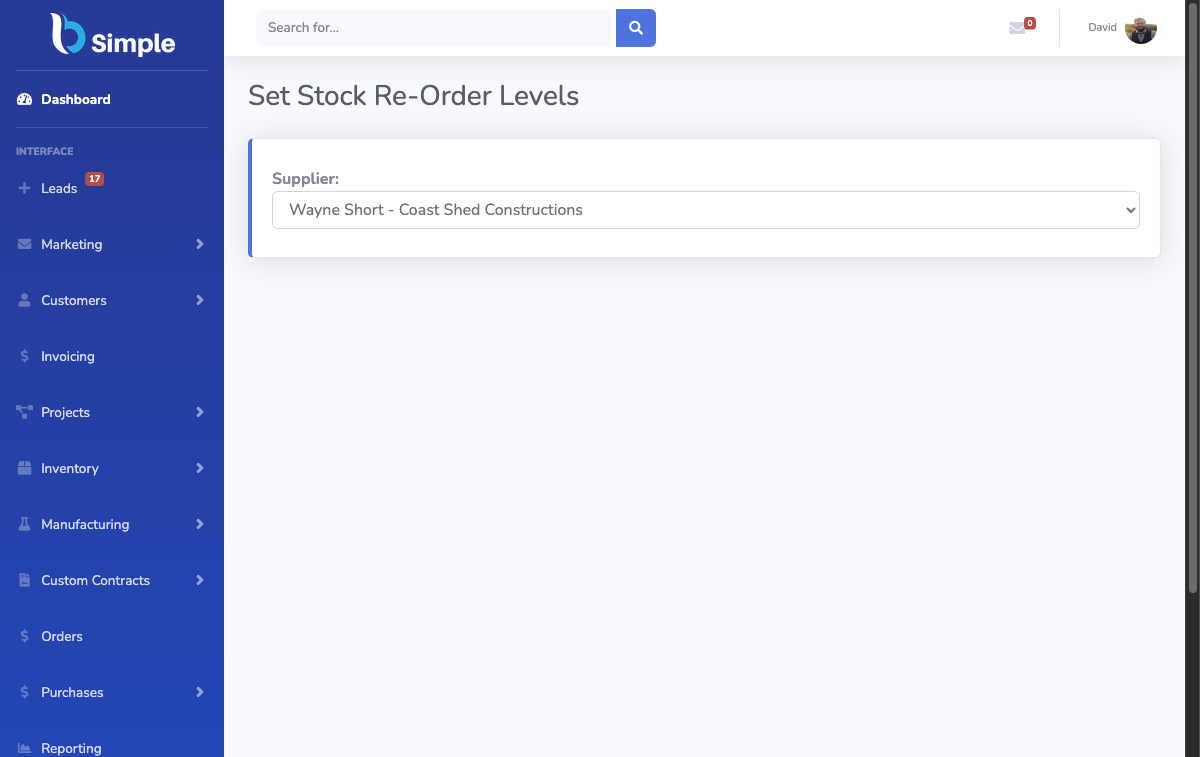
- BSimple's class: cloud operations software for inventory, orders, purchasing and invoicing, with accounting handled by Xero or MYOB.
- 01The key facts
- 02The short answer: operations software
- 03Not accounting software, though they shake hands
- 04Not (usually) an ERP
- 05The sub-types worth knowing
The short answer: operations software
Inventory management software belongs to the operations class of business software: applications whose job is to keep an accurate record of physical activity — goods received, goods sold, goods moved, goods produced. Within that class it is the stock-control specialist, sitting alongside order management (the flow of customer orders) and warehouse management (the physical handling inside four walls). If the software's subject is things rather than money or people, it is operations software.
The technical classification of almost every modern product is a perpetual inventory system: each sale, receipt or adjustment is recorded as a movement, and the quantity on hand is derived from that history rather than typed in. That is the dividing line from periodic systems, where stock is only known when someone counts — and it is why a good inventory system has an audit trail by construction while a spreadsheet has one only if discipline holds.
Not accounting software, though they shake hands
The most common mis-classification puts inventory software in the accounting bucket. The confusion is understandable — both track "what the business has" — but the records differ: accounting records money (debtors, GST, profit), inventory software records goods (quantities, locations, batches). One system of each is normal; a system claiming to be both usually does one half thinly.
The relationship is a handoff, not a merger. Finished invoices and purchasing flow from the inventory system into the accounting system, and payment status flows back. In BSimple, that handoff runs to Xero and MYOB (US integrations rolling out) — BSimple keeps the operational record, the accounting system keeps compliance and payments, and neither pretends to do the other's job.
Not (usually) an ERP
Enterprise resource planning suites — SAP, Oracle, NetSuite — bundle inventory into a whole-of-business system alongside accounting, HR, MRP production scheduling and more. Inventory software shares a module-shaped overlap with that bundle but is a different category: lighter, faster to adopt, and priced for businesses that need the stock record to be right without deploying an ERP.
The boundary is worth stating precisely, because vendor marketing blurs it on purpose. An ERP typically adds MRP scheduling, HR and payroll, and deep financials. Dedicated inventory software deliberately does not — BSimple is explicit that it is not an ERP: no HR or payroll, no MRP scheduling, and accounting left to the accounting system. The ERP-adjacency question covers where the line sits for a growing business.
The sub-types worth knowing
Periodic vs perpetual — the fundamental split, described above; buy perpetual unless the business is genuinely tiny.
Batch/lot-tracked systems — stock that carries an identity beyond quantity: expiry dates, traceability, recall searches. Food, beverage, pharma and chemicals need this class, not plain quantity tracking.
Warehouse management systems (WMS) — the physical-handling sibling: bin locations, pick paths, scanning workflows. A small business usually wants inventory software first and grows into a WMS.
Order-management-adjacent systems — tools that extend stock control into the customer-facing flow: portals, pick/pack, invoicing. BSimple sits here deliberately, connecting the ordering experience to the stock record so both stay one truth — the inventory pillar maps the whole surface.

Frequently Asked Questions
Is inventory management software the same as an ERP?
No. ERPs bundle inventory with accounting, HR, payroll and production planning into one suite; inventory software is a focused operations layer. Some inventory products grow ERP-like features, but a focused tool that integrates with your accounting system is the lighter, faster-adoption choice for most small and medium businesses.
Is it a type of accounting software?
No — it records goods, accounting records money. The two connect: invoices and purchasing flow across, quantities update as payments reconcile. If a product describes itself as accounting software with inventory features, expect the operations half to be the thin half.
What is a perpetual inventory system?
One where every stock change is recorded as it happens and the on-hand quantity is derived from the movement history. Its opposite is the periodic system, where stock is only known at a count. Perpetual is what makes live availability, reorder alerts and audit trails possible.
Where does BSimple fit in these categories?
Cloud operations software: inventory, orders, purchasing, invoicing and customer portals on one record, with batches and recipes for production businesses — and accounting deliberately handed to Xero or MYOB rather than absorbed. From $180/month AUD, with a full-product trial.
Which type does a small business need first?
The perpetual-inventory core: products, movements, reorder levels. Portals, batch tracking and purchasing can layer on as the business needs them — the mistake is buying warehouse-scale tooling before the stock record itself is trustworthy.
BSimple