
Guide / automotive parts
Inventory management for automotive businesses
Parts businesses punish software: wrong quantities cost downtime, packs and singles coexist, and stock lives across branches and vans. What matters here — and what BSimple does and does not cover.
The key facts
- The automotive problem is the shape of stock: single parts, boxed quantities of the same part, and slow movers worth more as data than as shelf space.
- What matters most: live quantities across locations, multi-level stock, reorder discipline, and counter-speed answers.
- BSimple handles the operations layer: multi-location stock, multi-level units, reorders, purchase orders, customer ordering with per-customer pricing.
- The honest limits: no vehicle-fitment (year/make/model) catalogue, no workshop booking, no integrated ecommerce storefront — Shopify orders sync in, invoicing stays with your accounting system.
- 01The key facts
- 02Why automotive parts inventory is hard mode
- 03What BSimple covers for a parts business — and what it does not
- 04Evaluating any system for a parts operation
Why automotive parts inventory is hard mode
Parts businesses sell the same item in several shapes — a single bearing, a box of ten, a case of fifty — and pricing that does not collapse when someone orders a case at single-unit prices is survival, not sophistication. Stock sits in a warehouse, a shop counter, and a van or three, each holding real quantities that must be true at the moment of the sale. And because a missing part stops a customer's vehicle (or their workshop), speed of answer is the product: the phone call is "do you have it", and the answer is either instant or worthless.
Add the accounting reality — parts wholesale runs on thin margins and correct GST treatment — and the software dividing line appears: the ledger records, but only an operational record that updates on real movements can answer the counter. The QuickBooks question is a common version of this; the module inside accounting systems rarely survives multi-location parts truth.
What BSimple covers for a parts business — and what it does not
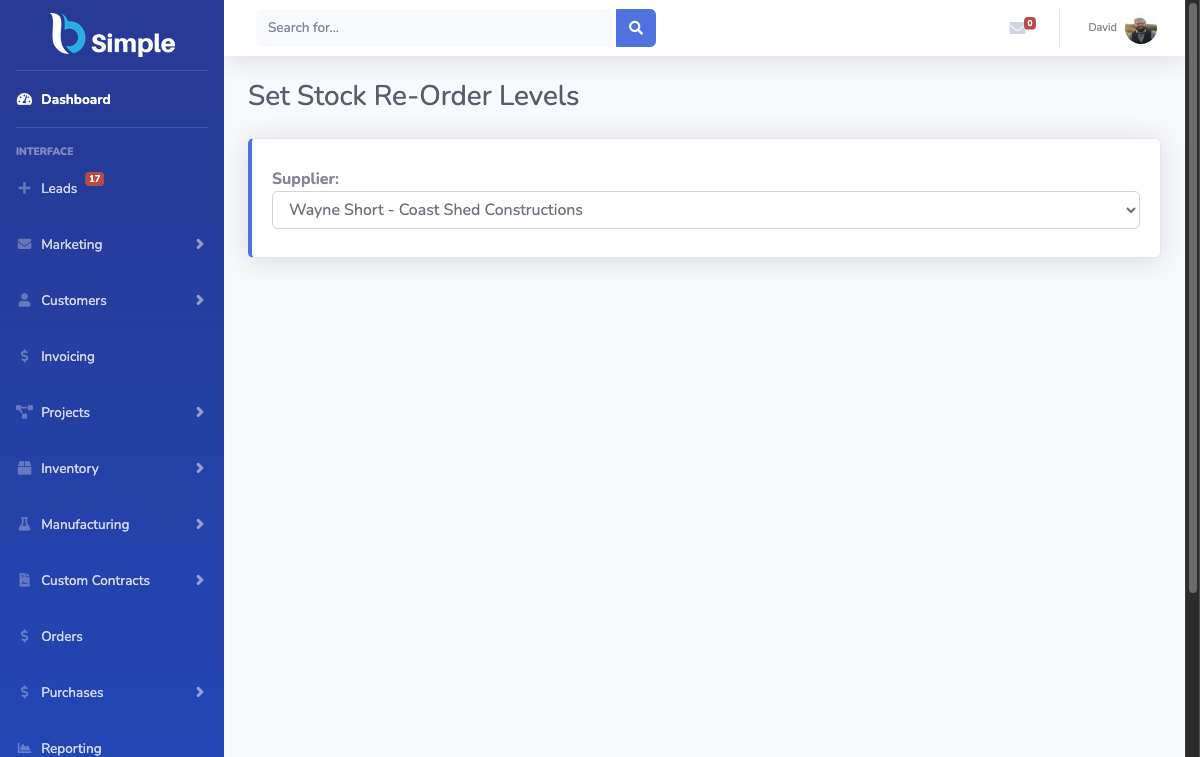
We build BSimple, so weigh that. Covered: live quantities across locations (warehouse, counter, vans), multi-level stock so boxes and singles are the same record at different pack sizes, negative-inventory guardrails, reorder levels with a view of what to buy, purchase orders that reconcile GST-inc or ex-GST, and customer ordering portals where trade accounts see their own pricing and order — which for parts wholesalers replaces a fax machine-era workflow with something a workshop can use from the hoist.
Not covered, stated plainly: no year/make/model fitment catalogue — if you need customers to look up parts by vehicle, that data layer lives in specialist fitment systems, not here. No workshop booking or job-card features. No built-in online storefront — Shopify orders import by webhook, while invoicing stays between the store and your accounting system. None of this is hidden in fine print; it decides whether the product fits, and the manufacturing-side angle covers the production half for businesses that make as well as sell.
Evaluating any system for a parts operation
Test the four moments that fail in practice: the counter check (how fast from "how many of these?" to a trusted number, including stock in the van), the pack conversion (sell a case, receive singles — do the quantities stay true without manual adjusting), the reorder signal (does it reflect open orders, not just shelf counts), and the trade order path (can a workshop customer order their usual list at their pricing without a phone call). A system that passes all four is worth a deeper look; a system that demos well but stumbles on the pack conversion will cost you more than it saves.
BSimple's trial runs those four tests on your own parts list, and the inventory guide is the wider reference if the evaluation is still early.
Frequently Asked Questions
Does BSimple handle part supersession (old part to new)?
Not as a built-in supersession chain. You can record replacements in product notes and manage both SKUs' stock, but there is no automated "this part was replaced by" lookup — if supersession is central to your operation, verify how a candidate system handles it before committing.
Can we track stock in delivery vans?
Yes — vans are locations, so each holds real, visible quantities and movements between warehouse and van are recorded transfers. The counter can see what the van holds before promising a part.
Does BSimple integrate with accounting for a parts business?
The established handoff is Xero and MYOB — invoices push after approval and payment status mirrors back — with US accounting integrations rolling out. Compliance stays in the accounting system; the parts record stays live here.
Can trade customers order online themselves?
Through their portal: a unique link with their own product list and pricing, order history and status — no passwords, no phone tag. It is not a public storefront; it is per-customer ordering, which is what trade usually actually wants.
We are a small wrecking/used-parts yard — does the same apply?
The stock principles do: unique items and quantities, locations (shelves, yard rows), and photos-as-evidence workflows. BSimple handles the record side; the honest check is whether per-item one-off tracking (rather than SKU quantities) is your dominant pattern — if so, trial it with your real items first.
BSimple