
Guide / Access and databases
Inventory in Microsoft Access — free, and what it costs you
Access is the most capable "free" inventory platform many businesses already own: a real database with forms. Its limits are structural, and the migration path is kinder than you expect.
The key facts
- If you own Microsoft 365/Office, Access adds no licence cost — the "free" is real in the subscription sense you already pay.
- Access is a genuine relational database with forms — a serious step above Excel, and structurally the right shape for inventory.
- The limits are structural: Windows-only, single-file sharing limits, no browser reach, and you are the developer forever.
- No free BSimple tier: $180/month AUD upward with a full trial — and the Access-to-system migration is spreadsheet-grade easy.
- Context: the full inventory system holds the wider system, this page one stop in it.
- 01The key facts
- 02What an Access inventory system genuinely handles
- 03Where the ceiling is — structurally
- 04The migration path — and the honest price of the alternative
What an Access inventory system genuinely handles
Access deserves more respect than it gets in this conversation. It is a relational database engine with a forms layer: products, categories, movements and suppliers as proper related tables; forms for receipt and issue; queries for reorder reports; validation rules that actually enforce something. Built well — an append-only movements table with derived quantities — an Access inventory system is architecturally superior to anything a spreadsheet can be, and teaches the same lessons production systems use. The Excel comparison covers the stage below this one; the VBA variant is Excel wearing Access's ideas.
For a single power user or a small office sharing a file on a network drive, it can run a business for years. If the builder enjoyed it, that is also a signal worth reading — someone in the building thinks in databases.
Where the ceiling is — structurally
Reach. Access is a Windows desktop application. The warehouse floor, a tablet, a phone, a customer portal, a second site — all outside its world without real development. The record lives where the laptop lives.
Concurrent users. Beyond a handful of simultaneous users on a split database, performance and corruption risk degrade together. Access was designed for a workgroup, not a warehouse team.
The bus factor. An Access system is a custom application with one maintainer — usually the person who built it. When they take leave, change roles or leave the business, the system becomes archaeology. Every Access veteran has inherited a colleague's .accdb with no documentation; it is a rite of passage.
No ecosystem. No scanner integration story, no accounting handoff, no Shopify, no API — everything is hand-built or absent.
The migration path — and the honest price of the alternative
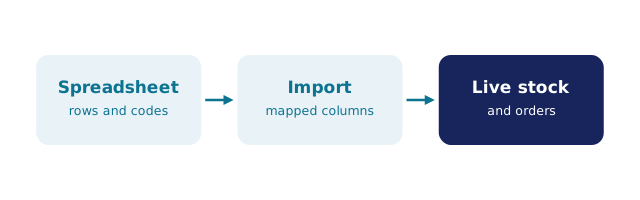
The good news: an Access database exports cleanly — tables to CSV, relationships documented in the design. Any proper inventory system imports that in an afternoon; BSimple (built by this site's authors, so weigh that) treats spreadsheet-grade import as first-class: products in, quantities baselined by one stocktake, movements recorded from day one, accounting handed to Xero or MYOB. The free-in-Excel sibling and the free-honesty dissection cover the stages below.
On the "free" in this search, plainly: Access is free only inside a Microsoft subscription you already pay, and it costs the maintainer's time forever after. BSimple is $180/$250/$399 per month AUD — the trial is how you price the trade against your builder's hours.
Frequently Asked Questions
Is Microsoft Access good for inventory management?
For one or two users, on Windows, with someone who maintains it — genuinely yes, and architecturally sound if built around a movements table. It fails on reach: browser, mobile, multi-site and portals are all outside Access's world.
Is Access really free?
Only within Microsoft 365/Office editions that include it — the database engine itself needs that licence. The real cost is maintenance time, which never appears on the invoice but never stops either.
How many users can share an Access inventory database?
Realistically a handful on a split database — front ends on each desktop, back end on the share. Beyond that, corruption risk and performance grow together. It is a workgroup tool, not a floor tool.
Can we keep using Access and just add a scanner?
Scanners type into focused fields, so Access forms accept them — that part is easy. The harder question is where the scanned work happens: Access on a laptop in the office versus a browser record on the floor is the real gap.
What does migrating from Access involve?
Export the tables, import the products, run one stocktake to baseline quantities, record movements in the new system from day one. The trial runs that on your data before any commitment — the archive stays as your backup.
BSimple