
Guide / configured vs bespoke
Custom retail inventory and order management system
"Custom" cuts two ways: a bespoke build you own forever, or a system configured to fit how you sell. For retail-adjacent wholesale, the second is almost always the better buy — what configuring actually covers, and where the retail boundary sits.
The key facts
- Two meanings of "custom": a bespoke build commissioned from developers, or a system configured to your selling pattern — per-customer pricing, portals, your product structure.
- The bespoke trap: retail-and-order logic looks simple and is not — reservations, partial fulfilment and price lists are where custom projects bleed. The build-vs-buy arithmetic prices it.
- The retail boundary: BSimple is not a counter point-of-sale; it serves businesses that sell product to retailers and stores, not scanned checkout counters.
- What configuration covers in BSimple: per-customer price lists, private ordering portals, product variants, locations, approval workflows — from $180/month AUD with a full-product trial.
- Where it fits: this page is one step of the order management walkthrough.
- 01The key facts
- 02What "custom" should mean for a growing seller
- 03The retail boundary, stated plainly
- 04When a bespoke build is genuinely right
What "custom" should mean for a growing seller
Businesses search for a "custom retail inventory and order management system" because off-the-shelf tools failed a specific way: customers with different prices, orders arriving by email and getting re-keyed, stock counts that disagree with the shop. The instinct is that a custom build is the only fix. Worth checking first is whether the failures are actually configuration failures — the tools simply were not set up with per-customer price lists, a self-serve ordering lane, or live stock across locations.
Configuration and bespoke differ in who owns the tail. A bespoke build means owning every patch, hosting decision and future feature. A configured system means the vendor carries the maintenance while the business shapes the parts that touch its customers: their lists, their pricing, their portal. For most operations the second gets to "works exactly how we sell" without the first's permanent payroll — the build-route arithmetic puts numbers on the difference.
The retail boundary, stated plainly
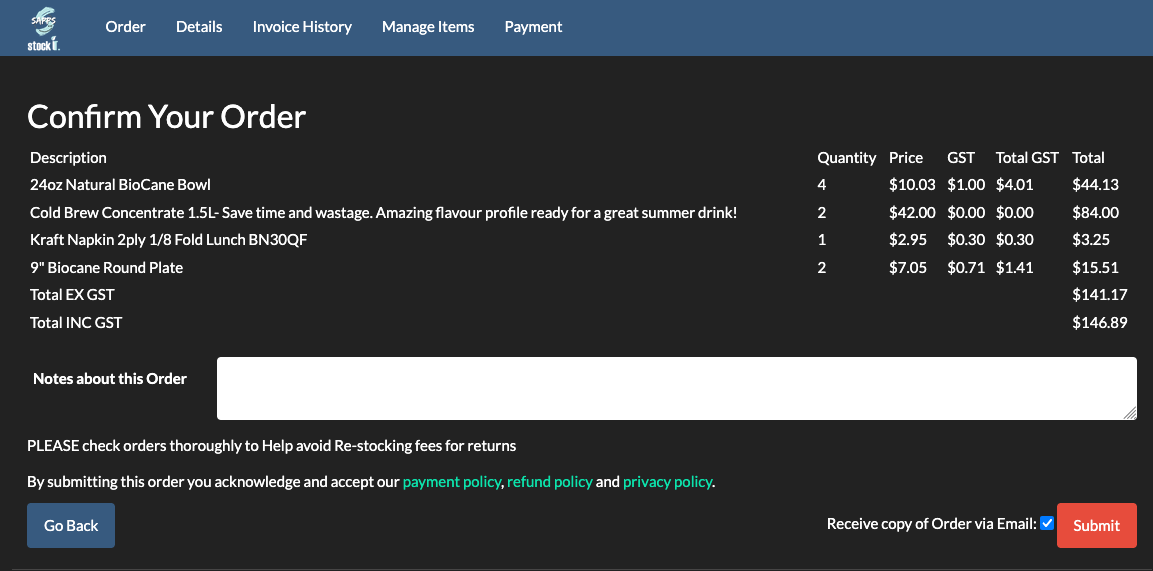
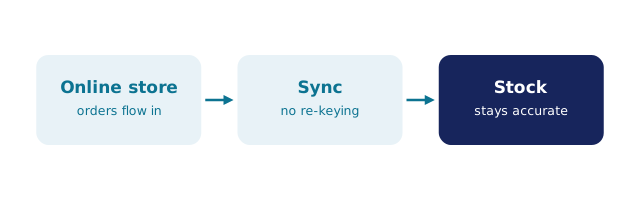
We build BSimple, so weigh that: it is not a checkout counter system. There is no till, no in-store POS, no walk-in customer scanning — retail storefronts typically run a POS in front and an operations system underneath. Where BSimple genuinely fits is the sell-to-retail pattern: wholesale supplying stores, e-commerce fulfilled from the same record (Shopify orders import by webhook), mail-order and B2B accounts that reorder.
What the configuration covers: each customer gets a private portal with their own product list and pricing; live quantities across locations hold the stock truth; orders move through pick and pack to an approved invoice that deducts stock and lands in Xero or MYOB (US integrations rolling out); backorders and partial fulfilment are designed paths, not workarounds. From $180/month AUD, with the trial as the full product so the configuration can be tested on your own catalogue. For apparel and variant-heavy sellers, the apparel-specific guide covers the sizing dimension in depth.
When a bespoke build is genuinely right
Sometimes the honest answer is build: selling models that no product configures to (marketplace-style commission splits, made-to-order with customer-supplied materials), or integration surfaces nothing standard touches. If that is your case, commission deliberately — with the data model specified before the screens, and the maintenance tail priced in writing. What should never be bespoke is the boring core underneath: stock movements, derived quantities, audit trails. Those are solved problems; solving them again is where custom retail projects historically go to die.
Frequently Asked Questions
Can BSimple be customised for my retail operation?
Configured, yes: per-customer product lists and pricing, private ordering portals, variants, locations and approval flows are all set up to match how you sell. The underlying product is not bespoke-built — that is the point: the fit comes from configuration, the reliability from shared maintenance.
Does BSimple work as a shop counter POS?
No — no till, no barcode-scanned checkout, no walk-in transactions. BSimple runs the stock and order record behind a business that sells to stores and online; a POS for the counter and BSimple underneath is the common pairing.
How much does a custom retail inventory system cost to build?
More than the quote, always: bespoke builds carry a permanent tail of hosting, patches and feature work. Price two years of that against a configured product at $180–$399 AUD monthly, and include the risk that the build's edge cases — partial shipments, price-list changes — surface after launch.
Can customers with different price lists order online?
Yes — that is exactly the per-customer portal model: each customer sees only their products at their prices through a private link, and orders land in the same record the warehouse fulfils from, with no re-keying.
How do I test whether configuration covers my needs?
Load your real catalogue into the trial, set up two customers with genuinely different price lists, and run one order through each to invoice. If the configuration reaches your selling model, the custom-build question dissolves.
BSimple