
Guide / categories
Business process management tools: a practical list
Most "BPM tools" lists are vendor rosters in disguise. This one starts from the processes a wholesale, manufacturing or distribution business actually runs — and names the categories of tool that manage each, with the honest limits of BPM software for operations.
The key facts
- The categories that matter: process mapping and documentation, workflow automation, ERP/BPM suites, integration platforms, and operations systems with the process built in.
- The honest ordering: for businesses that make, move or sell things, the operational record — inventory, orders, purchasing — is the process backbone; BPM layers come after.
- BPM software's real shape: mapping, modelling and workflow engines. Powerful for approval-heavy office processes; thin on physical operations.
- BSimple's corner: operations software for wholesale, manufacturing, distribution and trade — the stock-to-invoice process enforced by one record, not a modelling layer.
- 01The key facts
- 02What BPM tools actually are
- 03The practical list, by process
- 04Choosing between a BPM layer and an operations system
What BPM tools actually are
Business process management software is a discipline with a toolset: process mapping (documenting how work flows), workflow engines (routing tasks, approvals and handoffs by rule), and — at the heavy end — BPM suites that model, execute, monitor and optimise defined processes. The category earns its keep in approval-heavy, office-shaped processes: onboarding a customer, handling a claim, routing a requisition through three sign-offs.
The honest limitation for physical businesses: BPM tools model processes, but they do not hold the record the process works on. A workflow engine can route "check stock before promising delivery" to someone — it cannot itself know what stock exists. That is why operations-heavy businesses usually get more from a system with the process built into the record, and reach for BPM tooling later, for the office processes around the edge.
The practical list, by process
The stock-to-invoice process (the backbone for wholesale, manufacturing, distribution): an operations system — inventory, orders, purchasing, invoicing on one record. This is BSimple's category; the inventory pillar covers the record that makes the process real.
The customer-ordering process: portals with per-customer products and pricing, order status, pick-and-pack — built into operations software rather than modelled in a workflow tool. The ordering portal is the pattern.
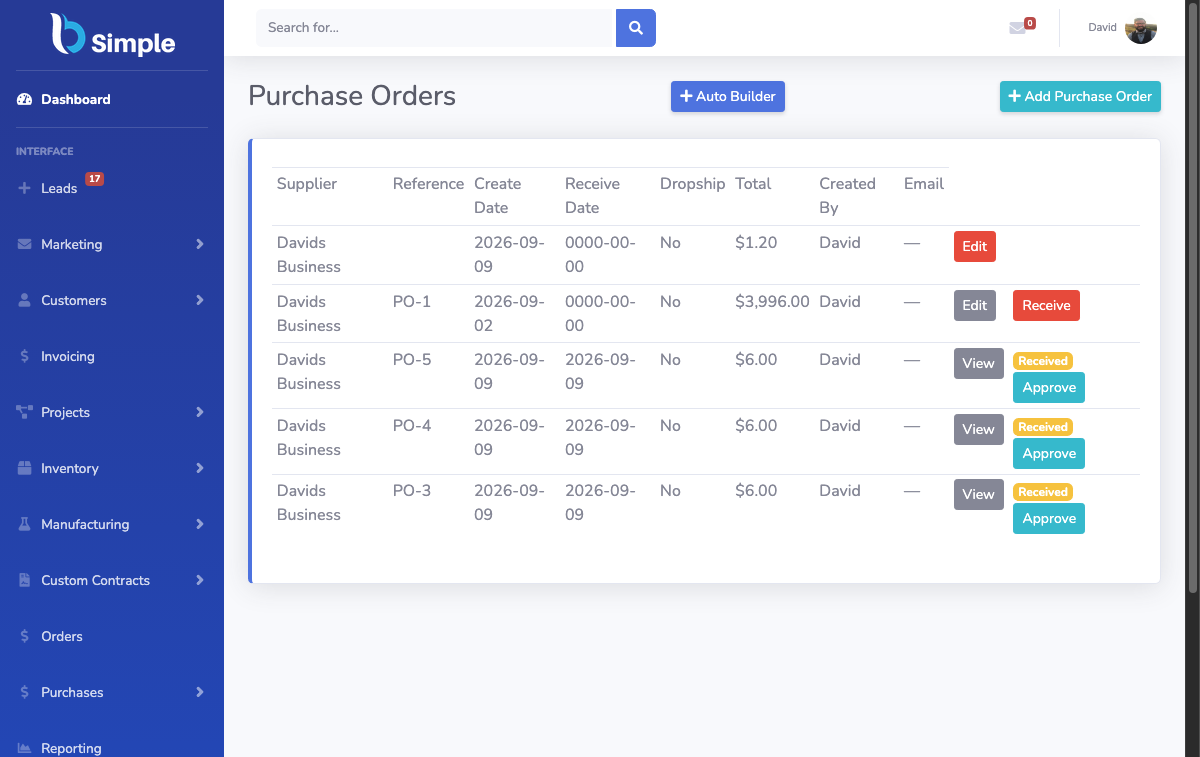
The purchasing process: demand-based POs, supplier invoice matching, price-variance flags, goods receipts updating stock — again, record-integrated, not routed.
Office and approval processes: here the classic BPM categories fit — mapping and documentation tools for defining the process, workflow engines for routing approvals, integration platforms for stitching systems together. The operations-process primer shows how the operational and office layers relate.
The automation surface: APIs and webhooks let processes cross system boundaries — the automation overview covers what BSimple exposes (public REST API, Shopify import, MCP for AI assistants).
Choosing between a BPM layer and an operations system
The decision test: does the process work on things or on approvals? Approvals — purchase sign-offs, customer onboarding, document routing — are BPM territory, and a workflow engine will serve them well. Things — stock, orders, production, invoicing — need a record, and no amount of process modelling substitutes for one. Businesses that buy the BPM suite first usually discover they have bought excellent documentation of a process that still runs on spreadsheets.
The pragmatic sequence for a small or mid-sized physical business: put the record first, let it enforce the operational process by construction, and add BPM tooling only where genuine approval complexity survives. We build BSimple, so weigh that — but the sequence holds regardless of vendor, and the trial tests whether one record really can carry the backbone process on your own products.
Frequently Asked Questions
What are business process management tools?
Software for defining, executing and improving business processes: mapping and documentation tools, workflow engines that route tasks and approvals by rule, and BPM suites that combine both with monitoring. They manage process flow; they do not hold the operational record the flow works on.
Is BSimple a BPM tool?
No — BSimple is operations software: inventory, orders, purchasing and invoicing on one record for wholesale, manufacturing, distribution and trade businesses. Its "process management" is structural — the stock-to-invoice process is enforced by how the record works, not by a modelling layer.
Which comes first, BPM software or an operations system?
For businesses that handle physical goods, the operations system: the record is the backbone, and process modelling over an untrustworthy record documents chaos precisely. BPM tooling earns its place later, for approval-heavy office processes around the edge.
What is an example of a process software should enforce?
The stock-to-invoice flow: an order validates against live stock, reserves without double-promising, moves through pick and pack, and deducts stock only at invoice approval. In an operations system that flow is the data model; in a BPM tool it would be a diagram routed to whoever checks the spreadsheet.
How do I evaluate a tools list without falling for a demo?
Run your own process — one real order, one real purchase, one real approval — through the candidate, including the failure paths. The trial exists so that test can happen on your own products before anything is bought.

BSimple