
Guide / IB course
Business management tools in IB
In the International Baccalaureate Business Management course, "tools" means the analytical toolkit — SWOT, Ansoff, STEEPLE, decision trees and their siblings — that students apply to case studies. What the toolkit covers, how to use it well, and where it meets real software.
The key facts
- The context: IB Business Management is a Group 3 subject in the International Baccalaureate Diploma Programme, assessed through case-study application and a research project.
- The toolkit: analytical frames — SWOT, Ansoff, STEEPLE, BCG, decision trees, fishbone diagrams, Gantt charts and similar — used to structure analysis, not to decorate it.
- How examiners read them: a tool earns marks when it drives the answer — applied to the stimulus, interpreted, and followed by a conclusion.
- The real-world bridge: every tool has an operational cousin — the inventory systems this site covers run the reorder and capacity ideas the course describes.
- 01The key facts
- 02What "tools" means in the IB course
- 03Using the tools well in assessment
- 04From the classroom to the operations floor
What "tools" means in the IB course
The course uses "tools" for the analytical frames that organise business thinking: SWOT for internal-external positioning, Ansoff for growth direction, STEEPLE for external environment, BCG for portfolio balance, decision trees for choices under uncertainty, fishbone diagrams for cause analysis, Gantt and critical-path thinking for projects. They share a shape: each one forces a specific set of questions onto a messy situation and produces a structure a reader can check.
That is also the skill being examined. A tool applied by rote — a SWOT with four bullet points and no consequence — scores little; the same SWOT that identifies which strength answers which threat, and what the business should therefore do, is the difference between naming and analysing. The fuller tools list catalogues them with usage notes, and the theories page separates tools from the theories they support.
Using the tools well in assessment
Anchor every tool in the stimulus. The case study supplies the facts; the tool organises them. If a SWOT point could appear in any business's analysis, it is not about this business yet.
Interpret, do not just present. The diagram is the beginning: what does the decision tree's expected value actually recommend, and what does it ignore? The evaluation sits after the tool, and that is where the marks concentrate.
Choose tools that fit the question. A question about market entry invites Ansoff and STEEPLE; one about a failing process invites fishbone. Examiners reward fit, not quantity — three well-driven tools beat six decorations.
Let the tool end in a decision. The course's through-line is decision-making under constraint; a tool that produces no "therefore" is unfinished. That habit — frame, evidence, decide — is the portable skill the toolkit teaches.
From the classroom to the operations floor
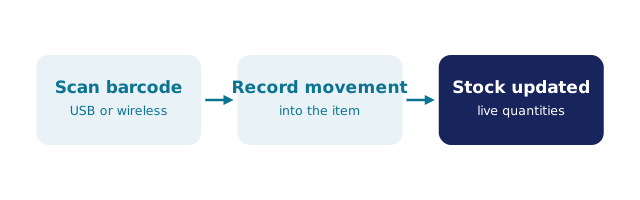
The tools are taught on paper because paper is where you learn to see the structure. In a running business, the same frames operate on live data: the reorder point is a decision rule, the production schedule is Gantt thinking enforced by software, and the stock variance investigation is a fishbone diagram with real causes and real dollars. Seeing that continuity is worth doing early — a worked order example shows the operational version of the decision-making the course teaches, and the software-versus-course comparison maps where study ends and practice begins.
We build BSimple, so weigh that: it is not a study resource but real operations software for wholesale, manufacturing, distribution and trade businesses — the systems layer where the course's inventory and operations concepts run for real, from $180/month AUD with a full-product trial.
Frequently Asked Questions
What are the business management tools in IB?
The analytical toolkit of the IB Business Management course — SWOT, Ansoff, STEEPLE, BCG, decision trees, fishbone diagrams, Gantt charts and similar frames — used to structure analysis of case studies and the internal assessment research project.
How many tools should I use in an exam answer?
The ones the question fits — usually one or three, applied deeply, rather than a scatter. Examiners reward tools that drive interpretation and a conclusion; decoration without consequence earns little.
What is the difference between tools and theories in the course?
Tools are the frames you draw and apply (a decision tree, a SWOT grid); theories are the underlying models they express or test. The tools-versus-theories page works through the distinction.
Are these tools used in real businesses?
Yes, in the same spirit: simpler and embedded in software. Reorder points and production schedules are decision rules; variance analysis is a fishbone with dollar figures. The operations side shows where the classroom concepts run daily.
Is this site part of the IB or affiliated with it?
No — BSimple is business management software, independent of the IB organisation. This page explains the course terminology honestly and connects it to real operations; nothing here is official IB material.

BSimple