
Guide / ISO 9001, honestly
Business management systems and ISO 9001
ISO 9001 is a quality management standard, and audits are mostly questions about records: who did what, when, against which version. Here is what the standard asks of a business system — and the honest limits.
The key facts
- ISO 9001 is a quality management standard — certification belongs to the business, audited by a certification body. Software is not certified; we do not claim it.
- What audits ask about records: control of documents, traceability of product, records of corrective actions — all record questions.
- Where an operational record helps: audit trails, batch traceability, controlled adjustments, document-able processes.
- Where it stops: the quality manual, management review and the culture are yours; software supports, it does not certify.
- 01The key facts
- 02What ISO 9001 asks of your records
- 03Where an operational record supports the audit
- 04BSimple, honestly placed
What ISO 9001 asks of your records
The standard is deliberately software-agnostic, but its requirements are record-shaped. Documented information must be controlled — current versions, available where used. Traceability must exist where it matters: what went into a batch, where it shipped. Nonconformity and corrective action must be recorded: what failed, what was done, what changed. Monitoring needs evidence over time.
Businesses trying to pass audits on spreadsheets discover the recurring theme: the evidence exists, but nobody can produce it quickly or trust it. "Who adjusted this quantity, and why?" is an audit question a spreadsheet answers with an hour of archaeology.
Where an operational record supports the audit
- Audit trail. Every stock movement, adjustment and approval recorded with user and timestamp — traceability of records, on demand.
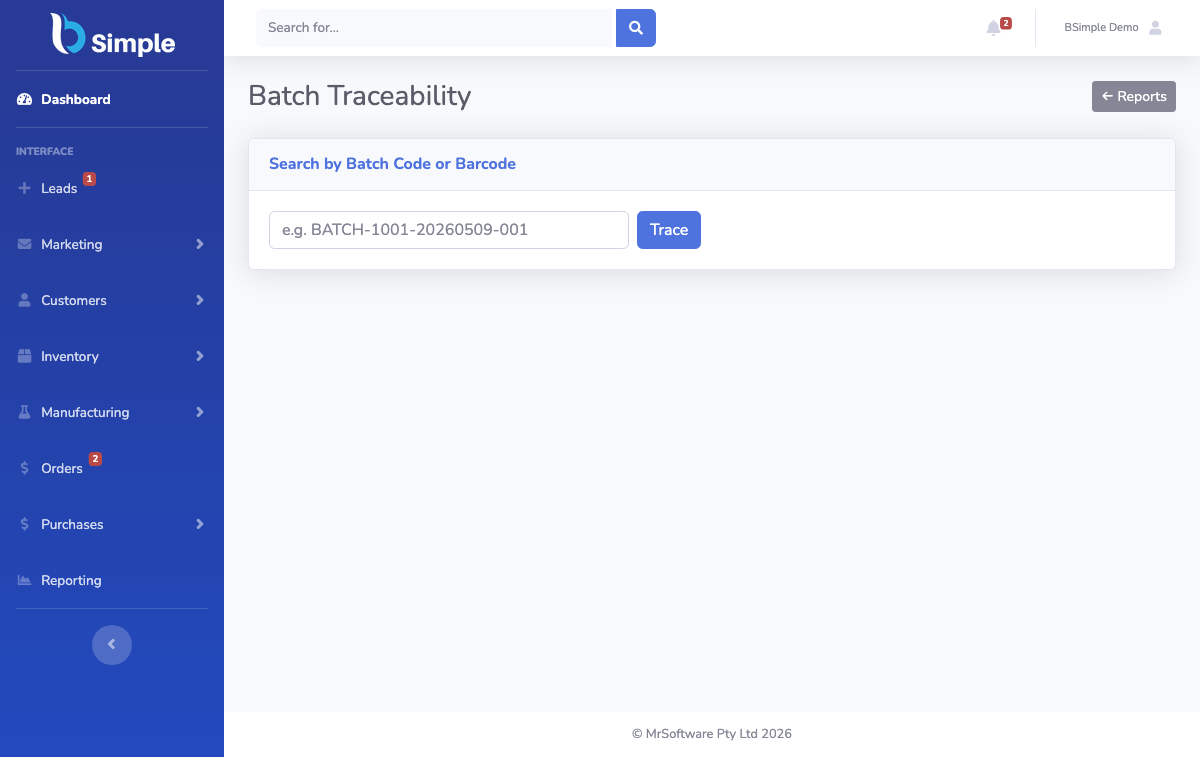
- Product traceability. Batch and lot tracking linking finished goods to inputs and outputs — the requirement where product realisation needs it.
- Controlled processes. Reorder levels and workflows that run the same way every time, rather than depending on who remembered.
- Deliberate adjustments. Variances and corrections entered with a reason — corrective action with evidence attached.
- Reporting. Order, invoice and stock values available as evidence rather than reconstructed.
What the software does not do: write your quality manual, run management reviews, or create the culture the standard is really about. Certification belongs to the business; the software keeps the records the auditor asks to see.
BSimple, honestly placed
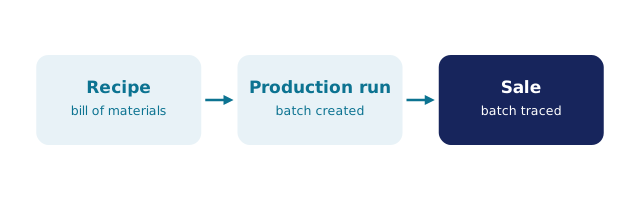
We build BSimple, so weigh that. BSimple is not ISO 9001 certified and we make no certification claims — the standard applies to businesses, and your certification body audits you. What BSimple provides is the operational record those audits ask about: batch traceability, audit trails, controlled workflows and reporting on one record, with invoicing handed to Xero or MYOB, from $180/month (AUD). The system diagram shows the record's shape; what a BMS is covers the definitions.
The honest test for an ISO-bound business: run the trial, then ask — for one real batch — can I produce its history in five minutes? If yes, the record layer is audit-ready; the rest of the standard is your project.
Frequently Asked Questions
Is BSimple ISO 9001 certified?
No — and no inventory software is, in the relevant sense: ISO 9001 certifies businesses' quality management systems, not products. What BSimple provides is the record-keeping layer — audit trails, traceability, controlled adjustments — that the standard asks you to demonstrate.
What records does ISO 9001 require from inventory?
Controlled documented information, traceability where required, records of nonconformity and corrective action, and monitoring evidence. In practice: who moved stock and why, which batch went where, and what changed after something went wrong.
Can BSimple replace our quality manual?
No. The quality management system — policies, reviews, culture — is yours. BSimple keeps the operational records that evidence your processes; the standard's management requirements sit outside any inventory product.
How do we test the record before our audit?
Run the trial, then pick one real batch and one real adjustment: produce the full history of each in minutes. That rehearsal is the audit question your records will face.
BSimple