
Guide / careers
Business management job application
The honest answer first: BSimple is business management software, not a recruitment platform — there is no application system here. What the search likely needs: how applications work, what business-management employers actually test, and which systems skills help.
The key facts
- The boundary: BSimple has no job board, no application portal and no recruitment module — it is operations software, and no HR or payroll lives in it.
- What the search usually wants: either how to apply for business-management roles, or how a small business should handle incoming applications — both answered without inventing features.
- What employers actually screen for: stock and record discipline, spreadsheet fluency, and hands-on familiarity with an operations system.
- The preparable edge: running a real software trial on your own scenario beats claiming "familiarity" in the interview.
- 01The key facts
- 02For the applicant: what the process looks like
- 03For the small business: handling applications without an HR module
- 04The systems skills that move an application forward
For the applicant: what the process looks like
Business-management role applications — coordinator, operations manager, inventory controller — follow the standard funnel: a résumé tailored to the operational achievements the ad names, a short cover letter that shows you understand the business's shape (what it stocks, who it sells to, how orders flow), and then interviews that probe scenarios rather than slogans. The differentiator at the interview stage is specificity: describing how you would chase a stock variance to its cause, or how you would structure a supplier negotiation, says more than any adjective about being "detail-oriented".
For warehouse-and-operations-flavoured roles, the warehouse software careers guide maps the role types and the skills each one is actually tested on. Where to apply: employer sites and the mainstream job boards — we publish no listings and will not pretend otherwise.
For the small business: handling applications without an HR module
The reverse intent also lands here: a small employer searching for software to manage job applications. The honest answer is that full hiring pipelines belong to recruitment tools, and lightweight needs belong to a shared inbox plus a folder — what matters is not the pipeline but the discipline: one place applications land, a named reviewer, a decision recorded within a promised window.
What an operations system does contribute to hiring is upstream: when stock, purchasing and orders run on one record, the operations role you are hiring for is defined by facts — the movement history shows what the job actually involves, and the new starter inherits a record rather than a mystery. Training on a real system beats training on folklore, and the free learning path covers the concepts before day one.
The systems skills that move an application forward
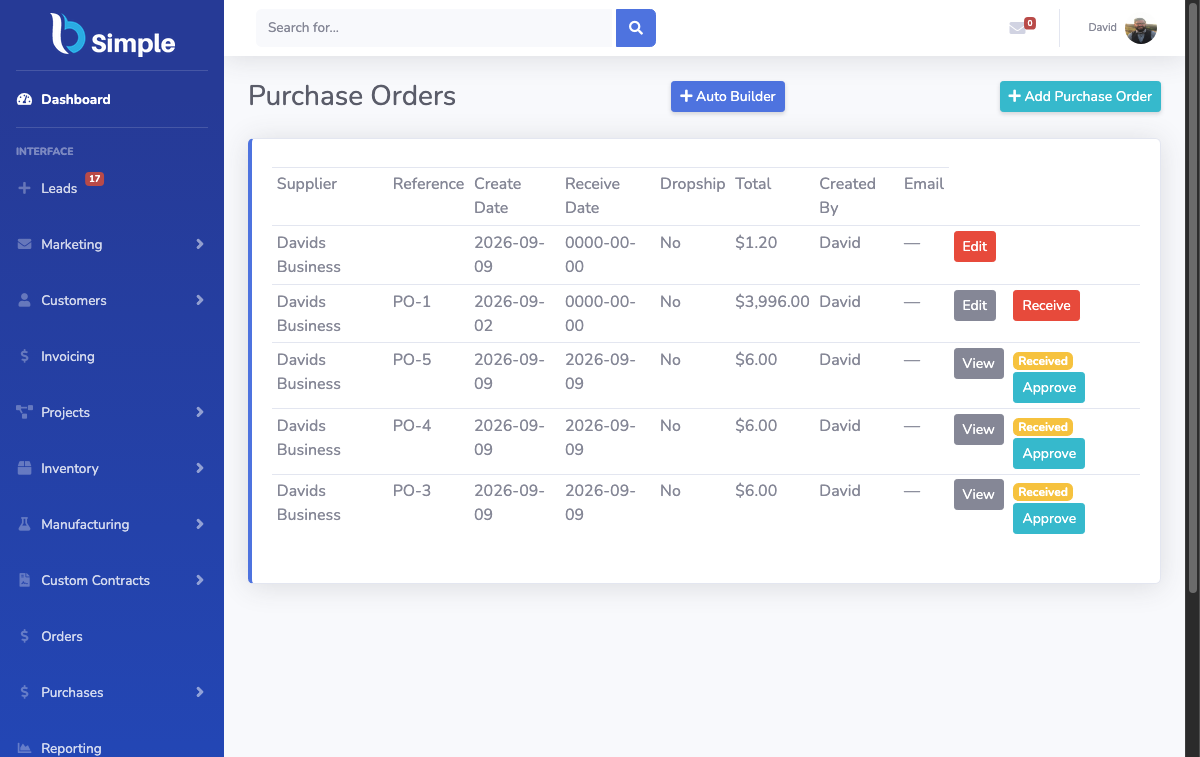
Across business-management hiring, the same practical signals recur: fluency with spreadsheets (filtering, pivoting, reconciling), discipline with records (counts, variances, audit trails), and hands-on experience with at least one real operations system — the brand matters less than the concepts. That experience is buildable before the interview: a full-product trial lets a candidate receive a purchase order, run a stocktake, chase a variance and walk an order from portal to invoice on real data — the exact workflow many interviews describe. We build BSimple, so weigh that: the trial is genuinely the whole product, which makes it a fair classroom as well as a fair test. And for what the underlying record actually is, the inventory management pillar is the reference.
Frequently Asked Questions
Can I apply for a job through BSimple?
No — BSimple is business management software for wholesale, manufacturing, distribution and trade businesses. There is no application portal, job board or recruitment module here; apply directly with employers or on the job platforms.
Does BSimple help a small business manage job applications?
No — hiring pipelines belong to recruitment tools, and light needs need only a shared inbox and discipline. BSimple's contribution is upstream: the operations record that defines the role and trains the new starter.
What do business management employers look for?
Record discipline, spreadsheet fluency and hands-on system experience — demonstrated through scenario answers rather than slogans. Being able to narrate a stock variance investigation or a supplier reconciliation is the interview-winning material.
How can I get hands-on system experience before an interview?
Run the trial — the full product — on a realistic scenario: one purchase order, one order through picking to invoice, one count with a variance. Walk the interviewer through what you did; it is the most credible evidence available.
Does BSimple have HR or payroll features?
No, deliberately — no HR, no payroll, no recruitment. BSimple covers inventory, orders, purchasing and production; the people layer stays with dedicated tools.

BSimple