
Guide / continuity
Business continuity management systems — what they are
A BCMS keeps a business operating through disruption: analysis, plans, exercises, governance. What the discipline involves, and what an operations record genuinely contributes to it.
The key facts
- A BCMS is a management discipline: impact analysis, recovery objectives, continuity plans, exercises and review — benchmarked by ISO 22301.
- It is governance, not software: tools support it; no product is a BCMS by itself.
- What operations software contributes: a record that survives disruption — vendor-managed availability, backups, audit trails, and remote access to live truth.
- BSimple is not a BCMS product — stated plainly; its contribution is the operational record your plans will point at.
- The full picture: how the inventory record works is the hub page for everything above.
- 01The key facts
- 02What a BCMS actually involves
- 03What an operations record contributes to continuity
- 04BSimple's position, plainly
What a BCMS actually involves
A business continuity management system is the organisational machinery for surviving disruption, formalised in standards like ISO 22301. Its moving parts: a business impact analysis (which activities, and how quickly they hurt when stopped — quantified in recovery time objectives and recovery point objectives); risk assessment for the scenarios that could stop them; continuity plans documenting who does what when they do; exercises that rehearse the plans before reality does; and governance — ownership, review cycles, and board-level accountability. The risk-management cousin and the solutions landscape cover the software that supports the discipline.
The definitional point that matters to this search: a BCMS is governance first, tooling second. Software that promises to "be your BCMS" is selling a document store; the discipline lives in analysis, decisions and rehearsals.
What an operations record contributes to continuity
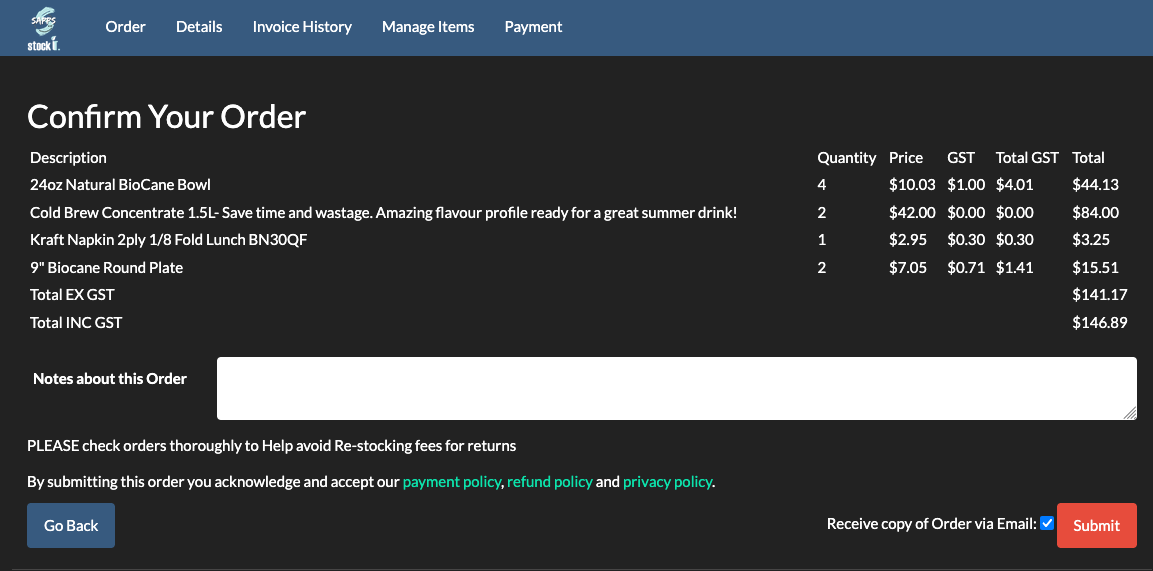
Continuity plans fail on one recurring detail: during disruption, nobody can answer "what do we actually have, owe, and owe whom?". An operational record that is live, backed up and remotely reachable changes that. Concretely, in BSimple's case: availability is the vendor's job (cloud, with redundancy and backups a self-hosted spreadsheet never had); the record is reachable from anywhere (browser-based — the warehouse can be underwater and the stock truth is still readable); the audit trail survives (every movement attributed, so recovery starts from known truth rather than reconstructed guesswork); and the accounting handoff stays clean (invoices pushed to Xero or MYOB, US integrations rolling out — the books keep moving while the floor recovers).
That is a contribution, not a BCMS — stated plainly. The analysis, objectives, plans and rehearsals remain management work that software supports but cannot substitute. The trust question — cloud versus self-hosted for continuity — is worth reading beside this.

BSimple's position, plainly
We build BSimple, so weigh that: it is operations software, not a BCMS product — no impact-analysis workflows, no plan libraries, no exercise management. What it offers the continuity conversation is subtraction from your plan's hard cases: the stock and order truth is live, attributable, backed up by the vendor, and reachable from any browser. Plans run $180/$250/$399 per month AUD, with the trial as the full product — and the continuity test is fair to ask: what happens to your current record tonight if the office is unreachable tomorrow?
Frequently Asked Questions
What is a business continuity management system?
The management discipline for surviving disruption: impact analysis with recovery objectives, risk assessment, continuity plans, exercises and governance — benchmarked by ISO 22301. Governance first; tooling supports it.
Is BSimple a BCMS?
No — no impact analysis, plan libraries or exercise workflows, stated plainly. Its contribution to continuity is the operational record itself: live, attributable, vendor-backed-up, reachable from anywhere.
What is the difference between a BCMS and ERM?
Continuity focuses on keeping operations running through disruption; enterprise risk management governs the wider register of risks. They overlap at the analysis stage — the ERM page covers the distinction.
How does an operations record help set recovery objectives?
It quantifies what disruption costs: how many orders flow per hour, which products matter, what the books need. RTO and RPO decisions improve when the record makes the stakes visible.
What should we ask a software vendor about continuity?
Where data lives, how backups run and are tested, what the availability record is, and how the record is reached during an outage. Ask us the same — the trial and the answers together are the honest evaluation.
BSimple