
Guide / books and stock, combined?
Open source accounting and inventory: the honest audit
One tool for books and stock is the dream the ERPs sold. Here is what the open-source route to it actually involves — and the division of labour that most SMEs land on instead.
The short answer
- Open-source suites exist that hold books and stock together — self-hosted, configured, and maintained by you.
- The real cost is the double duty: accounting compliance and warehouse workflow have different update rhythms, and you own both.
- The alternative division: operations in a dedicated system, the ledger in Xero or MYOB, invoices as the reviewed bridge.
- BSimple takes the second path — deliberately not accounting software, from $180/month (AUD) with a trial.
- 01The short answer
- 02What the combined route really involves
- 03The division that most SMEs land on
- 04Where BSimple fits
What the combined route really involves
The appeal is real: one tool, one licence bill ($0), books and stock in the same database. The involvement is real too. You become the administrator — hosting, upgrades, backups and security for a system that now matters to both the warehouse and the BAS. You own compliance adjacency: accounting rules change (rates, reporting, e-invoicing), and a community project updates on its own calendar, not yours. You own the seams anyway — bank feeds, payroll connections and tax filing often reach beyond the suite, so integrations appear after all. You own the knowledge: when the one person who configured the chart of accounts and the stock valuation logic leaves, they take the manual with them.
None of this makes open source wrong — it makes it a staffing decision. A business with genuine technical capacity and stable requirements can run a combined suite well. Businesses without that capacity inherit a second job.
The division that most SMEs land on
The alternative keeps each tool on its own rhythm: operations in a dedicated system — stock, orders, purchasing, invoicing, live and workflow-driven — and compliance in the ledger (Xero or MYOB), with approved invoices as the reviewed bridge between them. Payment status mirrors back; purchase orders reconcile with their GST detail; the accountant keeps their tools; the warehouse keeps live quantities. Each system updates when its world changes — tax rules in the ledger, workflow in the operations system — and neither holds a copy of the other.
That is the design BSimple implements, deliberately: it is not accounting software and does not hold a ledger. What it holds is the operational record those books deserve: the Xero integration specifies the bridge, and inventory software versus ERP draws the combined-versus-divided line in full.
Where BSimple fits
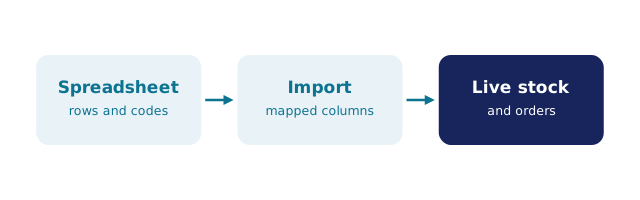
We build BSimple, so weigh that. It is closed-source, cloud, browser-based — the opposite corner from the self-hosted suite — and it exists for businesses that would rather run the record than the software: live multi-location stock, orders with a customer portal, purchasing from demand, batch traceability, invoicing handed to Xero or MYOB with US systems rolling out. From $180/month (AUD), with the free trial as the honest test. For the open-source inventory layer alone — without the accounting ambition — the open-source store assessment weighs that narrower choice.
Frequently Asked Questions
Is BSimple open source?
No — closed-source commercial software, cloud-based, from $180/month (AUD) with a free trial. It does publish a REST API with keys and scopes, so your operational data remains accessible and scriptable even though the code is not open.
Can open-source software handle Australian GST?
Some community-maintained suites have GST support, but the depth — inc/ex purchasing reconciliation, BAS-ready outputs, tax-code extension — varies and is yours to verify and maintain. The divided approach keeps GST handling in the ledger (where it is maintained professionally) and the operational GST detail in the record.
Why not hold books and stock in one database?
Because the two worlds change on different clocks and carry different risk: a workflow update should never touch compliance, and a tax change should never touch the pick path. The reviewed invoice bridge gives you one truth without one point of failure — which is the part the ERP dream actually wanted.
What would make the combined open-source route right?
Genuine technical capacity in-house, stable requirements, comfort being the administrator of record for a system the accountant also depends on — and a preference for licence freedom over vendor accountability. Businesses that match that description run such suites happily; the honest failure is businesses that match it aspirationally.

BSimple