
Guide / examples
Inventory management system examples (PDF)
An examples document is worth its length only if the examples are real: one complete workflow, honest sample data, and a schema that survives scrutiny. What to look for when reading one, and how to assemble your own.
The key facts
- What a good examples document holds: one end-to-end workflow (order to invoice), realistic sample data, the schema behind it, and the failure paths — not a screenshot gallery.
- The reading test: can you trace one product from purchase order to sold-and-counted, on the document alone? If not, it is marketing.
- Writing your own: a handful of products, a week of movements, and the reports a real owner would run — the exercise that teaches the domain fastest.
- The bridge: the worked order example and the project-PDF structure pair with this page.
- The wider system: inventory management end to end maps the whole record this page sits in.
- 01The key facts
- 02What the good documents contain
- 03Reading an examples PDF critically
- 04Writing your own examples document
What the good documents contain
One complete workflow, not five partial ones. A single product traced from purchase order through receipt, putaway, allocation, pick, dispatch, invoice and payment — with the stock figure shown at each step. Completeness is what makes an example teach; five disconnected screenshots teach nothing about sequence.
Honest sample data. Twenty products with real-looking names, units and costs; a movement history with a messy week in it — a partial receipt, a count correction, a backorder. Seeded perfection demonstrates nothing; the value is in seeing how the system represents the ugly cases.
The schema. Even one page: products, movements, orders — with the movement table visible and quantities derived. If the document omits the data model, it is hiding the only part that predicts behaviour. The database-design reference is what a serious schema page looks like.
The failure paths. A short pick, a cancelled reservation, a voided payment — shown as the system handles them. Examples that only show the happy path are demonstrations, not documentation.
Reading an examples PDF critically
Trace, don't browse. Pick one product and follow it through every image and table in the document. If the trace breaks — the stock figure changes without a movement, the invoice appears without an approval step — the system behind the document is guessing.
Check the arithmetic on the page. On-hand quantities should equal the movements shown; invoice totals should equal their lines. Examples documents that fail their own arithmetic are common, and they are a gift: the vendor has shown you the record discipline in one page.
Note what is absent. No audit trail shown? No user identities on the movements? No handling for the second user? The omissions are the requirements list for your questions — the buying-guide checks turn them into a script.
Writing your own examples document
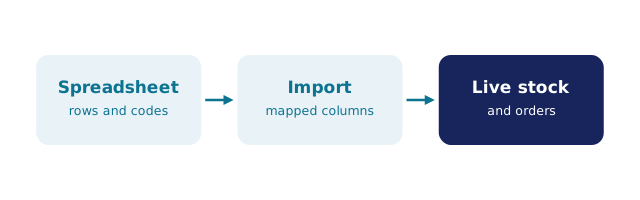
The exercise is the fastest way to learn the domain: choose a handful of products, write a week of movements by hand — receipts, sales, a correction, a return — and derive the stock on hand for each day. Then write the invoices those sales produced, with tax codes, and reconcile the week against a stocktake. Whatever felt ambiguous is exactly what the software you eventually choose must answer, and the document you have produced is the requirements list. The project-PDF structure gives it a professional shape, and the trial route turns it into a test script — the full product on your own data, which is the one example document that cannot mislead you.
Frequently Asked Questions
What should an inventory system examples PDF include?
One complete traced workflow, honest sample data including failures, the schema with the movement table visible, and the failure paths. Screenshot galleries without sequence are marketing, not examples.
Where can I find a real examples document?
Vendor documentation and this site's guides. The worked order example traces one order end to end, and the trial produces the most honest example of all: your own products moving through the system.
How many examples does a good document need?
Fewer than you think: one complete workflow teaches more than ten fragments. Add examples only for genuinely different shapes — a return, a production run, a transfer — after the first one is airtight.
What is the most common flaw in examples documents?
Stock figures that change without movements behind them. It is usually a rendering choice by the designer, but it hides exactly the record discipline — audit trail, derivations — that the reader most needs to see.
Can I write one for my own business?
Yes, and you should: a week of movements, derived stock, invoices and a count reconciliation, by hand. It is the fastest inventory education available and doubles as the requirements list for any system you evaluate.

BSimple