
Guide / comparing inventory software
Inventory management software: the honest list
Most lists rank ten products you have never heard of. This one gives you the categories every real list draws from, what each type is good at, and how to shortlist for your business.
The list, in one view
- Spreadsheets and templates — free, flexible, fine for one person; no workflow, no guardrails.
- Free and open-source tools — real software at no licence cost; you pay in setup, limits and self-support.
- POS and ecommerce-attached inventory — stock control bolted onto a retail or online-store system.
- SMB business management systems — inventory, orders, purchasing and invoicing on one record; BSimple sits in this category.
- Full ERP suites — deep and expensive; the right answer at a scale most readers of this page have not reached.
- 01The list, in one view
- 02Spreadsheets, free tools and store-attached stock control
- 03SMB business management systems
- 04Full ERP suites
- 05How to shortlist from any list
Spreadsheets, free tools and store-attached stock control
Spreadsheets are where nearly everyone starts, and they are not shameful — one person, a few hundred SKUs, and careful habits can go a long way. What they cannot do is enforce anything: nothing stops two people editing the same sheet, nothing reserves stock for an order, and accuracy only returns at each count.
Free and open-source tools are the next rung: genuinely free software with real records, paid for in setup time, feature ceilings and looking after it yourself. They suit teams whose needs are simple and stable. The honest limits of that tier — and why "free" pages deserve scrutiny — are covered in the free stock management comparison.
POS and ecommerce-attached inventory keeps stock inside the system that makes the sale. It works until stock moves anywhere except that channel: a wholesale order, a second warehouse, a purchase order. If every sale happens at one counter or one store, it can be enough; the moment it is not, the stock record needs to be its own thing.
SMB business management systems
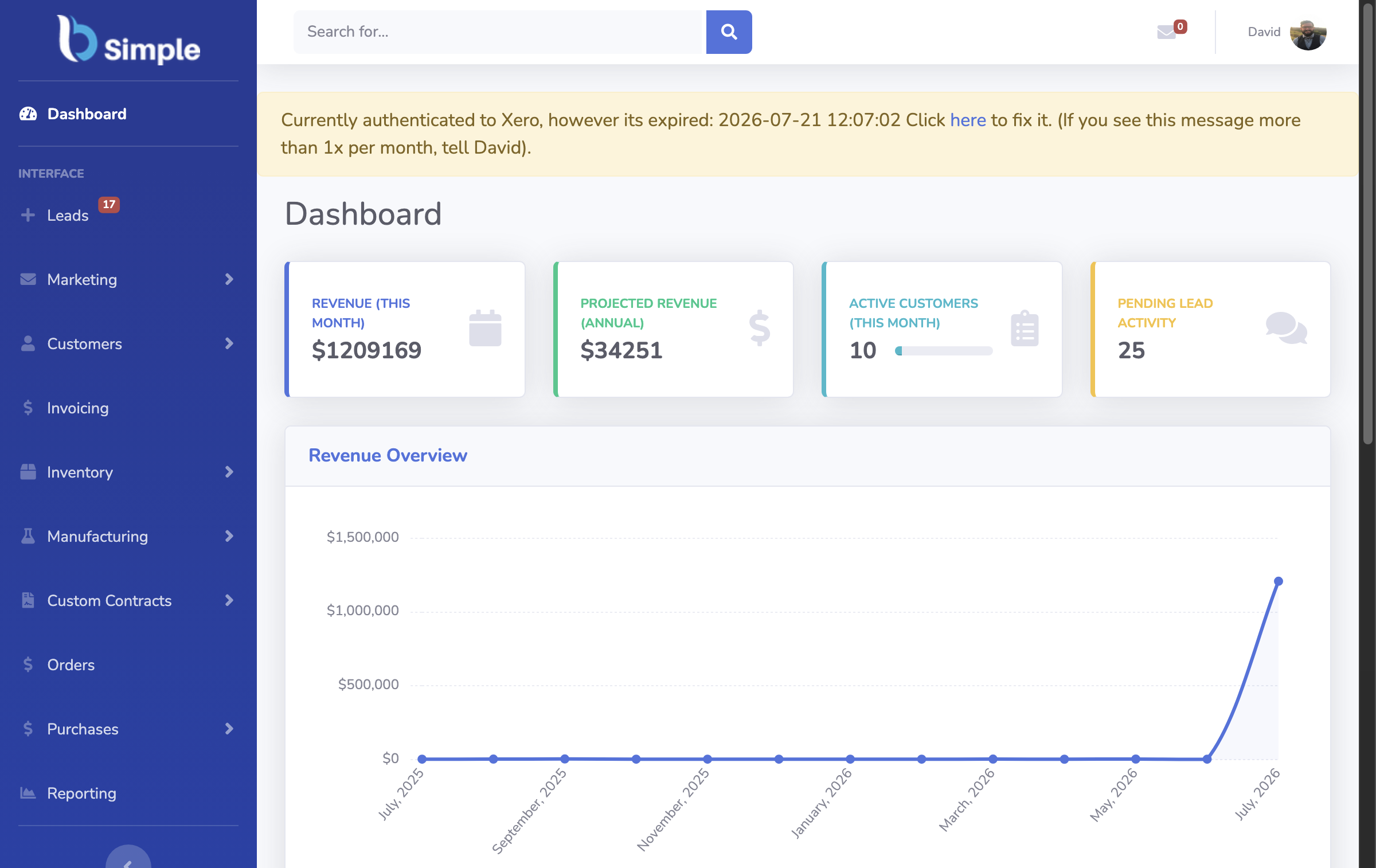
This is the category most growing product businesses actually need, and the one BSimple sits in: inventory, orders, purchasing and invoicing on a single record, with accounting handed off to Xero or MYOB rather than replaced. The defining test of the category is that the quantity the warehouse sees, the order book sees and the invoice carries are the same number — because they are one record, not three synced copies.
Within the category, products differ by emphasis: some lean retail, some lean production. BSimple is built for wholesale, manufacturing, distribution and trade businesses — multi-location stock, reorder and par levels, a customer ordering portal, batch and lot tracking, and recipes and production runs included in every plan from $180/month (AUD). The inventory management overview shows how the pieces connect.
Full ERP suites
Every list ends with the ERPs, and most readers should let it. ERP suites carry MRP scheduling, HR and payroll, deep configuration and dedicated administration — appropriate for larger organisations with the staff to run them. Buying one "for the features" usually means paying enterprise cost for capabilities a smaller operation will never switch on, while the inventory basics still need implementing.
If you are weighing the line between the two, inventory software versus ERP walks through where one ends and the other begins. The short version: if nobody in the business administers software full-time, an ERP will not make you better; it will make you slower.
How to shortlist from any list
Whatever list you read, apply the same four checks before trialling anything. First, the accounting handoff — if the tool cannot push invoices to your accounting system and mirror payment status back, someone will re-key data forever. Second, the one-record test — ask whether stock, orders and invoices share a record or sync between modules. Third, your actual failure — the feature that matters is the one that fixes what breaks today: overselling, re-keying orders, or surprise counts. Fourth, the total cost — licence plus modules plus the labour the gaps leave behind.
BSimple starts at $180/month (AUD) with a free trial, and the features page shows what is included before you speak to anyone.

Frequently Asked Questions
What is the most popular inventory management software?
It depends on who is answering: retail-heavy lists favour POS-attached tools, manufacturing lists favour production systems, and accounting-adjacent lists favour add-ons. Popularity measures marketing reach, not fit. The categories above, and the four checks in the shortlisting section, will narrow the field faster than any ranking.
Is there a free inventory management software that actually works?
For small, stable needs, yes — spreadsheets and open-source tools both work, with the limits described above. What does not exist is a free product that runs orders, purchasing, invoicing and a customer portal on one record with an accounting handoff; that is paid software. BSimple offers a free trial, not a free tier — the difference matters when you are planning around it.
What should every inventory management software list include?
At minimum: what business type each tool suits, what the accounting handoff looks like, and what is genuinely included in the base price versus sold as add-ons. A list that ranks products without those three facts is an advertisement, not a list.
Where does BSimple sit on this list?
In the SMB business management category, leaning wholesale, manufacturing, distribution and trade. It is not a POS system, not an ERP, and not free software — it is one record for stock, orders, purchasing and invoicing with accounting handed to Xero or MYOB, from $180/month (AUD). If your needs are narrower, a spreadsheet phase is fine; if you need ERP depth, that is the better buy.
BSimple