
Guide / the short answer
Free stock management for small business: the short honest answer
Small businesses do not need software as much as they need one true record. Here is the short version: what free covers, the crossover moment, and what to trial when it hits.
The short answer
- Free covers the record-keeping: a spreadsheet with products and movements runs a small business's stock honestly.
- Free does not cover the promises: allocation, purchasing signals, portals, the ledger handoff — the flow is the paid product.
- The crossover is a moment, not a size: the first oversell, the second person, the unexplainable number.
- BSimple's place: a free trial of the joined record, then plans from $180/month (AUD).
- The full picture: how the inventory record works is the hub page for everything above.
- 01The short answer
- 02What free covers for a small business
- 03Where BSimple fits
What free covers for a small business
A small business's stock needs are narrow at the start: know what you have, know what it cost, replace it before it runs out. A structured spreadsheet delivers all three — products on one sheet, movements on another, on-hand derived, reconciled weekly. The habits matter more than the file: log movements when they happen, reconcile on schedule, never type over a calculated number. With those, free is genuinely free and genuinely honest.
What free does not cover is the moment the stock starts being promised: an order that must respect the shelf, a second person needing the same truth, a customer asking where their order is. Those are workflow events — allocation, purchasing signals, statuses — and they are what the paid record exists to hold. The full free ladder maps the rungs, the template guide builds the spreadsheet properly, and the free-stock audit prices the crossover line by line.
Where BSimple fits
We build BSimple, so weigh that. For small businesses at the crossover — wholesale, manufacturing, distribution and trade — it is the joined record: live multi-location stock, orders with a customer ordering portal, purchase orders from demand, counts from any phone browser, batch traceability where provenance matters, and invoicing handed to Xero or MYOB. Plans start at $180/month (AUD) with everything included, and the free trial is the crossover test: load your spreadsheet's products, run a real week, and see whether the promises hold.
The boundary: BSimple is not free software and not an ERP — no HR, payroll or MRP scheduling. The honest small-business strategy stays the same in every direction: free for the phase it serves, a trial at the crossover, the paid record only when the trial proves it.
Frequently Asked Questions
What is the best free stock management software for a small business?
A structured spreadsheet — products, movements, derived on-hand, weekly reconciliation. It is genuinely free and genuinely honest at small scale. Software-shaped free options are capped tiers or trials; the joined flow is paid everywhere in this market.
When should a small business pay for stock software?
At the crossover moment: the first oversell, the second maintainer, the first order the sheet could not referee. One structural failure is a warning; two is the decision. The trial before the decision is free — which is the correct order of events.
Is BSimple free for very small businesses?
No — plans start at $180/month (AUD) with the trial free. For businesses still in the basic scope, the spreadsheet remains the right answer and this page will not talk them out of it. The paid record earns its fee at the crossover, not before.
How do we move our spreadsheet into software?
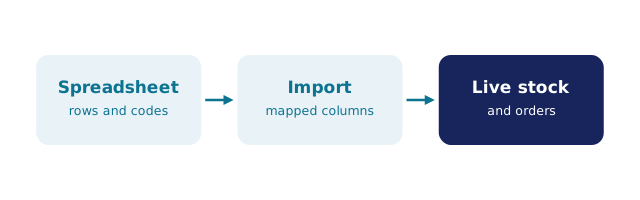
As data: product lists import directly, so the migration is a load and a check, not a re-type. The template structure is designed to match how systems like BSimple hold records — which is what makes the graduation cheap when the crossover arrives.

BSimple