
Guide / free software
Free inventory management software in Bangla
The honest answer first: BSimple is English-language, Australian, and paid from $180/month — there is no Bangla version and no free tier. What genuinely free options do exist, what they cost in practice, and how to judge any free claim you come across.
The key facts
- BSimple is not a free Bangla tool — the interface is English, it is built in Australia for wholesale, manufacturing, distribution and trade businesses, and plans start at $180/month AUD with a full-product free trial.
- Genuinely free options exist: a disciplined spreadsheet, or an open-source system you host and maintain yourself — each with real costs that arrive after the download.
- The language question: if the interface must be Bangla, that constraint matters more than the price tag, because an unusable tool at $0 is worse than a usable one at a known price.
- Any "free" claim deserves three checks: what the paid tier gates, what hosting and support cost, and who fixes it when the count is wrong.
- 01The key facts
- 02The honest answer about BSimple
- 03What genuinely free options exist
- 04What "free" usually costs
The honest answer about BSimple
BSimple does not have a Bangla interface and is not free software, so if either of those is a hard requirement, the honest recommendation is that this is not your tool — and no amount of marketing should blur that. What BSimple offers is a free trial of the full product: live multi-location stock, batches and traceability, purchasing, customer ordering portals and invoicing that pushes to your accounting system. The trial is long enough to load real products and see whether the way it works suits the business, which is a better use of an afternoon than installing four free tools to find the same answer.
The pricing is public: Starter $180, Professional $250, Organisation $399 per month AUD. If those numbers do not fit a business yet, that is exactly what the genuinely free routes below are for — better a spreadsheet you trust than a subscription you resent.
What genuinely free options exist
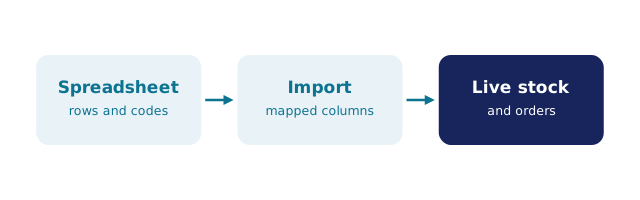
The spreadsheet. A well-built sheet with a products list, an in/out movement log and derived stock on hand handles a single-location business with one careful person and a weekly reconciliation habit. It fails at multiple users, multiple locations and audit history — the spreadsheet route covers how far it can be pushed and where it breaks.
Open source, self-hosted. Real free-inventory projects exist and can be run at $0 in licence fees, with the work of hosting, updating and securing falling on whoever installs them. For businesses in Bangladesh or West Bengal considering this route, the honest questions are local: who maintains the server, who fixes it the week before Eid when order volume spikes, and what happens when the one person who understands the deployment is unavailable. The open-source download guide lists the checks that separate maintained projects from abandoned ones.
Free tiers of paid products. Many tools advertise free, then gate the features that matter — locations, users, batch tracking, reports — behind the paid plan. Free is real when the gated list is read before committing data, not after.
What "free" usually costs
Every free route charges in the same currencies: time and trust. Time — building the spreadsheet logic, hosting the server, entering and correcting data by hand. Trust — a stock figure nobody double-checks is a stock figure that quietly stops being true, and the first stocktake after months of drift is where free systems usually reveal what they cost. The pattern to expect: free works until the business has a second person touching stock, a second location, or a compliance question it cannot answer from a spreadsheet.
When that point arrives, the inventory management pillar explains what the paid layer actually adds, and the free-with-GST comparison shows how to weigh a tax-handling requirement against the free options. The right sequence is usually: spreadsheet until it hurts, then one system that holds stock, orders and purchasing on one record — the trial if BSimple fits the shape of the business, an open-source deployment if the tail is acceptable.
Frequently Asked Questions
Does BSimple have a Bangla version?
No. The interface is English and the product is built in Australia. If a Bangla interface is a hard requirement, a tool that does not meet it is the wrong tool regardless of price — this page will not pretend otherwise.
Is BSimple free?
No — plans are $180/$250/$399 per month AUD. There is a free trial of the full product with no feature gates, which is different from a free tier: the trial ends, the product does not pretend to be free.
What is the best free inventory option for a small business?
A movement-based spreadsheet, honestly kept, is the best free option for one location and one careful person: a products list, an in/out log, and stock on hand derived from the movements — never edited totals. It breaks at multiple users and locations, which is the signal to move up.
Are the free open-source inventory systems safe to use?
The maintained ones can be, with the hosting done properly: updates applied, backups tested, access controlled. The risk is not the licence fee — it is an abandoned project holding your stock record with nobody left to fix it. Check commit history and issue activity before committing data.
What should I check before trusting any "free" claim?
Three things: which features are gated behind the paid tier, what hosting and support actually cost, and who is accountable when the stock figure is wrong. Free software with no accountable person is a spreadsheet with extra steps.

BSimple