
Guide / reviews, honestly
Reading software reviews honestly
Review scores measure reviewer enthusiasm, not your fit. Here is how to read business management software reviews — including ours — with the scepticism they deserve, and what to test instead.
The key facts
- Review scores measure aggregated enthusiasm — weighted toward reviewers whose businesses may look nothing like yours.
- The incentives are real: listing fees and review-collection campaigns shape what appears on review sites; we do not aggregate or quote scores here.
- What reviews answer badly: "does it fit my operation?" — the only question that matters.
- What answers it well: a trial on your own products. BSimple's is the full product, no card.
- The full picture: how the inventory record works is the hub page for everything above.
- 01The key facts
- 02What reviews get right — and wrong
- 03The questions to ask instead
- 04What we offer instead of a score
What reviews get right — and wrong
Reviews are useful for what they surface: which products exist, which have a real user base, and which support failures recur. A pattern of the same complaint across many reviews is signal; a single furious review is a person, not a product.
Where reviews mislead is structural. The incentives: review platforms monetise vendors through listings and lead generation, and vendors run campaigns asking happy customers for ratings — the score is a marketing surface. The mismatch: a five-star review from a five-person agency tells a twenty-person wholesaler nothing about pick paths, batch traceability or the accounting handoff. The age: features change quarterly; reviews describe the product someone used years ago.
We practise what we say here: this page quotes no scores for anyone, including us.
The questions to ask instead
- Who is reviewing? A business shaped like yours — same channel mix, same size, same industry — or a different species entirely?
- What broke, and how was it handled? The complaint pattern matters more than the praise pattern; support stories age better than feature raves.
- Is the reviewer describing the record or the demo? "Loved the dashboard" is a demo comment; "counts finally reconciled" is a record comment.
- What did they move from, and why? Migration stories reveal more than onboarding stories.
The aggregator view of the inventory category shows how scores are presented; the category list is the useful frame — sort by centre of gravity before reading a single star.
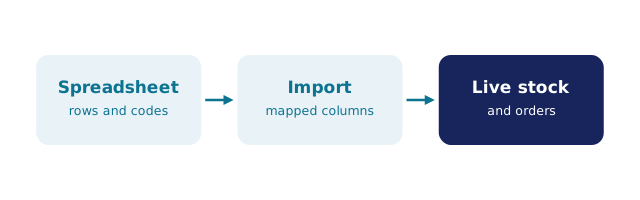
What we offer instead of a score
We build BSimple, so weigh that — and note the conflict of interest in any review we could quote. What we offer instead: the full product, free to trial, on your own data. Inventory, purchasing, orders, the customer portal, recipes and batches, invoicing with the Xero or MYOB handoff — one record, from $180/month (AUD). Run one real week of your operation through it and write your own review; it will be the only one with your business in it.
Frequently Asked Questions
Are software review sites trustworthy?
As directories, mostly yes; as verdicts, no. Scores aggregate enthusiasm under real vendor incentives, from businesses unlike yours. Use them to discover products; use a trial to judge one.
Where are the reviews of BSimple?
We do not aggregate or quote review scores on our site — for anyone. The honest substitute is the free trial: the full product on your own data, no card, no commitment.
What do reviews answer well?
Existence, maturity, and recurring support failures. A repeated complaint across many independent reviews is signal. Everything else — rankings, awards, star averages — is a marketing surface.
What is the one question a review cannot answer?
Whether the record fits your operation. Only your own products, orders and counts can answer that — which is exactly what a trial runs, in an afternoon.

BSimple